They say knowledge is power, but they rarely specify what kind of power – or at what cost it comes when wielded by the hands of a curious child. In theory, expanding one’s awareness of the world is a noble pursuit. In practice, it often ends with something on fire, something in tatters, and someone shouting from a back door.
I learned early that theory had its limits. One could read about gravity, but until you’ve attempted to parachute from a garden shed roof using your mum’s best sheets, you don’t feel it. I was, and perhaps still am, an enthusiast for empirical investigation – particularly when the results were messy, mischievous, and likely to make someone else’s life fractionally more inconvenient than my own.
And so it was that I discovered, through no formal curriculum, that cowpats – those humble field droppings – could be dried into aerodynamic discs and flung like frisbees. I don’t recall the precise moment this revelation dawned, but it struck me with the quiet inevitability of fate. I wasn’t put upon this earth to passively observe the world. I was born to hurl baked bovine faeces through the air with vigour and panache.
Somewhere I’d read (or imagined) that cow dung, when dried, served noble purposes in other parts of the world: heating homes, insulating walls, even forming the core of adobe houses. But in rural County Durham, circa 1970-something, I’d neither the architectural plans nor parental permission for a dung-fuelled civil engineering project. So I set my sights instead on recreation – frisbees fashioned from faeces.
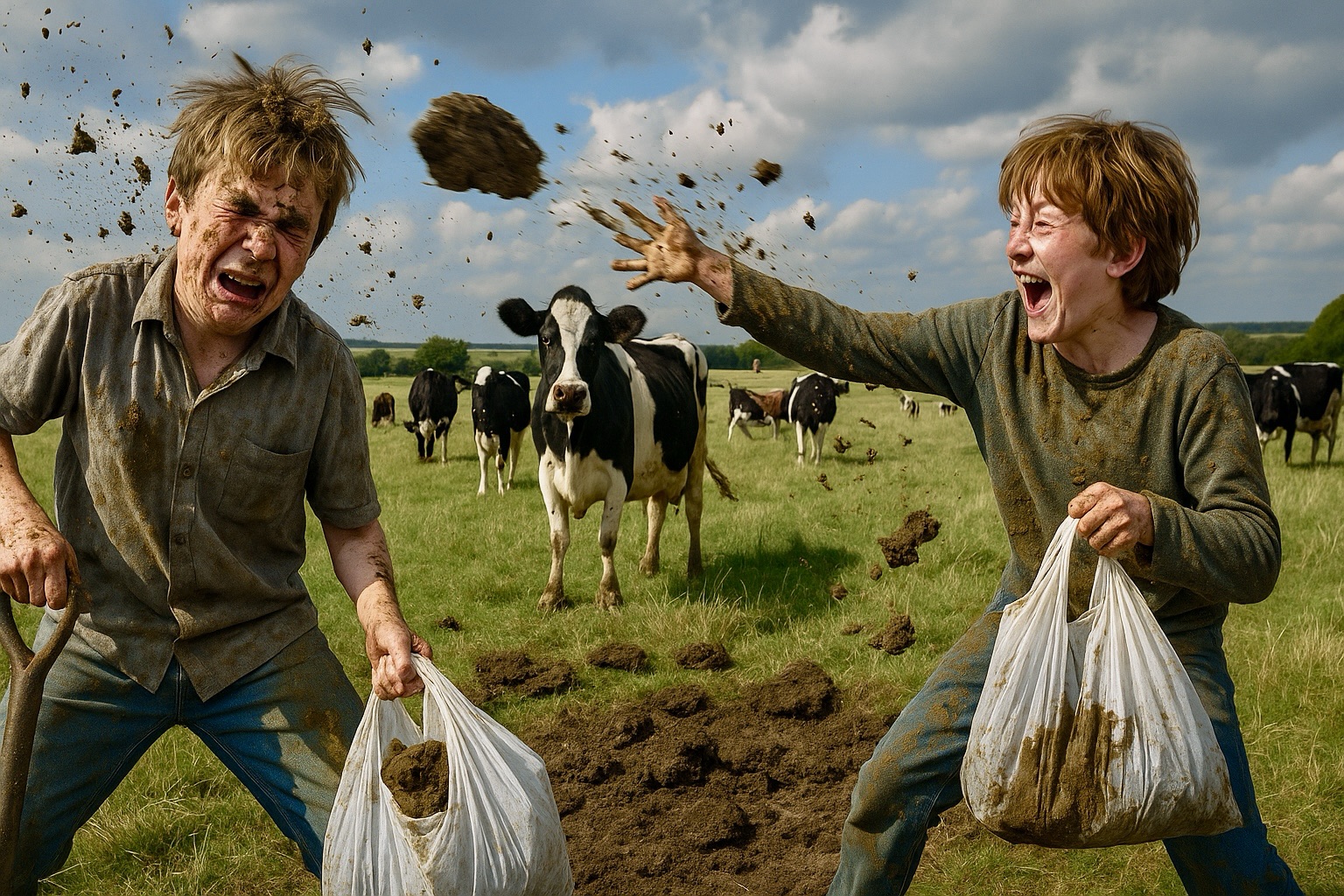
The first obstacle was procurement. To do this properly, one needed tools. My dad’s coal shovel – a stubby-handled implement of pleasing heft – seemed ideal. The coal bucket was a bridge too far: too conspicuous, too likely to get me noticed. But plastic carrier bags? We had dozens stuffed in the pantry like a nest of glossy rodents, endlessly multiplying – and of much better quality back then. I enlisted a willing accomplice (mischief is always better with witnesses), and off we went across the fields, sacks in hand, guided by nothing but purpose and a nose for cowflop.
Now, a word on the field: it was a veritable palimpsest of English history. I’ve often imagined those pastures as they might’ve looked in the Neolithic period – man transitioning from spear to plough, from hunter to herdsman. And there we were, in their footsteps, harvesting waste rather than wheat. It would’ve made Rousseau weep.
We were mindful of the ancient rule about avoiding bulls, especially if you were sporting red. Whether or not this held any scientific merit was immaterial; it was law. Anything without udders and with a menacing gaze was given a cautious berth. The cows, meanwhile, observed us with unsettling equanimity – ruminants with resting judgmental face. You’ve never known psychological warfare until you’ve tried to outstare a cow. They chew and watch, chew and judge. It’s like being cross-examined by a cud-munching barrister.
The dung itself came in various states of decay. Some patties were satisfyingly dry and firm, ready for sport. Others were fresher – moist, aromatic, and alive with a biblical plague of flies. These weren’t your average bluebottles either, but tiny brown demons that leapt in clouds the moment your shovel made contact. I adored insects as a child – beetles, bees, even spiders – but these squatters in the shite made my stomach lurch. There’s something spiritually degrading about squatting in a field, retching softly, as you coax excrement into a Fine Fare bag.
Nevertheless, we triumphed. Three bags full, and not a Mary had a little lamb in sight.
But of course, we couldn’t leave it there.
Somewhere between the pasture and the back gate, diplomacy broke down. Without warning, I felt the soft thud and wet slap of a pat to the back. That was it. Dung was declared. A full-scale, no-holds-barred, turd-hurling skirmish broke out. We abandoned all decency. The bags were ripped open, the contents weaponised. Hands plunged in, bombs were lobbed, laughter and shrieks echoed like banshees of the bog. One of us fell backwards into the nettles (I suspect it was me), but in the fog of war, honour had to be preserved.
We returned home like shell-shocked soldiers from some unspeakable battlefield – mud-splattered, stinking of methane and poor decisions. The look on my mother’s face said it all. And no, we didn’t have a story prepared. We rarely did. What explanation could there possibly be for returning home so spectacularly soiled? That we’d been preparing for a meteorological emergency in which only dried dung could save civilisation?
Even now, decades on, I remain firmly of the opinion that some lessons simply cannot be taught. You have to live them. Or, in my case, lob them.
Postscript
Education is all well and good – until it meets the real world. Then things get mucky. Literally. There’s a case to be made, I think, for reintroducing practical experimentation into the curriculum, though perhaps not with cowpats. Still, the next time someone praises hands-on learning, remember there are hands that have touched far worse than sandpaper and Pritt Stick.
And they probably grew up to write memoirs.

 Wording