A few moons ago, studying the Art History element of my degree, I came across an illustration on the side of a cassone in the National Gallery in Edinburgh; I was fascinated, especially as this particular one had an image which related to the title of this post. Cassone is an Italian term for a large, ornate chest or trunk traditionally given to newlyweds as a wedding gift. These chests were often elaborately decorated, sometimes with painted or carved illustrations on the sides, and they were typically used for storage in the couple’s bedroom. Cassoni were popular in Italy during the Renaissance and were often commissioned as bespoke pieces of furniture. They served both practical and symbolic purposes, representing the wealth and status of the newly married couple, as well as providing storage for their belongings. I was also fortunate enough to find in an old dusty bookshop, two, incredibly old, hardback volumes that make up The Decameron – having this work on Kindle is convenient, however, just holding and leafing through the physical volumes is priceless.
The Decameron, written by Giovanni Boccaccio in the 14th century, stands as a cornerstone of Italian literature and is recognised as a masterpiece of storytelling. The following is an analysis of its themes, structure, and impact.
The Decameron is structured as a frame narrative, where a group of ten young people (seven women and three men) flee from the Black Death in Florence to a countryside villa. To pass the time, they agree to tell stories, with each person contributing one story per day for ten days, resulting in one hundred tales. Someone very dear once promised me a trip to my beloved Florence for my 60th birthday – a promise that will now remain unfulfilled sadly. I digress.
Within this framework, each day’s storytelling session is introduced by a different member of the group, who serves as the king or queen for that day and sets the theme for the stories to be told.
A predominant theme throughout The Decameron is love in its various forms: romantic, familial, and platonic. Many stories explore the complexities of desire, courtship, and fidelity.
Boccaccio portrays the capriciousness of fate, with characters experiencing both good fortune and misfortune. The unpredictability of life is a central motif, reflecting the uncertainty of the medieval world.
The tales often provide a sharp critique of medieval society, including its hierarchy, religious hypocrisy, and corruption. Boccaccio uses humour and irony to expose the flaws and absurdities of his contemporary world.
Amidst the chaos and tragedy of the Black Death, the characters in The Decameron demonstrate resilience and creativity in their efforts to cope with adversity. The storytelling itself becomes a form of escape and catharsis.
Boccaccio’s decision to write the book in the Italian vernacular (instead of Latin) was groundbreaking, as it helped popularise the Tuscan dialect and played a crucial role in the development of the Italian literary tradition.
Boccaccio’s prose is celebrated for its elegance, wit, and lyrical quality. He skilfully weaves together vivid descriptions, dialogue, and narrative to create a rich tapestry of storytelling.
The Book masterfully balances elements of comedy and tragedy, blending humour with moments of profound insight and pathos. Boccaccio’s characters are often flawed, making their triumphs and failures all the more relatable.
It’s had a profound influence on Western literature, inspiring countless authors, playwrights, and artists over the centuries. Its narrative structure and thematic depth have been echoed in works ranging from Chaucer’s Canterbury Tales (I’ll be writing on Chaucer’s work soon, especially the hysterically funny Miller’s Tale) to modern short story collections.
Boccaccio’s portrayal of everyday life and ordinary people marked a departure from the epic and religious themes prevalent in medieval literature, helping to pave the way for a more realistic and humanistic approach to storytelling.
The work continues to be studied and celebrated for its exploration of timeless themes such as love, morality, and the human condition. Its relevance endures as a testament to the power of storytelling to transcend time and place.
In summary, The Decameron is a rich tapestry of storytelling that offers a panoramic view of medieval life and society. Through its engaging narratives, vibrant characters, and timeless themes, Boccaccio’s masterpiece continues to captivate readers and scholars alike, inviting us to reflect on the enduring complexities of the human experience.
Image Reference
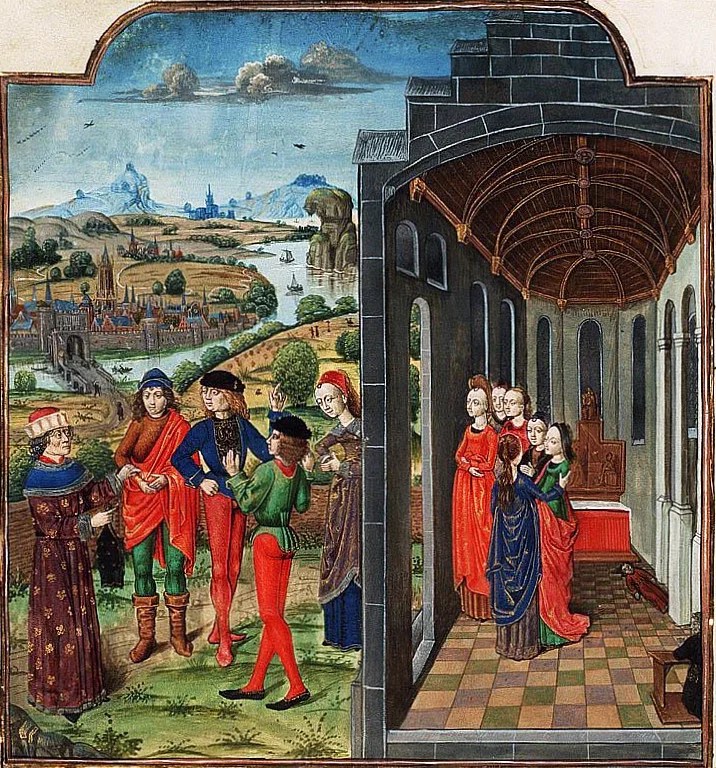
Bibliotheek, K. 2020, ‘Giovanni Boccaccio & Florentines Who Have Fled from the Plague’, World History Encyclopedia, viewed 17 April 2024, https://www.worldhistory.org/image/12052/giovanni-boccaccio–florentines-who-have-fled-from/.
Illustration from a medieval manuscript: Giovanni Boccaccio, Le Decameron. Translated from the Italian by Laurent de Premierfait Bruges, Master of 1482 and follower (illuminators); c. 1485 CE. Manuscript reference: The Hague, KB, 133 A 5, fol. 3v. Museum Meermanno-Westreenianum & Koninklijke Bibliotheek, Den Haag.

 Wording