Yesterday, Christians celebrated one of the most significant feasts in the Christian calendar – the Feast of Pentecost. This day marks the descent of the Holy Spirit upon the apostles, fulfilling Christ’s promise and inaugurating the birth of the Church. As we delve into the profound mysteries of this feast, we open our hearts to receive the grace and wisdom bestowed by the Holy Spirit.
Pentecost, also known as the Feast of Weeks, originally was a Jewish festival celebrating the giving of the Law on Mount Sinai, fifty days after Passover. In the Christian context, it is celebrated fifty days after Pascha (Easter), commemorating the outpouring of the Holy Spirit as recorded in the Acts of the Apostles, chapter 2. This event marks the fulfillment of Jesus’ promise to send the Comforter, the Holy Spirit, to guide, empower, and sustain the Church.
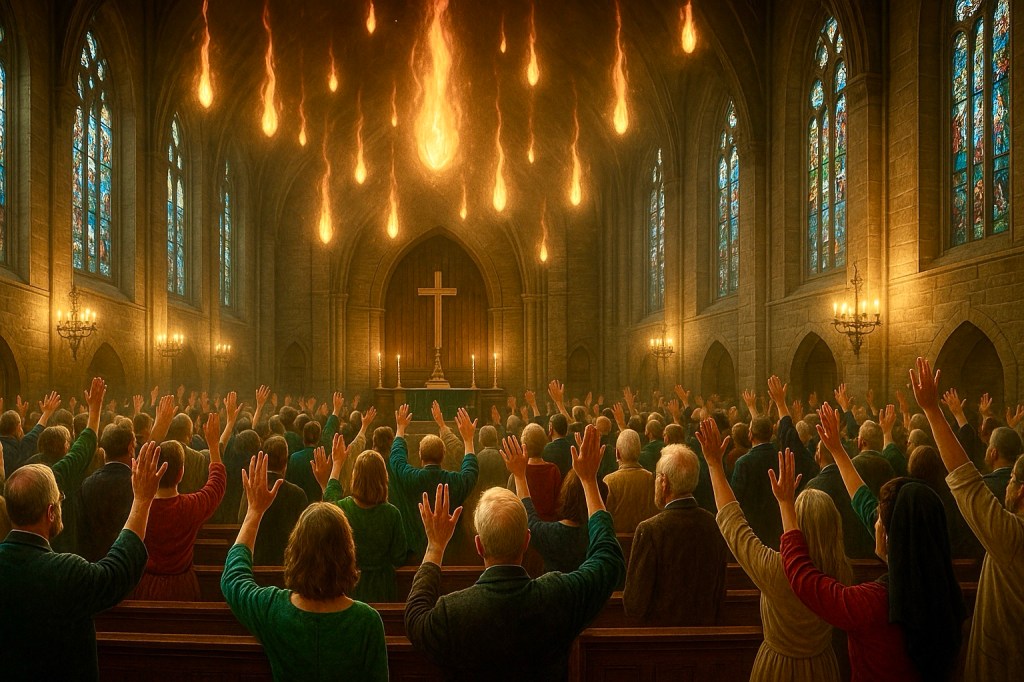
In the Book of Acts, we read: 1And when the day of Pentecost was fully come, they were all with one accord in one place. 2And suddenly there came a sound from heaven as of a rushing mighty wind, and it filled all the house where they were sitting. 3And there appeared unto them cloven tongues like as of fire, and it sat upon each of them. 4And they were all filled with the Holy Ghost, and began to speak with other tongues (languages), as the Spirit gave them utterance. (Acts 2:1-4)
This passage reveals several key elements:
- Unity and Gathering: The apostles were together in one place, symbolising the unity that the Holy Spirit brings to the Church.
- Heavenly Manifestation: The sound from heaven and the tongues of fire signify divine intervention and the presence of God.
- Empowerment and Witness: The apostles were filled with the Holy Spirit, enabling them to speak in various languages, which symbolises the universality of the Church’s mission to all nations.
The Holy Spirit, the third Person of the Holy Trinity, plays a crucial role in the life of every Christian and the Church as a whole. The Holy Spirit:
- Sanctifies: He sanctifies the faithful, making them holy and conforming them to the image of Christ.
- Guides: He leads the Church into all truth, illuminating the Scriptures and the teachings of the Fathers.
- Empowers: He bestows spiritual gifts for the edification (edification: an important word when it comes to speaking in tongues – more on this in another post) of the Church, enabling believers to serve one another in love.
- Unifies: He brings believers into one body, transcending cultural, linguistic, and social barriers.
- Comforts: He provides comfort and peace, particularly in times of suffering and persecution.
Pentecost is rightly called the birthday of the Church. On this day, the apostles, once fearful and hiding, were transformed into bold proclaimers of the Gospel. Peter, filled with the Holy Spirit, delivered his powerful sermon, resulting in the conversion of about three thousand souls. This marked the beginning of the Church’s mission to make disciples of all nations, baptising them in the name of the Father, and of the Son, and of the Holy Spirit.
As Christians, we are called to live in the Spirit. This entails:
- Daily Renewal: Seeking the continuous filling of the Holy Spirit through prayer, fasting, and the sacraments.
- Active Participation: Engaging actively in the liturgical and communal life of the Church, where the Holy Spirit is especially present.
- Spiritual Growth: Cultivating the fruits of the Spirit – love, joy, peace, patience, kindness, goodness, faithfulness, gentleness, and self-control (Galatians 5:22-23): 22But the fruit of the Spirit is love, joy, peace, long-suffering, gentleness, goodness, faith, 23Meekness, temperance: against such there is no law.
- Mission and Evangelism: Sharing the Gospel with others, empowered by the Holy Spirit, to bring them into the life of the Church.
As we celebrated this glorious Feast of Pentecost, let us remember that we are the heirs of the apostles, entrusted with the same Spirit and the same mission. May we always be open to the workings of the Holy Spirit in our lives, allowing Him to transform us and use us for the glory of God and the building up of His Church. Let us pray earnestly for a fresh outpouring of the Holy Spirit upon us, our communities, and the entire world, that we may truly become witnesses of Christ to the ends of the earth.
Amen.
The Significance of Pentecost in Christian Theology and Practice
Pentecost, derived from the Greek word “pentēkostē,” meaning fiftieth, is a pivotal event in Christian theology and the liturgical calendar. It commemorates the descent of the Holy Spirit upon the apostles and other followers of Jesus Christ, as described in the Acts of the Apostles (Acts 2:1-31). Occurring fifty days after Easter, Pentecost is celebrated on the seventh Sunday after Easter and marks the birth of the Christian Church. Let’s explore the historical, theological, and liturgical significance of Pentecost, highlighting its impact on Christian doctrine and practice.
Pentecost originally was a Jewish festival, Shavuot, which celebrated the giving of the Torah at Mount Sinai and also marked the end of the grain harvest. Early Christians, many of whom were Jewish, observed Shavuot, and it was during this festival that the transformative event described in Acts 2 occurred.
According to the Acts of the Apostles, the followers of Jesus were gathered in one place when a sound like a mighty rushing wind filled the house, and tongues of fire appeared, resting on each of them. They were filled with the Holy Spirit and began to speak in other languages as the Spirit enabled them. This miraculous occurrence drew a crowd, and Peter addressed them, interpreting the event as the fulfillment of a prophecy from the book of Joel. He proclaimed the resurrection of Jesus and called for repentance and baptism, leading to the conversion of about three thousand people. This event is considered the inception of the Christian Church.
Pentecost holds profound theological implications. It signifies the fulfillment of Jesus’ promise to send the Holy Spirit to his disciples, a promise made in passages such as John 14:16-17 and Acts 1:8. The arrival of the Holy Spirit empowered the apostles, transforming them from a fearful group into bold preachers of the Gospel.
Theologically, Pentecost underscores the role of the Holy Spirit in the life of the Church. The Spirit is seen as the source of spiritual gifts (charismata) that equip believers for ministry (1 Corinthians 12). These gifts are diverse, ranging from wisdom and knowledge to healing and prophecy, emphasising the unity and diversity within the body of Christ. Moreover, Pentecost symbolises the reversal of the Babel narrative in Genesis 11:1-9, where human pride led to the confusion of languages and scattering of people. At Pentecost, the Spirit’s enabling of the apostles to speak in various languages signifies the unifying power of the Gospel, breaking down barriers and bringing people together in Christ.
In the liturgical calendar, Pentecost is one of the principal feasts, often referred to as the “birthday of the Church.” The liturgical colour for Pentecost is red, symbolising the flames of the Holy Spirit. Many Christian denominations celebrate Pentecost with special services, including readings from Acts 2, hymns invoking the Holy Spirit, and the sacrament of baptism, which links the outpouring of the Spirit with the initiation into the Christian community.
The ecclesiastical impact of Pentecost extends beyond a single day of celebration. It serves as a reminder of the Church’s mission to spread the Gospel to all nations, a mandate grounded in the Great Commission (Matthew 28:19-20). The empowerment by the Holy Spirit is seen as essential for this mission, providing believers with the courage, wisdom, and strength to witness to their faith.
In contemporary Christianity, Pentecost continues to inspire and shape the Church’s identity and mission. The charismatic movement, which emerged in the 20th century, particularly emphasises the experience and gifts of the Holy Spirit. This movement has led to a renewed focus on spiritual gifts, worship practices, and evangelism, impacting a broad spectrum of Christian denominations – unless you’re a cessationist: more on this at the end.
Pentecost also encourages reflection on the unity and diversity of the Church. In a globalised world, the message of Pentecost calls Christians to transcend cultural and linguistic differences, fostering a sense of global communion. The Holy Spirit’s work in uniting believers from different backgrounds serves as a model for addressing contemporary issues of division and conflict within and beyond the Church. Issues of conflict within the Church, in my opinion, continue, as many denominations are making rash decisions to keep pace with contemporary culture. It’s a sensitive time, and I won’t go into the detail at this point. Culture changes so swiftly and so often, the Church as a whole, must remain biblically faithful. Lots are not, and so this is why we often see turmoil in today’s Church. Only this week I came across a post on social media, where an officer of the Salvation Army, made an affirming statement of sin. I won’t go into detail. I will say, though, that William and Catherine Booth may just be taking a turn or two in their graves.
Pentecost remains a cornerstone of Christian theology and practice, celebrating the empowering presence of the Holy Spirit and the birth of the Church. Its historical roots, theological depth, and liturgical expressions underscore its enduring significance. As a transformative event, Pentecost challenges and equips Christians to live out their faith with boldness and unity, continuing the mission that began with the apostles over two millennia ago.
Cessationism
Cessationism is a theological belief within Christianity that asserts that the miraculous gifts of the Holy Spirit, such as speaking in tongues, prophecy, and healing, ceased with the apostolic age. According to cessationists, these gifts were specific to the early church for the purpose of establishing and authenticating the message of the gospel. Once the New Testament was completed and the foundational period of the church had ended, the need for these extraordinary gifts diminished, and they gradually ceased to function within the church.
Cessationists often point to scriptures such as 1 Corinthians 13:8-10 and Ephesians 2:20 to support their view, interpreting these passages to mean that the miraculous gifts were temporary and intended only for the foundational era of Christianity. They believe that the primary means by which God works in the world today is through the ordinary means of grace, such as preaching, teaching, and the sacraments, rather than through miraculous signs and wonders.
This perspective contrasts with continuationism, which holds that the miraculous gifts of the Holy Spirit are still active and available to believers today. The debate between cessationism and continuationism is a significant theological issue within the broader Christian community, influencing how different denominations and believers understand the work of the Holy Spirit in the present age.
The Father, Son and Holy Spirit are supernatural. We’re not. We are of the World, and in my own personal opinion, these gifts are no longer applicable. I’ve frequented a few churches over the last few years, and have witnessed first-hand, people speaking in tongues. Whatever you utter in private may well be understood by God, however, the gobbledygook I’ve witnessed in church is pure hokum. First of all, if someone is to speak in tongues, it should edify the congregation, and an interpreter must be present, which tells us that the tongues must be an authentic language, and not the mumbling, incomprehensible utterances of someone deluded enough to believe they are being driven by the Holy Spirit to do so. The Apostolic age is over, and we should pray for those individuals and churches, such as the mega-prosperity gospel and word of faith churches that prey on the wallets and purses of their congregations, to cease their mischief. As with the Charismatic Movement, they need to cede to sanity.
Perhaps I’m being harsh, and perhaps I shouldn’t include my anecdotal experiences in posts such as these, but there you have it. And why not?

 Wording