When I need a quick cheer-up, I reach for a more humorous book from my library, something along the lines of Chaucer’s Canterbury Tales, especially The Miller’s Tale; makes my ribs ache!
The Miller’s Tale by Geoffrey Chaucer, one of the more… let’s say, exuberant stories in The Canterbury Tales. Here, Chaucer gives us a raunchy romp through medieval England, full of love triangles, mistaken identities, and, of course, a bit of well-placed flatulence. Grab your tankards and gird your loins, because this is going to be quite the tale.
The Plot: A Medieval Sitcom
The Miller’s Tale centres around a love quadrangle between John the carpenter, his young wife Alison, the amorous clerk Nicholas, and the lovesick parish clerk Absolon. Think of it as Three’s Company meets The Jerry Springer Show, but with more ye olde shenanigans.
- John the Carpenter: A gullible old man married to a young, beautiful woman. The medieval equivalent of a sitcom dad, clueless and easily duped.
- Alison: John’s wife, the quintessential “hot girl next door” who is more than ready to trade up from her dusty old husband.
- Nicholas: A young scholar renting a room in John’s house, who, unlike a typical student, spends less time hitting the books and more time hitting on Alison.
- Absolon: The squeaky-clean parish clerk who pines for Alison with the fervour of a thousand Nicholas Sparks novels, but whose romantic timing is as off as his fashion sense.
The Scheme: “DIY Noah’s Ark”
Nicholas, smitten with Alison, concocts a ludicrous plan to get John out of the way. He convinces John that a second Noah’s flood is imminent and that they must all sleep in separate tubs suspended from the ceiling to survive. John, ever the trusting fool, buys it hook, line, and sinker. Meanwhile, Nicholas and Alison get some quality alone time. This, dear readers, is what medieval problem-solving looks like – no texting, just a whole lot of gullibility and carpentry.
Absolon: The Persistent Fool
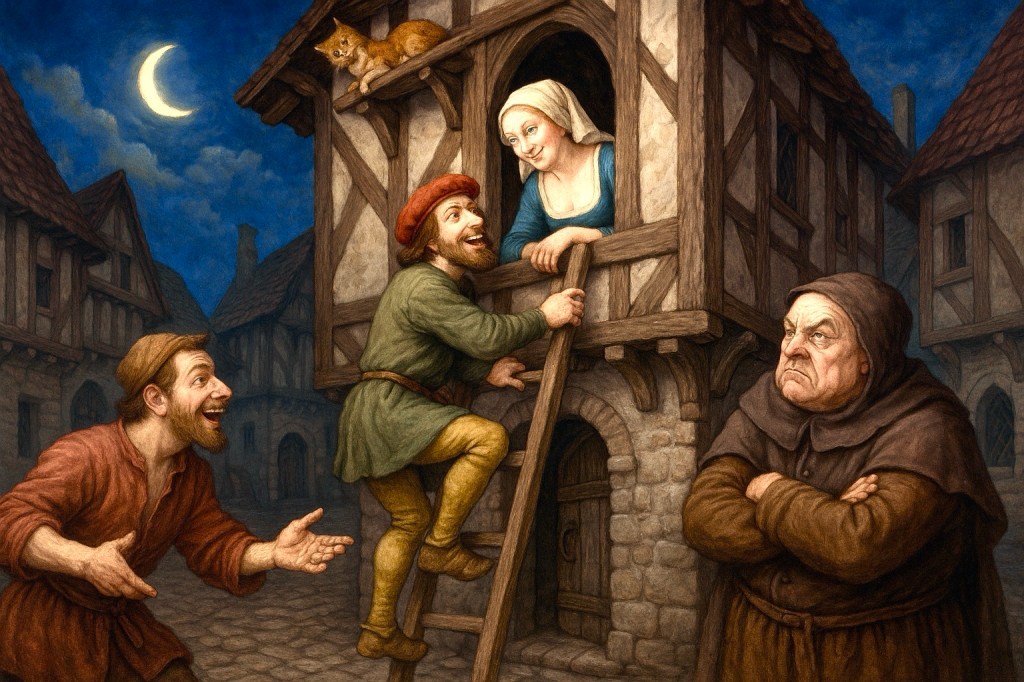
Not to be outdone in the love-fool department, Absolon also tries to woo Alison. His serenades are as smooth as a gravel road, and his gifts, like a gilded offering of a pair of shoes, are about as charming as a wet sock. But Absolon is undeterred. Determined to win Alison’s heart, he arrives at her window for a midnight kiss. Unfortunately for him, Alison and Nicholas have other plans.
The Prank: A Kiss to Remember
In a scene that would make the producers of Punk’d proud, Absolon begs Alison for a kiss through her window. Instead of the sweet peck he expects, Alison presents her… posterior. Oblivious in the darkness, Absolon plants a smooch on her rear, becoming the first recorded victim of medieval catfishing – and confused at the apparent hair he feels while kissing Alison, assuming it was her lips he was kissing; you can use your own imagination on that one.
Humiliated, Absolon vows revenge. Armed with a red-hot poker, he returns to exact his vengeance. This time, Nicholas, ever the prankster, decides to take Alison’s place at the window. Cue another posterior, another poke, and a howl of pain as Nicholas gets a scorching surprise. Instead of Alison, Nicholas stuck his buttocks out of the window in the darkness. When Absolom leans in for the kiss, Nicholas farts in his face and is repaid with a scorching prod in the fundament!
The Fallout: Chaos Ensues
John, who has been blissfully unaware of the shenanigans below, hears the commotion and assumes the flood is upon them. He cuts the ropes holding his tub, crashes to the floor, and breaks his arm. His neighbors rush in to find him babbling about a flood, while Alison and Nicholas play the innocent victims. Poor John is left looking like the village idiot, his reputation in tatters.
The Humour: Chaucer’s Laugh Track
Chaucer’s tale is a masterclass in comedic timing and bawdy humour. The story brims with irony and slapstick, from Nicholas’s absurd plan to the iconic moment of mistaken identity. The Miller, a teller of tales known for his crude humour, spares no detail in describing the farcical events, making it clear he relishes every scandalous twist.
- Irony: John, the supposedly wise and cautious carpenter, is easily duped by Nicholas’ outlandish story, highlighting his gullibility.
- Slapstick: Absolon’s kiss and Nicholas’ branding are straight out of a medieval Looney Tunes episode, complete with exaggerated reactions and physical comedy.
- Scandal: Alison’s willingness to participate in Nicholas’ scheme and Absolon’s persistence despite repeated rebuffs add layers of risqué humor, showcasing the timeless nature of human folly.
Conclusion: A Timeless Comedy of Errors
The Miller’s Tale endures as a comedic gem because it taps into universal themes of love, jealousy, and the sheer absurdity of human behaviour. Chaucer’s clever use of humour, from wordplay to physical comedy, ensures that the tale resonates with audiences centuries later. So, next time you’re feeling down, remember: somewhere in medieval England, a carpenter is still falling from his ceiling, a clerk is nursing a singed backside, and Chaucer is laughing in his grave.
If you haven’t yet had the pleasure of The Canterbury Tales and the The Miller’s Tale, you might want to pick up a copy written in modern English, otherwise, not being someone from the medieval period, you won’t get the full effect. Enjoy.

 Wording