It feels like an eternity since I last delved into the pages of this captivating novel – perhaps around four months ago, though time seems to dance with memory. Yet, as the seasons turn, it beckons me once more, whispering secrets and stories I’ve missed. And so, with eager anticipation, I immerse myself anew in its world.
Years ago, amidst the shared dreams and whispered promises of a life entwined, my wife and I forged a beautiful tradition: our own intimate bedtime book club. The inception of this cherished ritual was marked by the choice of this very novel, its spine cracking open to reveal the beginning of our literary journey together. Though her heart leaned toward the gentle allure of Austen’s prose, she graciously indulged my fervent desire to traverse the moors of Wuthering Heights by my side.
With each turn of the page, we traversed the tumultuous landscapes of Brontë’s masterpiece, our minds intertwined as we dissected its characters and plumbed the depths of its themes. The soft glow of lamplight cast a halo around us, cocooning our shared moments in warmth and intimacy.
Yet, like chapters in a book, our story took an unexpected turn. The book club dissolved, its whispered discussions fading into silence, much like the echoes of our chat that once filled the room. And alas, our marriage, too, succumbed to the passage of time, its once vibrant pages stained with the ink of bittersweet memories.
But even as the chapters of our shared narrative draw to a close, the echoes of those nights linger still, a testament to the power of literature to bind hearts and minds, if only for a fleeting moment.
Emily Brontë’s Wuthering Heights is a novel of extreme passions and dark, brooding atmospheres, one that defies the conventions of its time and remains a powerful exploration of human nature and the complexities of love and revenge. The novel’s intricate structure, multifaceted characters, and Gothic elements create a work that is as challenging as it is rewarding. Let’s delve into the novel’s central themes, narrative techniques, and character dynamics.
Themes of Love and Revenge
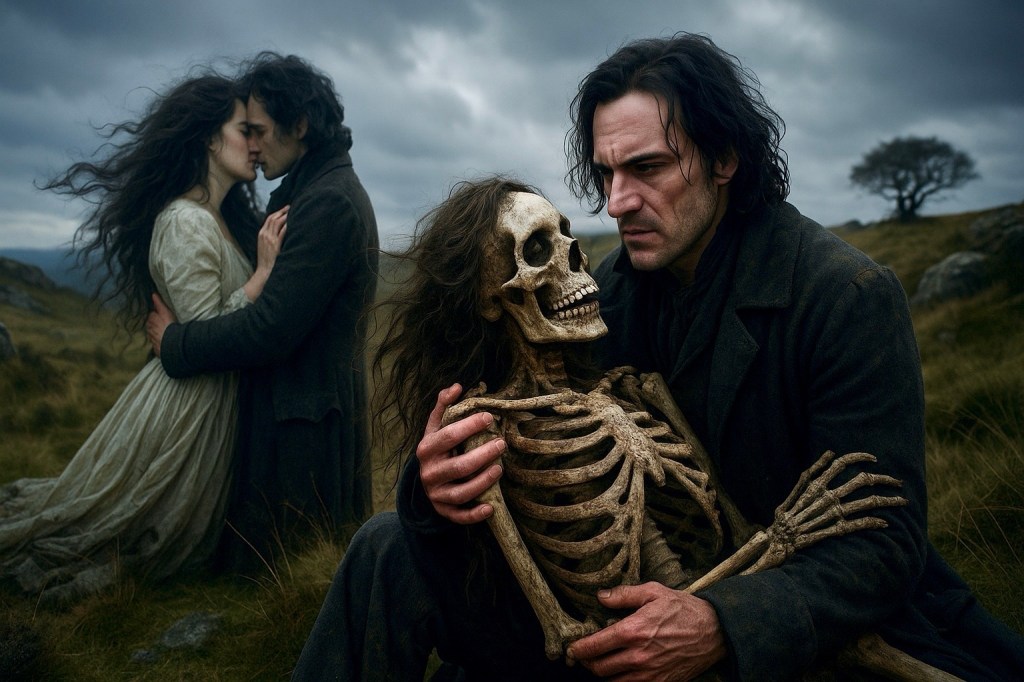
At the heart of Wuthering Heights is the tumultuous relationship between Heathcliff and Catherine Earnshaw. Their love, fierce and destructive, transcends conventional romantic ideals, becoming an almost supernatural force that dominates their lives and the lives of those around them. This passion, however, is not tender but is instead marked by jealousy, obsession, and vengeance. Heathcliff’s love for Catherine fuels his desire for revenge against those who have wronged him, particularly Edgar Linton and Hindley Earnshaw.
Love, in its most fervent form, is indistinguishable from madness.
Brontë portrays love as a force that can elevate and destroy. Heathcliff and Catherine’s bond defies social norms and moral boundaries, suggesting that true love is not always pure or redemptive but can be as savage as it is sublime.
The Duality of Human Nature
The novel explores the duality of human nature through its characters and their actions. Heathcliff embodies this duality most starkly. He is both a victim and a villain, his tragic background invoking sympathy even as his ruthless actions elicit fear and loathing. Catherine, too, is a study in contrasts—she is wild and free-spirited yet constrained by societal expectations and her own ambitions.
Within every soul lies the capacity for both nobility and cruelty.
Brontë’s characters are not one-dimensional but are instead complex beings whose motivations and actions reflect the conflicting forces within them. This complexity challenges readers to reconsider simplistic notions of good and evil.
The Gothic Atmosphere
Wuthering Heights is steeped in Gothic elements that enhance its dark and foreboding atmosphere. The setting – remote, desolate moors and the eerie, isolated Wuthering Heights itself – mirrors the tumultuous emotions of the characters. The supernatural also plays a significant role, with ghostly apparitions and a pervasive sense of doom that blurs the line between reality and the otherworldly.
Where shadows fall, the human heart reveals its darkest depths.
The Gothic elements in the novel serve not merely as a backdrop but as an integral part of the narrative, heightening the emotional intensity and underscoring the themes of love, revenge, and the supernatural.
Narrative Structure
Brontë employs a complex narrative structure, using multiple narrators and a non-linear timeline to tell the story. The primary narrator, Mr. Lockwood, and the secondary narrator, Nelly Dean, provide different perspectives on the events at Wuthering Heights. This layered storytelling adds depth and ambiguity, allowing readers to piece together the fragmented narrative and question the reliability of the narrators.
Truth is a mosaic of perspectives.
The use of multiple narrators highlights the subjectivity of truth and the ways in which personal biases and limited viewpoints shape our understanding of events and characters.
Social Commentary
While primarily a tale of passion and revenge, Wuthering Heights also offers a critique of the social and class structures of the time. Heathcliff’s status as an outsider, both racially ambiguous and socially marginalised, reflects the rigid class hierarchies and prejudices of Victorian society. Catherine’s marriage to Edgar Linton represents a surrender to social expectations at the expense of personal happiness.
Society’s chains often bind the heart’s true desires.
Brontë critiques the ways in which social conventions and class distinctions constrain individuals, leading to personal and collective tragedies.
Conclusion
Wuthering Heights stands as a timeless exploration of the extremes of human emotion and the complexities of human relationships. Emily Brontë’s masterful use of Gothic elements, multi-faceted characters, and innovative narrative techniques create a novel that continues to captivate and challenge readers. Through its themes of love, revenge, and social critique, Wuthering Heights reveals the dual nature of humanity and the powerful forces that drive us, offering profound insights into the human condition.
In the storm of life, love and hate are the winds that drive us.
In conclusion, Brontë’s work remains a compelling testament to the enduring power of literature to probe the deepest recesses of the human heart and soul. Wuthering Heights is not just a story but a profound reflection on the passions that define us and the societal structures that shape our destinies.

 Wording