First of all I have conflicting sources that title this painting differently: one is The Artist’s Dream and another, The Painter’s Dream. I’m not going to cry about it but some of the sources I’ve looked at were a waste of time – not including the sources you’ll find at the end of this post. Speaking of posts, let’s get on with it.
We’re talking about dreams again. I found this painting in an obscure little art history book that I find many years ago in a second-hand book shop. At the time I was searching out material on the Romantic period, and since I have some very personal experience of some not-so-good dreams, it piqued my interest.
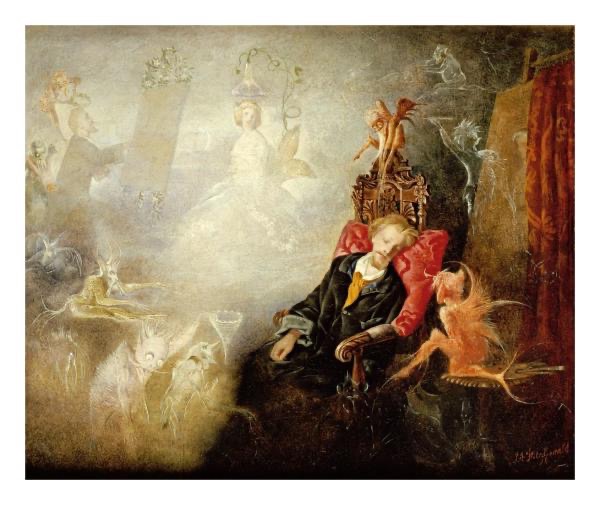
John Anster Fitzgerald’s The Painter’s Dream is not merely a painting; it’s an escapade into the whimsical recesses of the mind, akin to tumbling down a rabbit hole while clutching a paintbrush dipped in dreams. It’s as if Fitzgerald took a dash of surrealism, a sprinkle of fantasy, and a hearty scoop of Victorian eccentricity, whipped them together, and splashed the resulting concoction onto the canvas. In this delightful work, the artist doesn’t just capture a dream but invites us to revel in its absurdity and splendour, much like a child chasing after butterflies in a garden of impossibilities.
The painting bursts forth like a visual cacophony, a symphony of colors and forms that dance together in a choreographed chaos. Imagine walking into a party where Salvador Dalí, Lewis Carroll, and J.M.W. Turner are the hosts, each determined to outdo the other with their contributions to the décor. The result is a scene brimming with ethereal creatures, each more fantastical than the last, as if the gates of an enchanted zoo had flung open, allowing its inhabitants to roam freely across the painter’s canvas.
At the heart of the painting, we find the eponymous painter, slumped over, perhaps overwhelmed by the sheer magnitude of his nocturnal vision. He resembles a puppet with its strings cut, dangling limply amidst the chaos he has unwittingly conjured. His dreams spill out around him, like an overturned box of trinkets, each more peculiar than the last. It’s as though his subconscious, fed up with the constraints of reality, has staged a coup, flooding the room with figments of imagination run amok.
Surrounding the beleaguered artist are a myriad of fantastical figures, each one a testament to Fitzgerald’s mastery of detail and whimsy. There are fairies, delicate and diminutive, flitting about like sequins caught in a breeze. These aren’t your garden-variety Tinkerbells; they’re imbued with a mischievous spark, like a cocktail of fireflies and pixie dust with a dash of impish glee. Their wings shimmer with an iridescence that seems almost palpable, as if one could reach out and feel the gossamer texture beneath their fingertips.
Then there are the more grotesque denizens of this dreamscape – goblins and gremlins with twisted limbs and exaggerated features, who cavort with an unholy glee. They are the visual equivalent of a nightmare that you can’t help but find fascinating, much like watching a horror movie through the gaps between your fingers. These creatures bring a certain balance to the painting, their dark, contorted forms providing a counterpoint to the lighter, more ethereal beings, much like the bass line in a piece of baroque music.
The background of The Painter’s Dream is a swirling vortex of colour and form, a tempestuous sea of creativity that threatens to engulf the viewer. Fitzgerald employs a palette that ranges from the deepest midnight blues to the brightest, almost neon, hues. The colours bleed into one another, creating a sense of motion and fluidity, as if the very air in the room is alive with the hum of artistic fervour. It’s like standing in the eye of a psychedelic storm, where every brushstroke pulses with the rhythm of the painter’s heartbeat.
Amidst this tumultuous tableau, the eye is drawn to various vignettes – a fairy queen perched regally on a throne of toadstools, her expression a mixture of boredom and disdain, like a cat surveying a particularly uninteresting piece of string. An unsettling-looking imp proffers a glass of something-or-other. This glass, and the the depiction of a large convolvulus, widely to contain narcotic properties. The flower resembles a large, exotic blossom, with petals that are vividly coloured and somewhat exaggerated in form. It appears to be drooping or hovering in an almost sentient manner, contributing to the dreamlike quality of the painting. The presence of such an extraordinary flower enhances the overall sense of wonder and surrealism, aligning perfectly with the fantastical theme of the artwork. The flower’s intricate details and vibrant hues draw the viewer’s eye, emphasising the magical atmosphere Fitzgerald sought to create. Could the slumberer be under the influence of a substance? Something widely partaken of during that era. Certainly a lot of folk would regularly chase the dragon.
Fitzgerald’s painting is a masterclass in contrasts – the delicate against the grotesque, the vibrant against the muted, the real against the imagined. Each element plays off the others, creating a harmonious discord that is both jarring and mesmerising. It’s as if he has bottled the essence of a dream, with all its inconsistencies and incongruities, and poured it onto the canvas, allowing it to flow and settle in its own peculiar pattern.
The Painter’s Dream is a visual feast that defies conventional analysis. It is a journey through the labyrinthine corridors of the mind, a place where reality is but a distant memory and imagination reigns supreme. Fitzgerald has created not just a painting, but a portal – a shimmering gateway into a world where anything is possible, and where the only limits are those of the dreamer’s own imagination. So, step through, dear reader, and lose yourself in the glorious, riotous, sublime madness that is John Anster Fitzgerald’s masterpiece.
Further Reading
Books:
- Wood, C. (2000). Fairies in Victorian Art. Antique Collectors’ Club.
- This book provides a comprehensive look at fairy paintings in the Victorian era, including works by John Anster Fitzgerald.
- Lambourne, L. (1999). Victorian Painting. Phaidon Press.
- A thorough examination of various Victorian painters and their styles, which includes a section on Fitzgerald and his contributions to the fairy painting genre.
Journal Articles:
An analysis of Fitzgerald’s work focusing on his use of dream imagery and fantastical elements.
Manning, S. (2009). “Fairy Painting and the Rise of Fantasy Art.” The Burlington Magazine, 151(1277), pp. 440-450.
This article discusses the development of fairy painting and its significance within the broader context of Victorian art.
Smith, A. (2013). “Dreams and Nightmares: The Imaginative World of John Anster Fitzgerald.” Journal of Victorian Culture, 18(2), pp. 205-223.
Image: Art Renewal Center https://bit.ly/3Vp8dAH

 Wording