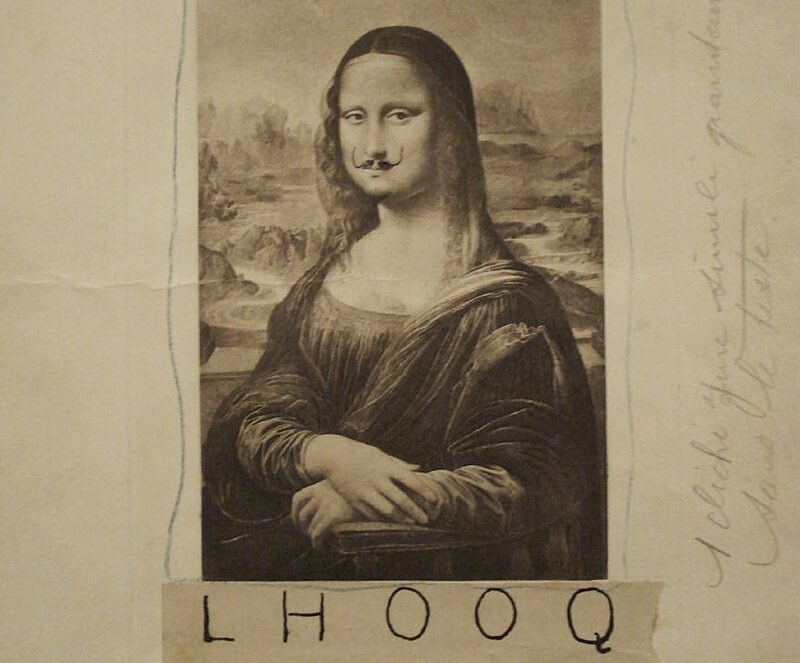
Marcel Duchamp’s L.H.O.O.Q., infamously known as Mona Lisa with a Moustache, is an audaciously irreverent assault on Leonardo da Vinci’s iconic masterpiece. This ready-made work, embodying Duchamp’s signature brand of Dadaist mockery, transforms the serene visage of the world’s most famous painting into a spectacle of absurdity and defiance. Let us delve into this piece with the analytical finesse it undoubtedly does not deserve, yet cannot escape.
The Butchering of a Classic
Duchamp’s desecration begins with his choice of the Mona Lisa, a painting whose very name elicits a universal gasp of admiration and reverence. By adding a crude moustache and goatee, Duchamp doesn’t merely alter the painting; he metaphorically drags it through the mud of his artistic playground. It’s as if he’s scrawling graffiti on the Sistine Chapel, except instead of witty commentary, we get facial hair doodles. This act of vandalism is akin to a mischievous child defacing his mother’s favorite photograph, with the only difference being that Duchamp’s tantrum is mistaken for genius by the art world.
The Title: A Masterstroke of Nonsense
L.H.O.O.Q. is not just a title; it’s an acronym of profound idiocy masquerading as intellect. Pronounced in French, it sounds like Elle a chaud au cul, which translates to She has a hot ass. Duchamp, in a stroke of what must have been self-satisfied brilliance, layers juvenile humour over an already ludicrous image. The sheer inanity of this pun is a testament to Duchamp’s commitment to turning the sublime into the ridiculous. It’s as if he dared the intellectual elite to find meaning in his prank, knowing full well they’d fall over themselves to do so.
The Faux-Philosophical Ramblings
Duchamp’s apologists often argue that “L.H.O.O.Q.” is a profound critique of art and society. According to them, the piece questions the very nature of art, challenging what constitutes artistic genius. To this, one might respond: does attaching a handlebar moustache to the Mona Lisa genuinely contribute to philosophical discourse, or is it simply the highbrow equivalent of drawing a moustache on someone’s school photo? The former interpretation requires such mental gymnastics that one might suspect Duchamp of inventing a new form of intellectual calisthenics.
The Artistic Merit Debate
In the grand hall of artistic achievements, Duchamp’s Mona Lisa with a Moustache stands as an irksome prankster, elbowing its way into conversations it doesn’t belong. True, it’s undeniably memorable – but so is stepping on a Lego brick in the dark. Does its memorability stem from artistic merit, or from the sheer audacity and sacrilege it embodies? Duchamp seems to revel in the fact that his work can incite passionate debate while offering little more than an elaborate snicker.
A Triumph of Trickery
In conclusion, Marcel Duchamp’s Mona Lisa with a Moustache is less an artwork and more a masterclass in trolling. It’s a jester’s jape masquerading as high art, a deliberate farce that mocks both its subject and its audience. To laud this piece as anything other than a grand joke is to fall victim to Duchamp’s cunning ruse. He has successfully tricked the art world into taking his doodles seriously, proving that with enough pretension, even the most trivial alterations can be heralded as groundbreaking.
Duchamp’s Mona Lisa with a Moustache stands as a beacon of the absurd, a defiant snub to tradition and taste. It’s a reminder that in the art world, sometimes the joke really is on us.
What about Duchamp’s Fountain?

Marcel Duchamp’s Fountain, a urinal turned art piece, stands as a testament to the artist’s capacity for both genius and juvenile antics. With a simple, subversive gesture, Duchamp forever altered the landscape of modern art, provoking ire, admiration, and incredulous laughter. Let’s take an analytical deep dive into this porcelain enigma, with all the scorn and humour it so richly invites.
The Elevation of the Banality
Fountain is nothing more than a standard, white porcelain urinal, presented without modification save for the signature R. Mutt. It’s as if Duchamp wandered into a plumbing supply store, saw a urinal, and thought, “This belongs in a gallery.” The sheer audacity of taking an everyday object, one associated with the most private and undignified of human functions, and declaring it art, is both laughably simplistic and audaciously defiant. It’s like proclaiming a wheelie bin a gourmet meal because you stuck a toothpick in it.
The Signature: A Stroke of Absurdity
Signing the urinal ‘R. Mutt’ is Duchamp’s piece de resistance. This pseudonym, a play on the name of the urinal manufacturer (Mott) and a nod to the cartoon strip Mutt and Jeff, transforms the urinal into a whimsical commentary on authorship and identity. It’s as if Duchamp wanted to see how far he could push the boundaries of credibility and still have the art world nod along in sage agreement. Imagine a comedian signing a knock-knock joke with a fake name and submitting it to a poetry contest. It’s both clever and maddeningly insincere.
The Faux-Philosophical Underpinnings
The apologists for Fountain often herald it as a profound statement on the nature of art, a challenge to the institutions and conventions that define artistic value. They claim it questions the role of the artist, the nature of creativity, and the function of art in society. However, one might argue that this interpretation is akin to finding deep existential meaning in a child’s doodle on a bathroom wall. Duchamp’s urinal doesn’t so much challenge these notions as it does mock the very idea that such questions need to be asked in the first place. It’s a prank on the art world, daring critics to derive profundity from what is essentially bathroom humour.
The Artistic Merit Debate
Fountain occupies a peculiar place in the pantheon of art history. Is it a masterpiece or merely a masterful prank? Its significance stems not from any inherent artistic quality but from the seismic impact it had on the definition of art. Duchamp’s urinal is the ultimate troll, a piece that forces serious discourse while simultaneously laughing in the face of its admirers. It’s as if Duchamp said, “Let’s see if they’ll buy this,” and the art world responded with rapturous applause, forever blurring the line between innovation and insolence.
A Triumph of Trolling
In conclusion, Marcel Duchamp’s Fountain is less an artwork and more an elaborate ruse, a masterstroke of trolling that redefined art by reducing it to the absurd. It’s a urinal, for crying out loud! The fact that it’s still being discussed, analysed, and displayed in museums is a testament to Duchamp’s unparalleled ability to provoke and perplex. Fountain is both a brilliant critique and a hilarious joke, a piece that forever changed the landscape of modern art by showing that sometimes, the emperor truly has no clothes – just a urinal signed ‘R. Mutt.’
In the grand narrative of art history, Fountain stands as a beacon of the absurd, a reminder that in the realm of high art, the most profound statements can sometimes come from the most ludicrous sources. Duchamp’s urinal remains an enduring symbol of his genius, his mischief, and his uncanny ability to make us question the very essence of creativity. In the realm of Modern Art, it deserves its place – there should be a genre called Absolute Rubbish, as that’s precisely where it, and most modern and post-modern art belongs: in the bin.

 Wording