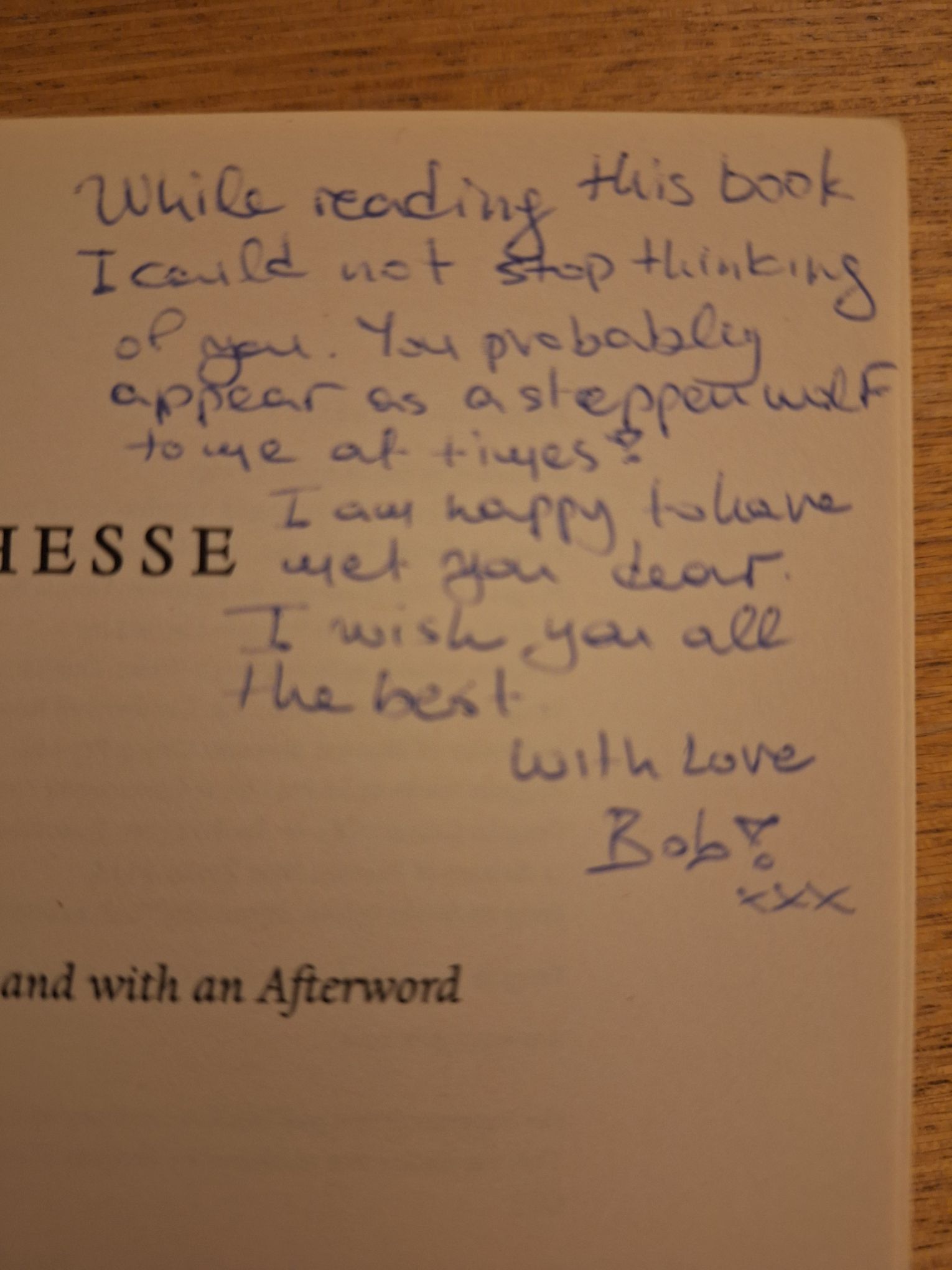
A long time ago I met a young lady who became, for a short time, a good friend. I liked her. For me, liking someone was a rare occurrence. To cut a long story short, my friend, Bob, called so as I couldn’t pronounce her Greek name, gifted me a book. A book I’d already read a couple of times over the years, however, I’ve re-read it a couple of times since, too. She wrote a little inscription inside the cover of the book, likening me, sometimes, to the protagonist. She was cheeky, yes. After my last recent reading, I was compelled to put pen to paper, as I do with most of these posts, scratching them out first in rough, then frantically typing away, this time, rambling more, and more…and more. Strap yourself, it’s a long one *cough*
Dancing with the Wolves: An Analytical Exploration of Hermann Hesse’s Steppenwolf
Imagine being invited to a dance party hosted by your own psyche, where every guest is a fragmented piece of your soul, some invited and some crashing the event without your consent. Welcome to the life of Harry Haller, the eponymous Steppenwolf, in Hermann Hesse’s fascinating novel – a mind-bending journey that straddles the line between existential crisis and spiritual awakening, with a few awkward cha-cha steps thrown in for good measure.
The Life of Harry Haller: Man or Myth?
Harry Haller is our protagonist, but calling him a hero might be stretching the term like a pair of old elastic pants. He’s a middle-aged intellectual trapped in a perennial state of self-loathing and existential angst, resembling that one friend who monopolises dinner conversations with nihilistic monologues, yet inexplicably still gets invited out.
Haller sees himself as a wolf of the steppes, caught between his human aspirations and animalistic instincts. Essentially, he’s torn between attending a posh opera or howling at the moon, which, let’s face it, is a dilemma a lot of people face after a few too many drinks on a Friday night.
The Magic Theatre: Not for Everybody
The novel’s turning point is Harry’s surreal adventure into the Magic Theatre. This isn’t your average cinema, but a fantastical realm promising “entrance not for everybody.” Think of it as an exclusive nightclub for your psyche’s most suppressed desires and fears, with a cover charge payable in sanity.
Inside, Haller encounters everything from the macabre to the sublime. It’s like walking through a Salvador Dalí painting while someone recites Nietzsche in the background – disorienting, profound, and slightly pretentious. Here, he faces myriad aspects of his personality in a series of vignettes that are as bewildering as trying to follow a David Lynch film without questioning your own grip on reality.
Hermine: The Enigmatic Guide
Enter Hermine, the femme fatale with a knack for psychoanalysis and tango. She’s Harry’s spiritual guide, seductress, and, oddly enough, a prospective murder victim (at her own request). Hermine’s role is to coax Haller out of his intellectual ivory tower and into the messy, vibrant world of sensual experience.
She teaches Harry to dance, both literally and metaphorically, leading him through a series of escapades that force him to confront his inner turmoil. Picture a therapist who can also moonlight as a dance instructor and life coach – she’s part Freud, part Ginger Rogers, with a sprinkle of that one friend who always insists you live a little.
Humour Amidst the Angst
Despite its heavy themes, Steppenwolf is peppered with moments of humour, often of the dark, ironic variety. Harry’s pompous self-seriousness is undercut by his frequent missteps and the absurdity of his lofty contemplations when faced with mundane realities. For instance, his constant vacillation between suicide and savouring a well-prepared meal highlights the absurdity of human existence – why ponder the void when there’s a perfectly good steak to be enjoyed?
Additionally, the novel’s absurdist elements shine in scenes like the Magic Theatre, where Harry’s confrontation with his own multiplicity is rendered with a surreal humour that would make Kafka proud. The spectacle of Harry trying to reconcile with his inner Immortal self, who mocks his earthly concerns, is both tragic and comically ridiculous, akin to watching someone argue with their reflection in a funhouse mirror.
The Grand Finale: Learning to Laugh
By the novel’s end, Haller’s journey leads him to a critical epiphany: the importance of humour and the ability to laugh at oneself. In the final scenes, as he grapples with his existential dilemmas, Harry learns that self-acceptance doesn’t come from lofty ideals or intellectual pursuits but from embracing life’s inherent absurdity.
It’s a poignant reminder that sometimes, the best way to navigate the labyrinth of the human psyche is to don a clown nose and dance with the wolves. Life, with all its complexities and contradictions, may not always make sense, but at least we can laugh at the absurdity and maybe, just maybe, find a little joy along the way.
So, the next time you find yourself caught between existential dread and the urge to howl at the moon, take a page from Harry Haller’s book: grab a drink, hit the dance floor, and don’t forget to laugh at the sheer absurdity of it all.
This is where my rambling scribbling began!
In Steppenwolf, the Tract for Steppenwolf offers a detailed critique of the bourgeoisie, reflecting Hermann Hesse’s broader commentary on society.
The Tract’s View on the Bourgeoisie
The tract describes the bourgeoisie as embodying mediocrity and conformity. It suggests that the bourgeois lifestyle is characterised by a comfortable but ultimately shallow existence, driven by materialism and social norms rather than individual thought or spiritual depth. The bourgeoisie is criticised for prioritising stability, security, and superficial respectability over genuine personal and intellectual growth.
According to the tract, the bourgeois mentality avoids extremes in all forms – emotional, intellectual, or spiritual. This aversion to the edges of human experience leads to a life of dullness and predictability, where the richness of human potential is left unexplored. The bourgeoisie’s fear of instability and passion keeps them in a constant state of compromise and moderation.
The tract also accuses the bourgeoisie of hypocrisy. It portrays them as upholding a moral code that is more about appearances and social standing than true ethical principles. Their morality is seen as superficial, designed to maintain the status quo and avoid scandal, rather than fostering genuine virtue or integrity.
Meaning and Implications
Critique of Modern Society
Hesse uses the tract to critique modern society, which he saw as increasingly bourgeois in nature. The middle class’s focus on economic success, social status, and comfort, according to Hesse, stifles the deeper, more meaningful aspects of human existence. This critique resonates with broader existentialist themes, questioning whether a life driven by materialism and social conformity can truly fulfill the human spirit.
The tract underscores the tension between individuality and societal expectations. For Harry Haller, the Steppenwolf, this tension is a source of profound inner conflict. He feels alienated from bourgeois society because it suppresses the individual’s quest for authenticity, creativity, and deeper understanding. The tract suggests that true individuality often stands in opposition to the homogenising tendencies of the bourgeoisie.
The tract reflects the existential struggle faced by individuals who seek deeper meaning in life. It acknowledges the difficulty of maintaining one’s individuality in the face of societal pressures to conform. This struggle is central to Haller’s character and to the novel’s exploration of identity, purpose, and the human condition.
The “Tract for Steppenwolf” is a critical examination of the bourgeoisie, depicting it as a force of mediocrity, conformity, and superficial morality. Through this critique, Hermann Hesse delves into broader existential questions about the nature of society, individuality, and the quest for meaning. The tract challenges readers to reflect on the compromises they make and the authenticity of their own lives within the context of societal norms.
The Bourgeoisie:
“They do wish to serve God, but they also give Bacchus his due, and although they want to be virtuous they are not entirely averse to earthly pleasures and creature comforts. In short, they attempt to put down roots midway between two extremes, in a bland and temperate zone without strong winds and rainstorms. Their attempt succeeds too, yet at the expense of all those intense experiences and emotions that only a life devoted to absolute and extreme goals can afford. Intensity of life is only possible at the expense of self. But there is nothing members of the bourgeoisie value more highly than self, albeit only at a rudimentary stage of development. Thus, at the expense of intensity, they manage to preserve their selves and make them secure. Instead of possession by God, an easy conscience is the reward they reap; instead of desire, contentment; instead of liberty, cosiness; instead of life-threatening heat, an agreeable temperature. Members of the bourgeoisie are therefore essentially creatures weak in vital energy, timid individuals, afraid ever to abandon themselves, easy to govern. That is Why they have replaced power by majority rule, replaced force by the rule of law, and replaced responsibility by the ballot box”
This quote from the Tract for Steppenwolf provides a rich and detailed critique of the bourgeoisie, highlighting their preference for a balanced, moderate lifestyle over one filled with intensity and extremes. Let’s analyse its components and underlying meanings:
Serving God and Bacchus
The opening line highlights the bourgeois desire to serve both God and Bacchus, symbolising a tension between spiritual devotion and earthly pleasures. This dual allegiance points to a fundamental inconsistency in the bourgeois character – they strive for virtue but also indulge in material comforts and pleasures.
Midway Between Extremes
The bourgeoisie are described as attempting to root themselves “midway between two extremes, in a bland and temperate zone without strong winds and rainstorms.” This metaphor suggests a deliberate avoidance of the tumultuous and intense experiences that characterise a more passionate or extreme way of life. They seek a middle ground that promises stability and comfort, shunning the unpredictability of extreme pursuits.
Intensity of Life
The tract posits that true intensity of life can only be achieved at the expense of the self. This idea aligns with existentialist thought, which often suggests that the pursuit of profound, authentic experiences requires a willingness to sacrifice personal security and comfort. For the bourgeoisie, however, preserving the self – albeit at a rudimentary level of development – is paramount. This preservation comes at the cost of a deeper, more intense experience of life.
Values of the Bourgeoisie
The bourgeoisie’s highest value is the preservation of the self, which leads to a life marked by contentment rather than desire, cosiness rather than liberty, and an agreeable temperature rather than life-threatening heat. These substitutions underscore the bourgeois preference for comfort, safety, and predictability over the risks and rewards of a more intense existence.
Weakness and Governability
The tract argues that the bourgeoisie’s lifestyle makes them inherently weak in vital energy and timid. Their fear of abandoning themselves to passion or extreme goals renders them easy to govern. This critique extends to their political and social structures, which prioritise majority rule, the rule of law, and the ballot box over power, force, and responsibility. These systems, while ostensibly democratic and fair, are portrayed as mechanisms that maintain the status quo and suppress the potential for more profound individual and collective experiences.
This quote encapsulates Hesse’s broader critique of bourgeois society, portraying it as inherently compromised and lacking in vitality. By avoiding extremes and maintaining a temperate, secure existence, the bourgeoisie miss out on the deeper, more intense aspects of life. Their values – contentment, cosiness, and an easy conscience – are seen as poor substitutes for the more profound rewards of a life lived with passion and intensity. Hesse suggests that this way of life, while safe and comfortable, ultimately results in a shallow and incomplete existence.
In essence, the quote underscores the central tension in Steppenwolf between the safety and comfort of bourgeois life and the richer, albeit riskier, potential of a life devoted to extreme and absolute goals.
I think this aligns well with the themes presented in the quote. Let’s delve deeper into how the quote reflects the inherent dangers of bourgeois monarchies wielding absolute power and why they might prefer to delegate that power to politicians and powerful governments.
Fear of Extremes and Preservation of Self
The bourgeoisie’s fear of extremes and their desire for stability and comfort means that wielding absolute power could be inherently dangerous to them – an example would be Charles I, who was beheaded, leading England to become infected by Cromwell’s Puritan nonsense. Absolute power often demands bold, decisive actions and the ability to confront and manage intense, unpredictable situations. The bourgeois mentality, as described in the quote, avoids such intensity and seeks a middle ground to preserve personal security and comfort. This reluctance to embrace the risks associated with absolute power would make them ill-suited to hold such power effectively.
Preference for Stability and Rule of Law
Because the bourgeoisie prioritise a life of comfort and security, they naturally gravitate towards systems that ensure stability and predictability. Majority rule, the rule of law, and democratic processes like the ballot box provide a framework where power is distributed and regulated, reducing the risks and responsibilities associated with absolute rule. By delegating power to politicians and established governmental structures, the bourgeoisie can maintain their preferred lifestyle without the direct burdens and dangers of absolute power, thus, saving their heads.
Avoidance of Responsibility
The quote suggests that the bourgeoisie are “timid individuals, afraid ever to abandon themselves.” This timidity translates into a reluctance to take on the heavy responsibilities that come with absolute power. By replacing force with the rule of law and power with majority rule, the bourgeoisie can avoid the direct accountability and potential fallout of absolute decisions. This delegation of power allows them to enjoy the benefits of governance while avoiding its most intense and challenging aspects.
While the bourgeoisie may not wield absolute power directly, they still exert significant influence through the governance structures they support. By establishing and maintaining systems that reflect their values of stability, comfort, and predictability, they ensure that the broader society operates in a way that aligns with their interests. Politicians and powerful governments act as intermediaries, managing the complexities and potential conflicts of governance in a way that minimises risk for the bourgeois class.
The bourgeoisie’s intrinsic fear of extremes, desire for self-preservation, and preference for stability make them ill-suited to wield absolute power directly. Instead, they delegate this power to politicians and robust governmental structures that can handle the responsibilities and risks associated with governance. This arrangement allows the bourgeoisie to maintain their preferred lifestyle while ensuring that the broader society operates within a framework that minimises intensity and maximises predictability and comfort.
However, I have a suspicion about the frustrations of the common people – some of them – and their desire to replicate the bourgeois lifestyle. My suspicion is grounded in social reality and has significant merit. This dynamic is a critical aspect of societal structure and the perpetuation of class distinctions.
Aspirations and Frustrations of the Common People
The Desire for Upward Mobility
The common people, often referred to as the working or lower-middle class, frequently aspire to achieve the lifestyle associated with the bourgeoisie. This aspiration includes owning property, driving better cars, and enjoying a higher standard of living. These desires are driven by a societal narrative that equates success and happiness with material wealth and social status.
This phenomenon is particularly evident in the context of the American Dream, which promises that anyone, regardless of background, can achieve upward mobility through hard work and determination. However, in reality, systemic barriers and economic inequalities often make it challenging for common people to attain this ideal. The gap between aspiration and reality can lead to significant frustration and disillusionment. Do we have a term for this in good old Blighty? The British Dream doesn’t quite have that same ring to it.
The Role of Consumer Culture
Consumer culture plays a crucial role in perpetuating the desire to emulate the bourgeoisie. Advertising and media constantly bombard people with images of affluent lifestyles, suggesting that happiness and fulfillment are attainable through the acquisition of goods and services. This creates a relentless cycle of desire and consumption, where individuals feel pressured to keep up with societal standards of success.
The pursuit of a bourgeois lifestyle often leads to financial strain for ordinary people. Many incur substantial debt to afford homes, cars, and other symbols of success. This financial burden can result in a precarious economic situation, where individuals are constantly struggling to maintain their desired lifestyle, leading to stress and dissatisfaction.
Social and Psychological Implications
The gap between the aspirations of the common people and their actual living conditions can result in feelings of alienation and anomie. When people are unable to achieve the societal standards of success, they may feel disconnected from the broader social fabric and experience a sense of purposelessness. This can lead to social unrest and a questioning of the prevailing social order.
The constant comparison to the bourgeoisie can also impact individuals’ sense of identity and self-worth. When success is measured primarily by material possessions and social status, those who cannot attain these markers may feel inferior or inadequate. This can have profound psychological effects, including decreased self-esteem and increased anxiety.
The idea that the common people often become frustrated in their attempts to replicate the bourgeois lifestyle is well-founded. The pervasive desire for upward mobility, fuelled by consumer culture and societal narratives, creates significant economic and psychological pressures. This dynamic not only perpetuates class distinctions but also contributes to social and individual discontent. Understanding these factors is crucial for addressing the broader implications of inequality and fostering a more equitable society.
The dissatisfaction stemming from the struggle to replicate the bourgeois lifestyle often leads to the formation of new social movements and community ideals. This process is a response to the perceived shortcomings of the prevailing social and economic systems.
I could go on and on, but as this post took me almost a year to put together in the first place, it’s become an annoyance. I’ve deleted approximately 3000 more words from this piece and will probably serve it up in chunks in future posts. I’m trying to enjoy and get some relief from my writing, but posts such as this take the enjoyment out of it. Thus, here it ends.
Thank goodness for that Social Science module I chewed through over twenty years ago.

 Wording