I love Thomas Hardy’s work, even though when he writes some of his characters’ dialogue in the vernacular, it’s enough to make you dig your fingernails into your palms!
Thomas Hardy, that wizard of Wessex, had a knack for creating vivid and often haunting stories steeped in the bleak beauty of rural England. In The Withered Arm, Hardy crafts a tale of jealousy, magic, and retribution that, while dark and sombre, lends itself to a bit of light-hearted analysis. So, let’s take a stroll through the bucolic yet bizarre world Hardy conjures, where an unassuming milkmaid and a prosperous farmer’s wife are bound by fate and, perhaps more whimsically, by the unfortunate curse of a withered arm.
The Cast of Characters: Gothic Glamour Meets Rustic Reality
Hardy doesn’t give us ordinary characters. Oh no, he hands us a trio as rich and complex as a well-aged cheddar. There’s Rhoda Brook, the brooding milkmaid with a penchant for nocturnal clairvoyance. Next, we have Farmer Lodge, the quintessential 19th-century man of property, who is as emotionally available as a stone wall. Finally, we meet Gertrude, the farmer’s young and beautiful wife, whose charm could make a dairy cow give chocolate milk.
Rhoda is the picture of a woman scorned. She’s like the goth girl in a village full of cheery folk dancers, wearing her misery as a badge of honour. Farmer Lodge, on the other hand, seems blissfully unaware of the simmering resentment that Rhoda harbours, much like a cockerel who struts around oblivious to the fox eyeing his flock. Gertrude enters this pastoral stage as the ingenue, naïve to the sinister undercurrents swirling around her. Her transformation from radiant bride to disfigured sufferer is the stuff of Hardy’s most Gothic fantasies.
The Plot: When Magic Goes Hand in Hand with Misery
The narrative kicks off with Rhoda’s son being sent to spy on the newlyweds, an action that today would land her on a reality TV show but back then was just good old-fashioned curiosity. What follows is a tale where supernatural elements and rural superstition intertwine more intricately than a country hedgerow.
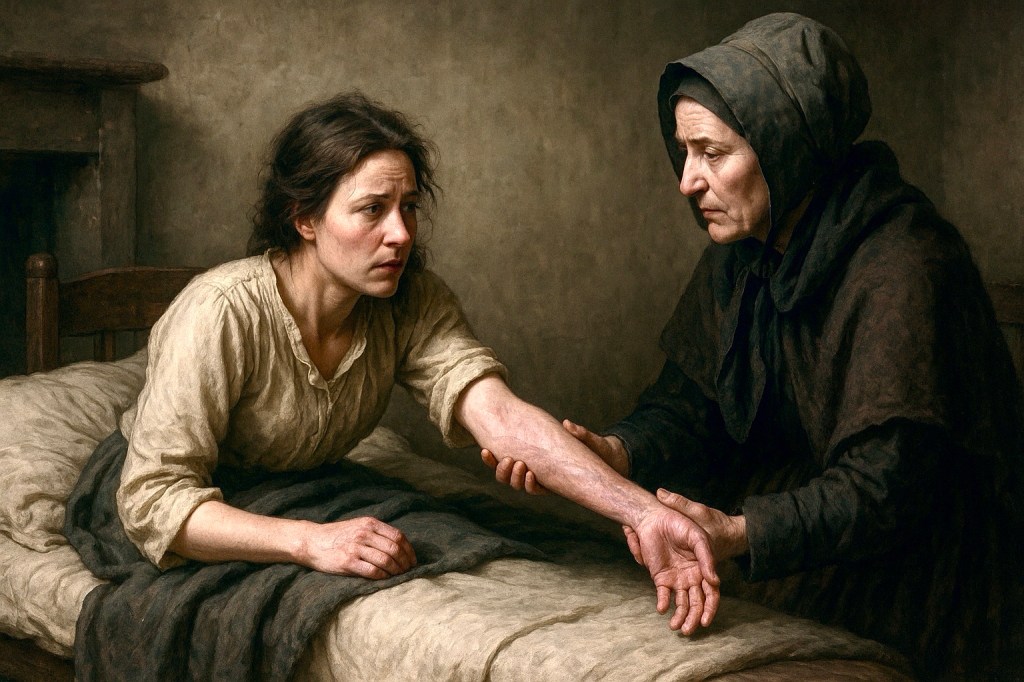
Rhoda’s dream, a vision of herself causing Gertrude’s arm to wither, becomes a chilling reality. If there’s a lesson here, it’s this: never underestimate the power of a milkmaid’s subconscious. The subsequent friendship between the women is as awkward as a cow on roller skates, especially since one of them has indirectly maimed the other. The true humour, albeit dark, lies in the absurdity of their interactions – Gertrude, blissfully ignorant of Rhoda’s role in her affliction, seeks solace and remedy from the very person who cursed her.
Gertrude’s journey to cure her arm brings her to a conjurer, which is as sensible as consulting a horologist about your aching tooth. The conjurer’s solution—touching the neck of a freshly hanged man – sounds like a macabre joke from a Victorian medical textbook. This bizarre remedy is Hardy’s way of saying, “You think your life’s weird? Hold my beer.”
Themes and Ironies: Hardy’s Wit Beneath the Woe
While Hardy is known for his tragic themes and often bleak outlook, The Withered Arm brims with ironic humour. The most striking irony is Gertrude’s transformation: she becomes so obsessed with healing her withered arm that it consumes her youth and beauty – the very qualities Farmer Lodge married her for. In essence, the more she tries to reclaim her former self, the more she loses it. Hardy seems to be winking at us, suggesting that life’s injustices are often compounded by our futile attempts to correct them.
Moreover, there’s an underlying humour in the idea that Rhoda, who has spent years in obscurity and bitterness, wields such supernatural influence. It’s as if Hardy is reminding us that those we overlook or underestimate might just have the power to twist fate – literally, in this case.
Finally, the ultimate comeuppance for Farmer Lodge, who loses both wife and son, is delivered with a kind of poetic justice that would make even Shakespeare nod in approval. Hardy’s message is clear: in the great cosmic ledger, debits and credits have a way of balancing out, often in the most unexpected ways. Certain people should continuously remind themselves of this.
Conclusion: A Gothic Tale with a Grin
The Withered Arm may be steeped in the gloom of Hardy’s Wessex, but it also bubbles with an ironic humour that underscores the absurdities of human nature. Rhoda, Gertrude, and Farmer Lodge are not just characters in a tragic tale but also players in a dark comedy of errors. So next time you read Hardy, remember to look for the humour hidden in the hedgerows of his prose. After all, even in the bleakest of tales, there’s always room for a wry smile.

 Wording