A gruesome title for a blog post, yes, but it deserves it, as you’re about to see.
From childhood, I harboured a fascination with the Betrayer, Judas Iscariot, who was already known by Jesus to be the one who would betray Him. An article in the Independent in 2016, that pitiable rag, argued that we should reconsider Judas’ character. The piece suggested that, like the other disciples, Judas had his flaws and was far from perfect. While pointing out the obvious, this article was penned by a minister of religion, likely too liberal to be authentically biblical and probably a progressive – a term that, in my opinion, has no place in relation to scripture.
We all know that Judas held the purse strings and was known for his pilfering, which is a common flaw. However, the aforementioned pointless article claimed that Jesus refused to bend to Judas’ demand for a more radical, activist stance against the Roman occupation. Thus, out of spite – another common trait in humanity – Judas chose to betray our Saviour. I don’t believe this narrative. I do sympathise with Judas, as someone had to betray Jesus. Jesus knew before and during the Last Supper that Judas would betray Him. Described as having a demon ( although I don’t think explicitly stated in the Gospels), Judas drew the short straw. The prophecy of Jesus’ death and resurrection could not have been realised without this betrayal. It seems there is a reason for everything in God’s glorious plan, eh?
John 13:21-27 (KJV):”When Jesus had thus said, he was troubled in spirit, and testified, and said, Verily, verily, I say unto you, that one of you shall betray me. Then the disciples looked one on another, doubting of whom he spake. Now there was leaning on Jesus’ bosom one of his disciples, whom Jesus loved. Simon Peter therefore beckoned to him, that he should ask who it should be of whom he spake. He then lying on Jesus’ breast saith unto him, Lord, who is it? Jesus answered, He it is, to whom I shall give a sop, when I have dipped it. And when he had dipped the sop, he gave it to Judas Iscariot, the son of Simon. And after the sop Satan entered into him. Then said Jesus unto him, That thou doest, do quickly.”
In John 13:27, the phrase “Satan entered into him” is the closest reference to demonic influence on Judas during the Last Supper.
Let’s examine a piece of art that deals with the outcome of Judas’ very short straw.
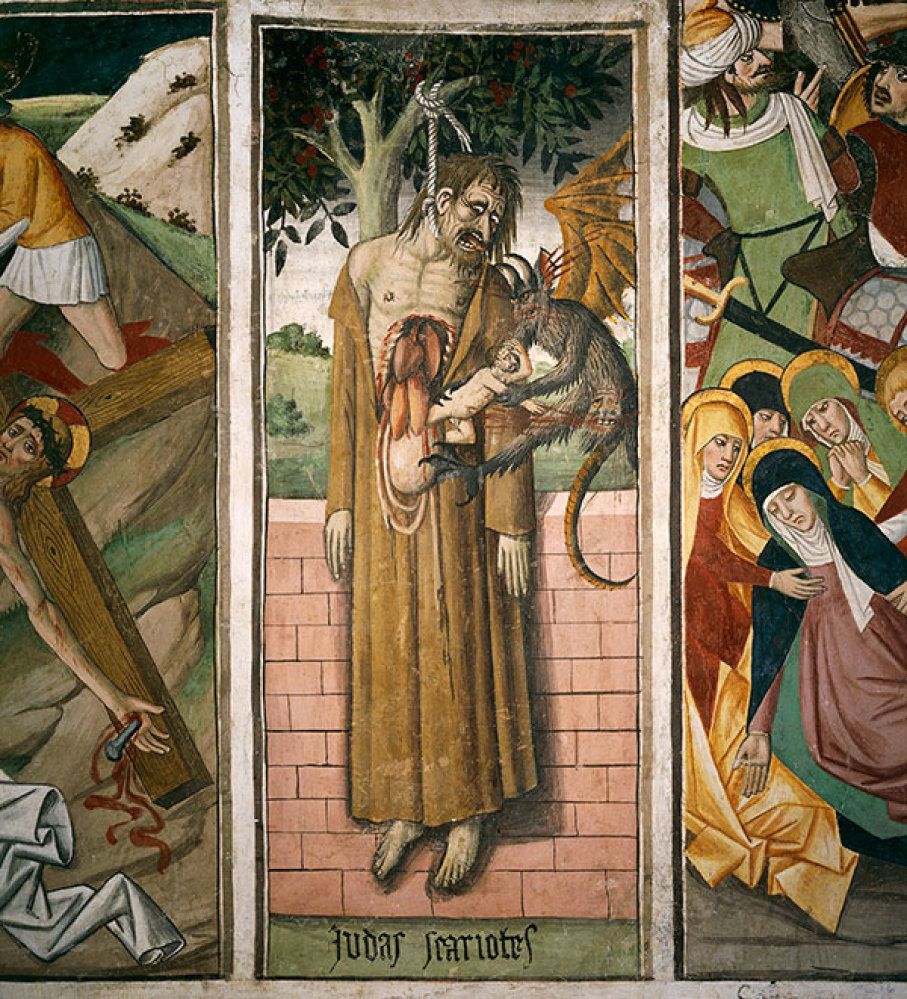
Giovanni Canavesio’s The Hanging of Judas, painted in 1492, is a fresco that packs a punch. Found in the Chapel of Notre-Dame des Fontaines in La Brigue, France, this artwork captures the not-so-glorious end of Judas Iscariot, the original betrayer before it was trendy.
Composition and Setting
Part of a larger series depicting the Passion of Christ, this fresco zeroes in on Judas’ final “oops” moment. The layout pulls your gaze right to the dangling figure of Judas, whose ill-fated investment in betrayal stocks plummeted spectacularly. The perspective is typically late medieval, slightly flat but rich in storytelling detail.
Figures and Expressions
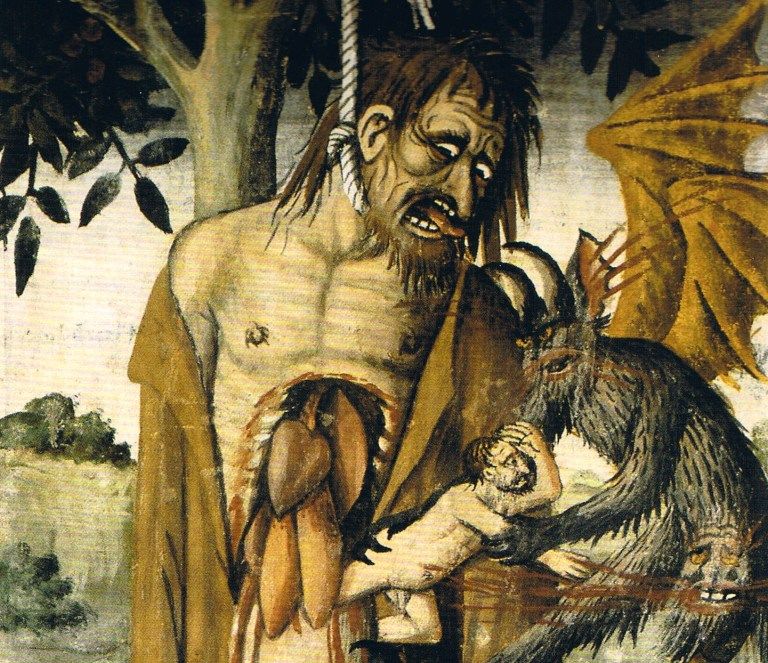
At the heart of this drama is Judas, hanging from a tree like an overripe fruit nobody wants to pick. His face, frozen in a blend of anguish and regret, suggests he’s realised too late that thirty pieces of silver don’t buy much in eternal currency. Surrounding him, you’ll find a cast of grotesque demons, perhaps Canavesio’s way of saying, “See kids, this is what happens when you don’t play nice.”
Colour and Lighting
Canavesio uses a palette of earthy tones, adding to the “don’t try this at home” atmosphere. Red, the colour of both love and danger, subtly appears, likely reminding viewers of Judas’ crimson-tinted sins. The lighting is even and sombre, ensuring the scene’s gravity (no pun intended) is crystal clear.
Symbolism and Themes
The tree from which Judas swings might as well be labelled “Tree of Regret,” contrasting sharply with the hopeful Tree of Life from earlier stories. Demons prying his soul from his belly add a layer of horror-comedy – imagine a medieval horror movie with a theological twist. Judas’ ever-present purse, those infamous thirty pieces of silver, is the ultimate “bad deal” reminder.
Emotional and Moral Impact
This fresco is not just art; it’s a medieval cautionary tale. It evokes a mix of pity, horror, and a sprinkle of “serves him right.” Canavesio masterfully uses Judas’ physical and emotional torment to hammer home a message: betray your friends, and you’ll get more than just a bad reputation.
Artistic Context
Active in the late 15th century, Canavesio straddled the Gothic and early Renaissance worlds. The Hanging of Judas showcases his knack for blending clear narrative with intense emotion, making even the most complex theological concepts as digestible as the daily bread.
Warning
Giovanni Canavesio’s The Hanging of Judas isn’t just a fresco; it’s a visual sermon with a stern warning. Through vivid composition, expressive figures, and symbolic depth, the artwork teaches a timeless lesson: betray trust, and you’ll end up in quite the pickle – possibly with a demon digging into your gut. So, think twice before you double-cross someone, or you might end up hanging around in the wrong kind of gallery.
Moreover…
The Hanging of Judas, is indeed common in depictions of this scene for a demon or a grotesque creature to be shown taking Judas’ soul from his body, often symbolising his damnation. This visual element reinforces the idea of Judas being condemned to hell for his betrayal of Jesus.
In this particular fresco, a small demon is depicted emerging from Judas’ belly, grasping his soul. This demon has exaggerated, grotesque features typical of medieval representations of evil spirits. The act of the demon pulling out Judas’ soul directly from his abdomen emphasises the belief in the tangible and immediate consequences of his sins.
This element serves several purposes:
Moral and Didactic Message: It vividly illustrates the idea of divine retribution and eternal damnation awaiting those who commit grievous sins.
Narrative Enhancement: The presence of the demon adds a dramatic and supernatural dimension to the scene, heightening its emotional impact.
Symbolic Representation: The demon represents the forces of evil that have claimed Judas’ soul, highlighting the spiritual warfare theme prevalent in medieval Christian art.
Thus, Canavesio’s inclusion of the demon extracting Judas’ soul is a powerful and evocative element that enhances the moral and theological messages of the fresco.
Betrayal transforms a moment of trust into a lifetime of doubt.

 Wording