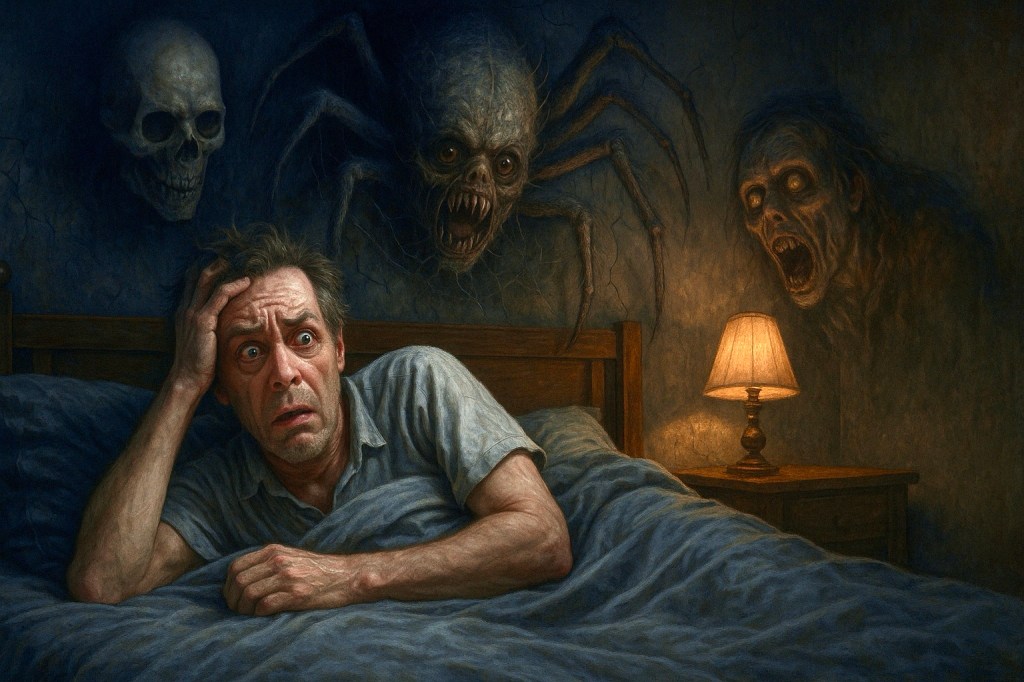
For countless years, sleep has been an unrelenting adversary in my life. Each night, I find myself locked in a relentless battle against the elusive embrace of Morpheus. When sleep does finally claim me, it is rarely a sanctuary. Instead, it becomes a stage for dark and tormenting dreams, sinister and vivid, that unravel my peace and set a foreboding tone for the day ahead.
The essence of this following poem appears to be misery, something with which I’m reasonably well experienced. Let’s have a look at the poem first, then we’ll dissect it a little:
Sleep brings no joy to me, Remembrance never dies, My soul is given to mystery, And lives in sighs.
Sleep brings no rest to me; The shadows of the dead, My wakening eyes may never see, Surround my bed.
Sleep brings no hope to me, In soundest sleep they come, And with their doleful imag’ry Deepen the gloom.
Sleep brings no strength to me, No power renewed to brave; I only sail a wilder sea, A darker wave.
Sleep brings no friend to me To soothe and aid to bear; They all gaze on how scornfully, And I despair.
Sleep brings no wish to fret My harassed heart beneath; My only wish is to forget In endless sleep of death.
Emily Brontë’s poem, though short, dives deep into the murky waters of despair, angst, and gloom. But let’s face it, we’ve all had those nights where sleep does nothing but throw us back into the arms of our anxieties. Let’s dissect this poetic lament and if we’re going to be miserable, we might as well laugh about it.
Structure and Repetition
The poem is like a broken record, each quatrain kicking off with the repetitive line “Sleep brings no,” driving home the point that sleep, for this Bronte, is about as useful as a screen door on a submarine. This repetition is Brontë’s way of saying, “Yes, I am that miserable, and I’m going to make sure you feel it too.” The iambic tetrameter keeps the rhythm going, much like the persistent tick-tock of a clock in a room where you can’t fall asleep.
Theme of Unending Sorrow
The first stanza opens with “Sleep brings no joy to me, / Remembrance never dies.” Translation: “My brain is a 24/7 horror show of bad memories.” The soul’s commitment to “mystery” and living “in sighs” suggests that Brontë is forever wandering in a fog of woe, which she apparently enjoys enough to make it her permanent residence.
The Haunting Presence of the Dead
The second stanza offers a delightful image: “The shadows of the dead, / My wakening eyes may never see, / Surround my bed.” This is Brontë’s way of saying her bed is less a place of rest and more a nightly séance. Forget about counting sheep; she’s busy keeping track of the ghosts who’ve decided to have a sleepover.
Dreams as Extensions of Gloom
In the third stanza, we learn that even in her “soundest sleep,” Brontë’s dreams are like reruns of the most depressing soap opera ever: “And with their doleful imag’ry / Deepen the gloom.” Because what’s better than waking up from a bad day than diving right back into it when you close your eyes?
Sleep as a Turbulent Sea
The fourth stanza shifts to a maritime metaphor: “I only sail a wilder sea, / A darker wave.” Forget calm waters; Brontë’s sleep is more like navigating a hurricane in a leaky rowing boat. While others might dream of sunny beaches, she’s apparently stuck in the Bermuda Triangle of her subconscious.
Alienation and Despair
The fifth stanza claims, “Sleep brings no friend to me / To soothe and aid to bear.” Apparently, the Sandman skipped her house, leaving her alone with her scornful inner critics. These critics, who are as helpful as a wet blanket, watch her struggle and despair without lifting a finger.
The Final Escape
Finally, we get to the pièce de résistance: “My only wish is to forget / In endless sleep of death.” Well, if that isn’t a cheery way to end a poem! Brontë’s ultimate wish is to clock out permanently because nothing says “I’ve had enough” like preferring death over another minute of this nightmare.
Conclusion
Emily Brontë’s poem is a masterclass in turning sleep into an extended metaphor for relentless suffering. With each stanza, she vividly paints sleep not as a refuge but as a continuation of her daytime woes. Through this darkly humorous lens, we see Brontë’s ability to make even the most mundane of activities – like trying to get some shut-eye -into a gothic horror tale. So, next time you’re tossing and turning, remember: at least your bed isn’t haunted by your regrets and the shadows of the dead. Or is it?
On a more profound note, I am an ardent admirer of the Brontë sisters, having cherished their literary masterpieces for as long as I can remember. Among their works, my heart beats strongest for the haunting melodies of Wuthering Heights, the indomitable spirit of Jane Eyre, and The Tenant of Wildfell Hall . The poem I discussed earlier is from a collection titled Poems from the Moor, a cherished gift from my much-missed estranged wife. This book resonates deeply with me, its verses echoing the corridors of my soul. There are moments when the heartache of seeing it, let alone touching it, tempts me to destroy it. Yet, the remnants of my marriage, though painful, remain treasured artifacts…for now.

 Wording