
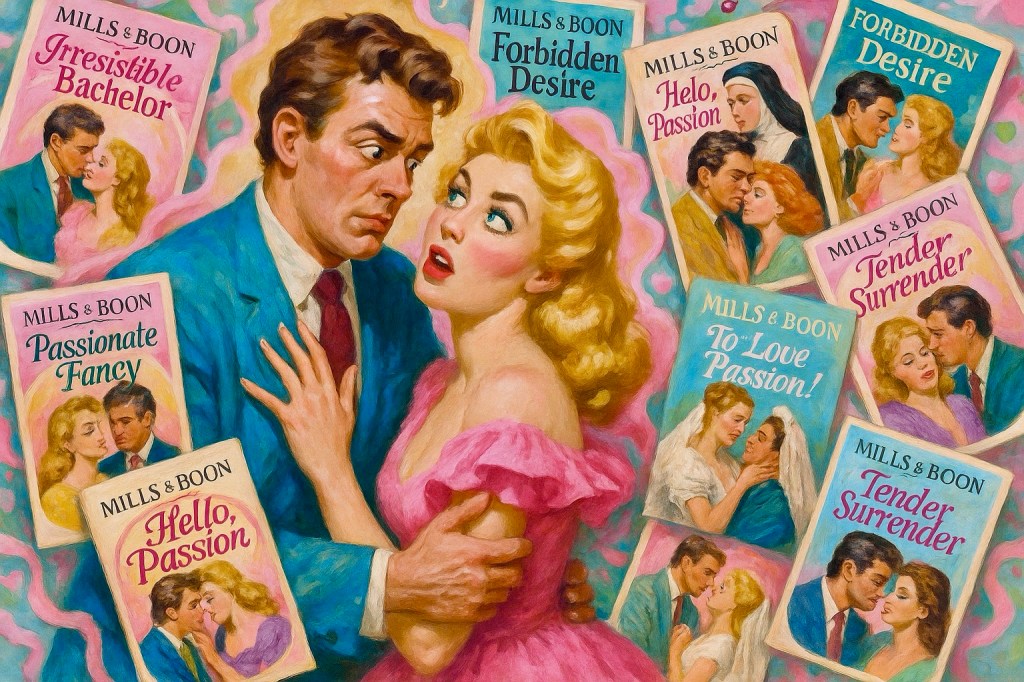
Given my well-known penchant for classic literature, it was only a matter of time before someone challenged my reading habits, urging me to delve into something more contemporary and ‘everyday’. One fateful afternoon, amid the humdrum of office life, I found myself the subject of playful ridicule. My colleagues, ever eager to see me squirm, proposed I read something vastly different from my usual fare. A Mills & Boon novel, they suggested, with mischievous glints in their eyes.
Horrified but determined to prove my adaptability, I accepted the challenge. A particularly unliterary co-worker handed me a slim volume, its cover adorned with a swooning couple locked in an embrace. My stomach churned, but I steeled myself for the task ahead.
As I embarked on this literary misadventure, I discovered that Mills & Boon novels are indeed bite-sized. Yet, despite their brevity, each page felt like an eternity. The simplistic prose and predictable plot twists were nothing short of torment. By the end of the short read, I was ready to dive headfirst into a wood-chipping machine, seeking any means of escape from the sugary drivel that assaulted my senses.
That ordeal took place many years ago, and the specifics of the book have mercifully faded from memory. In its place, I have conjured a fictional title and author, serving as a proxy for that particular genre of piffle. What follows are my candid thoughts on the experience, a blend of bemusement and critique, for your reading pleasure. Enjoy.
Ah, the Mills & Boon novel: a literary delicacy that lies somewhere between a stale crumpet and an expired can of spam, meant to feed the masses on a diet of wishful thinking and tawdry tropes. Lover’s Fantasy by Delilah Dreamweaver is no exception. It’s a novel so drenched in saccharine drivel that one might need insulin just to get through the first chapter. But let’s dissect this travesty, shall we?
Plot: Or, more accurately, the lack thereof. The storyline of Lover’s Fantasy is as thin as a piece of rice paper soaked in the tears of readers longing for actual substance. Our protagonist, Angelica – because what else would a Mills & Boon heroine be named – finds herself swept off her feet by the brooding billionaire Duke Sterling. That’s right, folks, a brooding billionaire duke. Because apparently, one exaggerated stereotype wasn’t enough. Angelica and Duke’s romance is a montage of clichéd encounters: accidental meetings, contrived misunderstandings, and passionate reconciliations that make you want to hurl the book across the room and then sterilise your hands.
Characters: Angelica is the epitome of a Mary Sue, complete with flowing hair, an inexplicable skill set (she’s a genius pianist, a martial arts expert, and a volunteer at a kitten rescue center), and a tragic backstory that’s about as compelling as a used tissue. Duke Sterling is the alpha male caricature – a man whose wealth is only matched by his emotional unavailability and propensity to gaze meaningfully into the middle distance. His only personality traits are his abs and his bank account. The supporting cast consists of cardboard cutouts: the sassy best friend, the scheming ex-girlfriend, and the wise old mentor who dispenses advice like an annoying know-it-all.
Dialogue: The conversations in this novel could give you cavities. Each exchange is a tug-of-war of simpering platitudes and overwrought declarations of love. At one point, Duke actually says, “I cannot live without you, Angelica. You are the breath in my lungs, the beat in my heart, the cheese to my macaroni.” Well, he doesn’t actually say the last part, but he might as well have. The attempts at witty banter fall flat, sounding more like two robots attempting to emulate human interaction.
Writing Style: Delilah Dreamweaver’s prose is so purple, it makes a colourful Muppet look beige (a word I’m rather fond of, by the way). Every sentence is dripping with unnecessary adjectives and adverbs, creating a sludge of verbosity that the reader must wade through. Descriptions are redundant and often ridiculous – how many times can one describe Duke’s “stormy, cerulean eyes” before it becomes a drinking game? The metaphors are mixed to the point of absurdity: “Her love for him was like a wild stallion, untamed and galloping through the lavender fields of her heart.” I wish I were making that up – well, technically I am, but you get the point.
Romantic Development: The relationship between Angelica and Duke progresses with all the subtlety of a freight train. They go from strangers to soulmates in the span of a few awkwardly written chapters. Their “love” is based on little more than physical attraction and repeated declarations of undying devotion, making one wonder if the author has ever experienced or even witnessed a real relationship. The obligatory conflict, usually a gross misunderstanding, is resolved with a single, heartfelt conversation – because why would we want to explore any real emotional depth?
In conclusion, Lover’s Fantasy by Delilah Dreamweaver is a shining example of everything wrong with formulaic romance novels. It’s a tepid rehash of tired tropes, featuring one-dimensional characters, laughable dialogue, and prose that could double as a sugar substitute. Reading it is like eating a meal composed entirely of whipped cream: initially sweet, but ultimately sickening and devoid of any real sustenance. If you have a masochistic streak or a penchant for mocking bad literature, give it a whirl. Otherwise, spare yourself the agony and invest your time in something more fulfilling – like watching paint dry.

 Wording