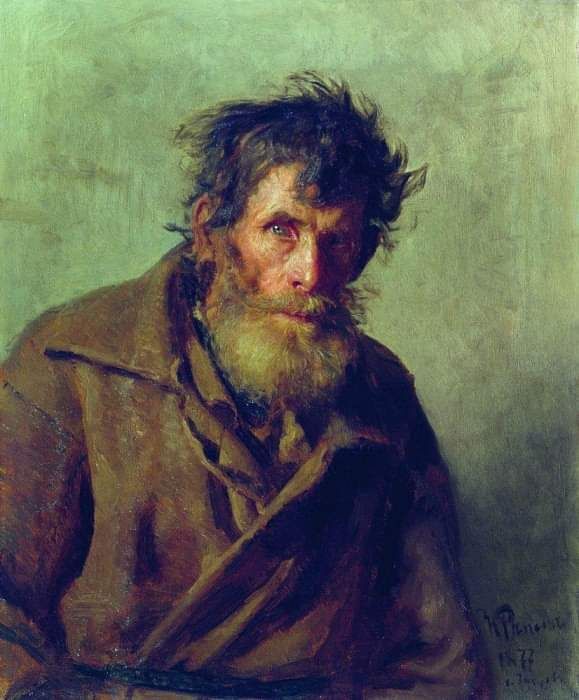
I find a deep resonance with the figure in this portrait; he embodies my own inner turmoil. He stands as the very essence of the sorrowful introvert, contentedly secluded from a world that has granted him nothing but relentless adversity. His eyes, brimming with profound pathos, tell a story of enduring pain and sadness. If tears were a commodity, this poignant portrayal would be the ultimate advertisement.
Ah, Ilya Repin, the maestro of making you feel things with just a brushstroke. His 1877 painting Shy Peasant is a delightful reminder that even in 19th-century Russia, the awkward socialite existed, long before modern-day introverts had Twitter (now X) to voice their woes. Let’s take a jaunty stroll through this artwork, keeping our wits about us as we analyse Repin’s creation.
Historical Context
Picture this: It’s post-1861 in Russia, and serfs have just been liberated. Sounds like a big deal, right? Well, imagine telling these newly “free” peasants, “Congratulations! You’re free to starve on your own now!” Repin’s timing couldn’t have been better, capturing the mixed feelings of freedom and financial despair. Shy Peasant steps into this scene with the grace of a man at his first ball, feeling a tad overwhelmed by it all.
Thematic Elements
Our star of the show is a peasant who looks like he’d rather be anywhere else, perhaps even back in the fields. His body language screams, “Please don’t notice me,” a sentiment we all share when our name is called out in a crowded room. The shy demeanour, the downward gaze, and the hunched shoulders – Repin’s peasant is the poster child for Introverts Anonymous.
But let’s not just sneer at his expense. Repin’s portrayal of this bashful fellow isn’t just for giggles. It’s a heartfelt nudge, reminding us that behind every rural caricature is a real human being with real feelings. This peasant isn’t just a social prop; he’s a person with a story, even if he’s too shy to tell it.
Stylistic Features
Repin’s detail is so sharp you could probably tell what brand of soap the peasant uses – or doesn’t. The rough texture of his clothes speaks volumes about his daily grind. It’s like Repin is saying, “Look at the fabric of his life, woven with hardship and simplicity.” His choice of earthy tones – think of a color palette inspired by mud – grounds the scene in rustic reality.
The lighting is Repin’s gentle way of guiding our gaze. A soft glow illuminates the peasant’s face, as if the artist himself whispered, “Hey, notice this man.” The peasant’s face emerges from the shadows like a hesitant party guest stepping into the spotlight, making sure the focus is on his inner world, not just his outer drabness.
Emotional Resonance
Despite all the humour, Shy Peasant tugs at the heartstrings. There’s a quiet dignity in his shyness, a subtle strength in his unwillingness to meet our gaze. Repin has captured that universal feeling of being out of place, a sensation familiar to anyone who’s ever walked into a fancy event wearing mismatched socks.
The composition of the painting enhances this feeling. Our peasant is slightly off-centre, much like how he probably feels in life. The negative space around him isn’t just blank canvas – it’s a reflection of his introspective nature, giving him room to be quietly, profoundly himself. It’s as if Repin is giving him the breathing space he so desperately needs.
Conclusion
In Shy Peasant, Ilya Repin has created more than just a portrait – he’s given us a window into the soul of a man who probably prefers the company of his chickens to that of people. With meticulous detail, clever composition, and emotional depth, Repin reminds us that even the shyest among us have stories worth telling. This painting is a witty, empathetic nod to the human condition, proving that whether in 19th-century Russia or today, everyone deserves a little understanding.

 Wording