G.K. Chesterton’s The Man Who Was Thursday is a novel that is as puzzling as it is entertaining, as philosophical as it is whimsical. It’s the literary equivalent of a well-executed magic trick: you think you know what’s happening until the very end, and even then, you’re not entirely sure. Let’s dive into this intricate tale with the same reckless abandon that Chesterton’s characters plunge into the depths of philosophical debate and covert operations.
The Plot: A Series of Unfortunate Events (and Pseudonyms)
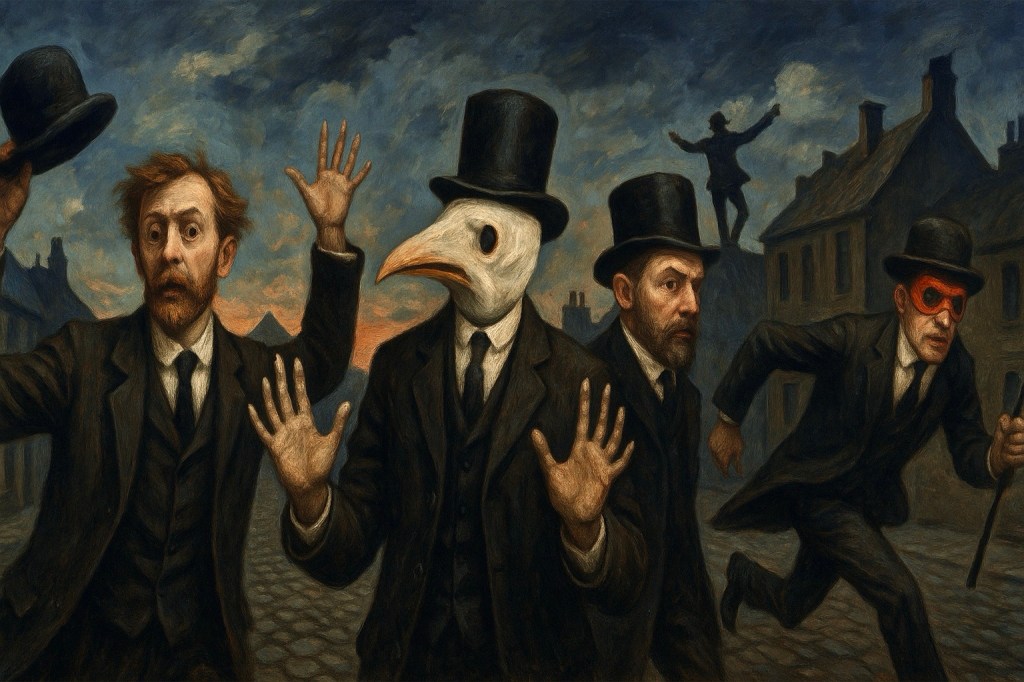
At its core, The Man Who Was Thursday is a spy novel – if spies were philosophers, and their missions involved existential crises rather than stolen microfilms. Gabriel Syme, our poet-turned-detective protagonist, infiltrates a secret council of anarchists who are named after the days of the week. The council is led by the enigmatic and corpulent Sunday, whose very existence seems to defy logical explanation. Each character Syme encounters is more peculiar than the last, with personalities as colourful and contradictory as a Picasso painting.
The plot twists and turns like a particularly indecisive snake, each revelation more baffling than the last. Every anarchist, it turns out, is not what they seem; instead, they’re all undercover policemen, just like Syme. Chesterton, it appears, has crafted a satire on the inefficacy and redundancy of law enforcement, or perhaps on the absurdity of human endeavours in general.
Characters: Archetypes and Anomalies
Gabriel Syme, the supposed voice of reason in a sea of madness, might remind modern readers of a particularly bemused office worker who discovers that all his colleagues are, in fact, undercover agents. Syme’s dedication to order and logic is continuously challenged by the anarchists, who, unbeknownst to him, share his true vocation. His journey is as much about uncovering the truth as it is about grappling with his own sense of reality.
Sunday, the titular man who was Thursday, is the novel’s grand enigma. His physical presence is imposing, his philosophical musings are profound, and his true nature is as elusive as a cat in a room full of rocking chairs. He embodies chaos and order simultaneously, leaving readers to ponder whether he represents the absurdity of the universe or the divine order behind it.
Themes: Anarchy, Order, and the Divine Comedy
At first glance, The Man Who Was Thursday might seem like a critique of anarchism. However, Chesterton’s treatment of the theme is anything but straightforward. The novel plays with the concept of anarchy not merely as a political stance but as a fundamental aspect of the human condition. The constant switching of roles between anarchists and detectives suggests that the battle between order and chaos is an intrinsic part of life.
The religious undertones are hard to miss. Chesterton, a devout Christian, weaves theological questions throughout the narrative, culminating in a final scene that feels more like a parable than a denouement. The council’s anarchists-cum-detectives undergo a kind of spiritual revelation, leading readers to contemplate the nature of evil, suffering, and redemption. It’s a bit like The Matrix, but with more bowler hats and fewer leather trench coats.
Humour and Absurdity: The Chesterton Touch
Chesterton’s humour is as sharp as his wit. His knack for the absurd is evident in the way he constructs his characters and scenarios. The dialogues are peppered with dry wit and clever repartee, making the novel a joy to read even as it delves into deep philosophical waters. Chesterton’s talent lies in his ability to make readers laugh while simultaneously making them think. It’s the literary equivalent of slipping a profound philosophical treatise inside a whoopee cushion.
Conclusion: The Ultimate Riddle
The Man Who Was Thursday is a novel that resists easy categorisation. It is a detective story, a philosophical treatise, a theological allegory, and a comedy of manners, all rolled into one. Its narrative complexity and thematic depth ensure that it can be read multiple times, each reading revealing new layers of meaning. Chesterton’s masterstroke is in crafting a story that is as thought-provoking as it is entertaining, leaving readers to ponder the nature of reality long after they have turned the final page.
In the end, The Man Who Was Thursday is like a hall of mirrors: endlessly fascinating, occasionally bewildering, and always reflecting the reader’s own search for meaning. It’s a novel that asks big questions with a smile, a wink, and the occasional slapstick fall, reminding us that sometimes the best way to grapple with the chaos of the universe is to embrace it with open arms and a hearty laugh.
If laughing’s an effort for you, I can empathise.

 Wording