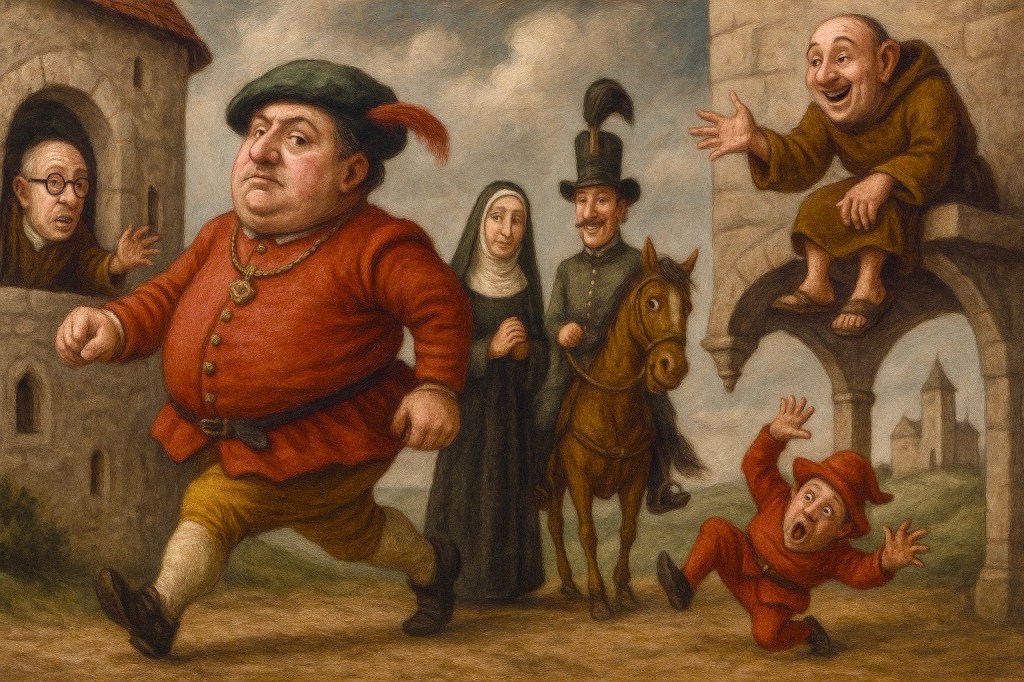
Stendhal’s The Charterhouse of Parma is an enduring classic of literature, often praised for its deep psychological insight, political intrigue, and richly detailed narrative. But let’s face it: wading through 19th-century novels can sometimes feel like being asked to appreciate the intricacies of tax law or to find the “fun” in a board meeting. Therefore, let us embark on a journey to dissect this masterpiece with the analytical rigour it deserves, while also poking a bit of fun at its peculiarities.
The Hero: Fabrizio del Dongo (why do I love this name so much?)
Fabrizio del Dongo, our protagonist, is the 19th-century equivalent of that friend who thinks he’s a poet because he once rhymed “love” with “dove” in a sonnet. He’s a nobleman with a penchant for adventure, a certain naivety, and an almost comic level of luck. Imagine Forrest Gump with a title and a horse, bumbling through life’s grand events. His naiveté is charming, but also perplexing. How does one so consistently stumble into and out of trouble? It’s as if Stendhal threw a dice for every major decision Fabrizio made, ensuring he landed just between disaster and mediocrity.
The Love Interest: Clelia Conti
Clelia Conti is the kind of love interest you find in epic tales – beautiful, virtuous, and, naturally, unattainable for most of the book. Fabrizio’s pursuit of her is less a courtship and more a masterclass in awkward longing. It’s as if Mr. Darcy had decided to woo Elizabeth Bennet by hiding in her shrubbery and composing sonnets about her eyebrows. Clelia herself is a delightful mix of intelligence and societal constraint, trapped in a narrative that demands she oscillate between passion and propriety like a Victorian metronome.
The Setting: Parma
The setting of Parma is as vital to the narrative as the characters themselves, a backdrop of political machinations, courtly intrigue, and operatic drama. Think of it as Game of Thrones but with fewer dragons and more powdered wigs. The microcosm of Italian politics is depicted with such meticulous detail that one wonders if Stendhal himself was a spurned bureaucrat in a past life. The duchy is rife with plots, counterplots, and the occasional prison break – a place where everyone’s business is everyone else’s business, and nobody has heard of minding their own.
The Plot: Or Lack Thereof
Plot in The Charterhouse of Parma is a rather loose term. The novel opens with the Napoleonic Wars, with Fabrizio hilariously misunderstanding his role in the Battle of Waterloo, believing himself a hero when he’s more of a tourist with a bayonet. From there, the narrative meanders through his misadventures: imprisonments, escapes, love affairs, and bouts of existential angst. It’s less a structured plot and more a series of events connected by Fabrizio’s charmingly baffled existence.
The Humor: Intentional or Otherwise
Stendhal is not known for his humour, which makes the unintentionally funny moments all the more precious. Fabrizio’s earnestness in absurd situations, the melodramatic declarations of love, and the elaborate political scheming often read like a highbrow sitcom. The sheer number of dramatic turns would give any soap opera a run for its money. It’s as if Stendhal, sitting at his desk, occasionally forgot he wasn’t writing for a dramatic theatre troupe but for readers who might chuckle at the absurdities of aristocratic life.
The Style: Dense but Rewarding
Stendhal’s writing style is like a rich tiramisu: layered, decadent, and sometimes a bit too much. His prose can be both beautiful and baffling, requiring readers to occasionally reread passages to ensure they haven’t missed a crucial detail or a sly wink from the author. His psychological insights, especially into the hearts and minds of his characters, are profound, though they sometimes veer into the territory of “did we really need three pages on this inner turmoil?”
The Conclusion: A Delightful Slog
The Charterhouse of Parma is a novel that rewards patience and perseverance, much like assembling IKEA furniture or mastering the art of sourdough bread. It’s a testament to the chaotic beauty of life, love, and politics, told through the eyes of a hero who is as endearing as he is exasperating. For all its density and drama, the novel remains a cornerstone of literary canon, inviting readers to laugh, cry, and occasionally roll their eyes at the grandiosity of it all.
In conclusion, approaching The Charterhouse of Parma with a sense of humour and a willingness to embrace its quirks makes the experience not just bearable but genuinely enjoyable. Stendhal might have written with the intent to probe the human condition, but he also inadvertently crafted a narrative that stands as a timeless comedy of errors. So, here’s to Fabrizio del Dongo – the hapless hero we never knew we needed, navigating a world as complicated as it is absurd.

 Wording