While there isn’t a single confirmed real-life story that directly inspired The Tell-Tale Heart, it’s likely that a combination of contemporary crime stories, specific cases like that of James Wood, Poe’s personal experiences, and the broader influence of Gothic literature all contributed to the creation of this iconic tale. Poe’s genius lay in his ability to weave these elements together into a narrative that continues to captivate and unsettle readers. I myself studied this tale as part of my English Lit A level many moons ago, and although I’d read it even more moons before, actually dissecting the tale hooked me more-so. Let’s have a dig.
Edgar Allan Poe, that ever-cheerful maestro of the macabre, bequeathed to us The Tell-Tale Heart, a story that proves once and for all that when it comes to madness, nothing screams “insanity” quite like an unreliable narrator who doesn’t understand that screaming “I’m not crazy!” only makes you sound crazier. Here, Poe dives deep into the tumultuous mind of a man so obsessed with proving his sanity that he meticulously orchestrates a murder to eliminate the vile “vulture eye” of an old man. As if murder was ever the mark of mental stability.
Let’s start with our dear narrator, who insists on his soundness of mind while systematically detailing how he committed a heinous crime. Of course, nothing says ‘mentally sound’ like the repetitive assertion of one’s sanity. His opening gambit, “True! – nervous – very, very dreadfully nervous I had been and am; but why will you say that I am mad?” sets the tone perfectly. Ah, yes, let’s take a moment to ponder why people might think you’re mad. Could it be your obsession with an elderly man’s eye, which you liken to that of a vulture?
Speaking of the eye, it is the catalyst for all the ensuing drama. This ‘Evil Eye’ that the narrator speaks of with such vitriol is, in reality, just an old man’s eye. But our narrator’s melodramatic descriptions elevate it to an object of pure malevolence. Clearly, he missed his calling as a professional hyperbolist. Poe expertly uses this hyperbole to emphasise the narrator’s madness. This eye, with its “dull blue” and “film over it,” is depicted with all the subtlety of a sledgehammer, a trait the narrator no doubt picked up from his own personality.
The meticulous planning of the murder is another masterstroke in showcasing our narrator’s brand of lunacy. He boasts about his cautious approach – how he watched the old man sleep for nights on end, creeping in every hour. If there were an Olympic sport for obsessive, paranoid stalking, our narrator would be a gold medallist. He takes pride in his meticulous nature, believing that this somehow exonerates him from any accusation of madness. Indeed, the line between thoroughness and lunacy is as clear as mud here.
Madness is the mind’s dance with its darkest fears, where reality blurs and illusions reign.
The actual murder is a theatrical affair, conducted with all the flourish of an overwrought stage play. The narrator’s description of smothering the old man under his own bed is delivered with a disturbing lack of remorse. What follows is the dismemberment of the body, described with a chilling nonchalance that would make a butcher blush. Here, Poe plays with the theme of guilt – or rather, the lack of it – highlighting the narrator’s delusion that his crime is justified and his conscience clear. After all, the Evil Eye had to be vanquished!
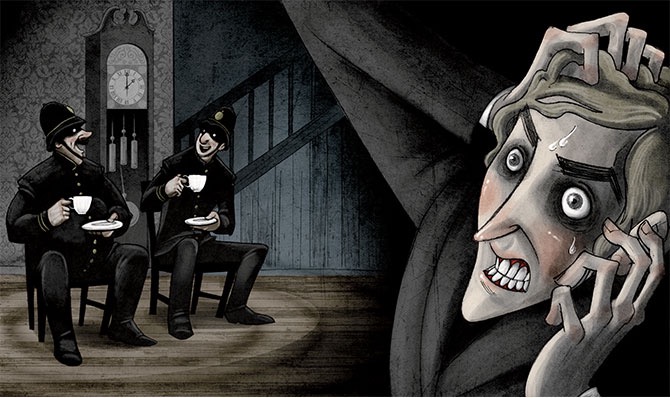
Of course, the pièce de résistance is the climax where the narrator, having duped the police with his charm (and who could resist the charm of a madman?), finds himself unravelling under the imagined beating of the old man’s heart. Ah, the sweet irony! The narrator, who had prided himself on his cleverness, is undone by his own guilt manifesting as auditory hallucinations. The heart, which he so carefully silenced, roars back to life, pounding louder and louder, drowning out any pretense of sanity he had left. It’s as if Poe is winking at us, saying, “See? I told you he was mad.” Personally, I’d like to think that the beating wasn’t an hallucination, rather the protagonist’s own heart beating faster and louder, drumming through his inner ears, as his anxiety and guilty conscience undo him whilst in the presence of the police officers – but, we can have it both ways.
In conclusion, The Tell-Tale Heart is a delightful journey into the mind of someone who is just sane enough to articulate their madness but too mad to realise how insane they truly are. Poe’s genius lies in his ability to make us both sympathise with and recoil from his narrator. We are drawn into his twisted logic, even as we recognise its absurdity. Through the narrator’s obsessive compulsions, hyperbolic paranoia, and ultimate breakdown, Poe masterfully illustrates the thin veneer separating sanity from madness. And if you take away one thing from this story, let it be this: if you find yourself repeatedly asserting your sanity, it might be time to take a good, hard look in the mirror – and not just at your eye.
Image: LIT Society https://bit.ly/3RFhPoz

 Wording