When I first encountered the works of W. Somerset Maugham, I was not yet in my teens. My initial foray into his literary world was through Of Human Bondage, and I was immediately captivated. However, it was The Moon and Sixpence that truly ensnared my imagination. The allure of this novel lay not only in its references to art, a subject I was as passionate about then as I am now, but also in its enchanting title, which I found irresistibly delightful. We’ll have a look at the other novel at a later time.
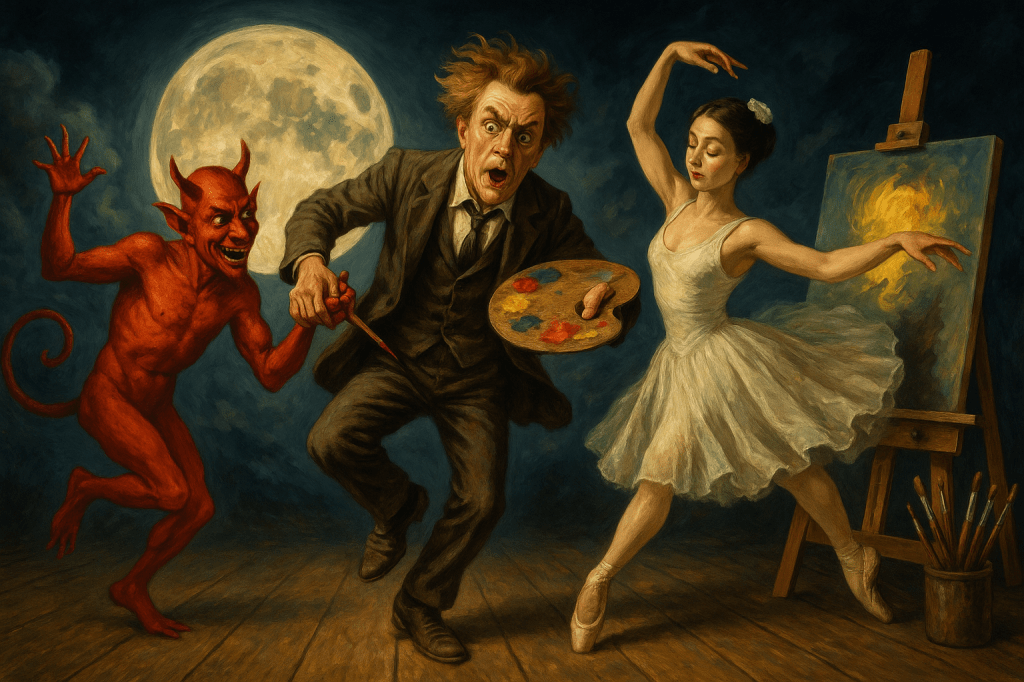
W. Somerset Maugham’s The Moon and Sixpence spins a tale that feels as timeless as it is transgressive, dissecting the tumultuous life of Charles Strickland, an artist driven by an insatiable, almost demonic, thirst for creative expression. Strickland, loosely based on the post-Impressionist painter Paul Gauguin, abandons a comfortable life and family in London to pursue his art in Paris and, eventually, the South Seas. In doing so, he sacrifices social norms, human connections, and even his own health. Through this narrative, Maugham explores the perennial conflict between the demands of society and the irrepressible call of artistic genius.
At the heart of the novel lies a paradox that Maugham skillfully unravels: the idea that true artistic brilliance often comes at the expense of conventional morality and human decency. Strickland is depicted as a man who is almost grotesquely indifferent to the lives he upends. His wife, children, and friends are mere collateral damage in his relentless pursuit of artistic fulfillment. Maugham’s Strickland is an antihero of the highest order, embodying the destructive side of genius. The author does not seek to redeem Strickland’s character but instead paints him as a figure who is both abhorrent and awe-inspiring.
Maugham employs a narrative structure that is as unconventional as his protagonist. The story is narrated by a fictionalised version of Maugham himself, providing a second-hand account of Strickland’s life. This choice adds a layer of detachment, allowing readers to view Strickland’s actions through the lens of someone grappling with the enigma of genius. The narrator’s ambivalence toward Strickland mirrors the reader’s own conflicted feelings, as we are both repelled by his cruelty and fascinated by his unwavering dedication to his craft.
The novel’s title, The Moon and Sixpence, alludes to a dichotomy that runs throughout the book. The moon symbolises the lofty, often unattainable aspirations of artistic purity and transcendence, while the sixpence represents the mundane, practical concerns of everyday life. Strickland’s journey is a testament to the perilous path of choosing the moon over the sixpence. His total immersion in his art leads him to forsake the comforts and compromises that most people cling to, revealing the often-brutal reality of artistic obsession.
Strickland’s eventual relocation to Tahiti serves as a symbolic return to a primal state, away from the suffocating constraints of Western civilisation. In this Edenic setting, Strickland’s art flourishes, reaching new heights of beauty and profundity. However, this paradise comes at a cost. Strickland’s body deteriorates, and he ultimately succumbs to leprosy. Yet, in his physical decay, there is a sense of spiritual and artistic purification. Maugham suggests that Strickland’s suffering and isolation are the prices he must pay for his uncompromising pursuit of artistic truth.
Maugham’s prose is both precise and evocative, capturing the inner turmoil of his characters with unflinching clarity. He delves into the psychological complexities of Strickland’s character, presenting him not as a one-dimensional monster, but as a deeply flawed human being whose actions are driven by an almost supernatural compulsion. This nuanced portrayal challenges readers to question their own perceptions of morality and genius.
In conclusion, The Moon and Sixpence is a masterful exploration of the often-painful intersection between artistic aspiration and human frailty. Through the character of Charles Strickland, Maugham confronts us with the uncomfortable truth that the pursuit of artistic greatness can sometimes necessitate a rejection of societal norms and personal relationships. Strickland’s life is a testament to the cost of genius, a cost that is often borne not only by the artist but by those around them. Maugham’s novel remains a powerful meditation on the sacrifices demanded by the creative impulse and the thin line that separates brilliance from madness.

 Wording