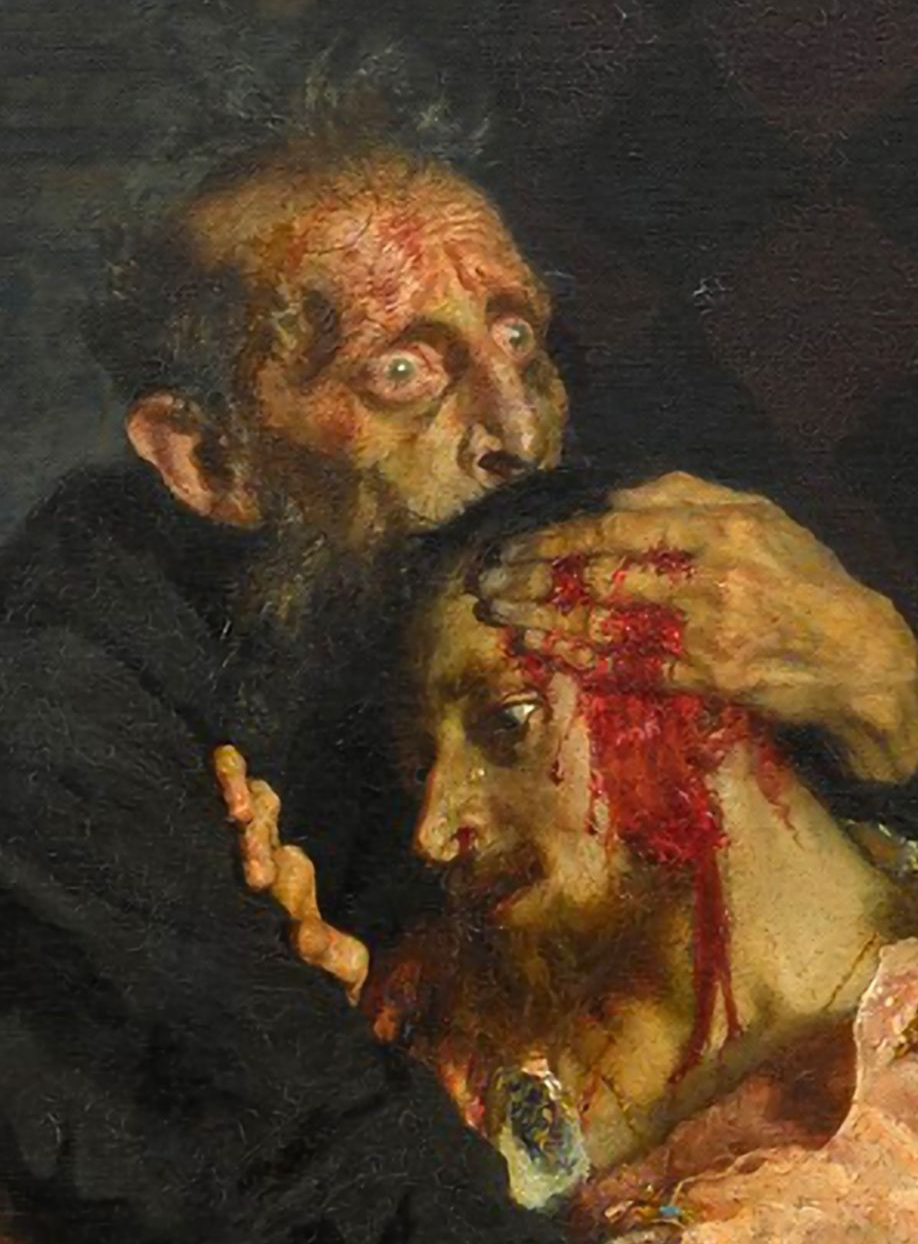
Stare into the absolute, tormenting agony etched in those eyes! I first encountered this haunting image as a schoolboy, and it’s lingered in my memory ever since. The distress conveyed in those eyes is almost tangible. They’re wide, brimming with an overwhelming cocktail of sadness, remorse, and sheer horror. I’ve seen grief on many peoples’ faces over the years in my former career, and it’s never the finer detail of their faces I remember but their eyes. They really are, in many cases, the windows to a person’s soul – in them is torment.
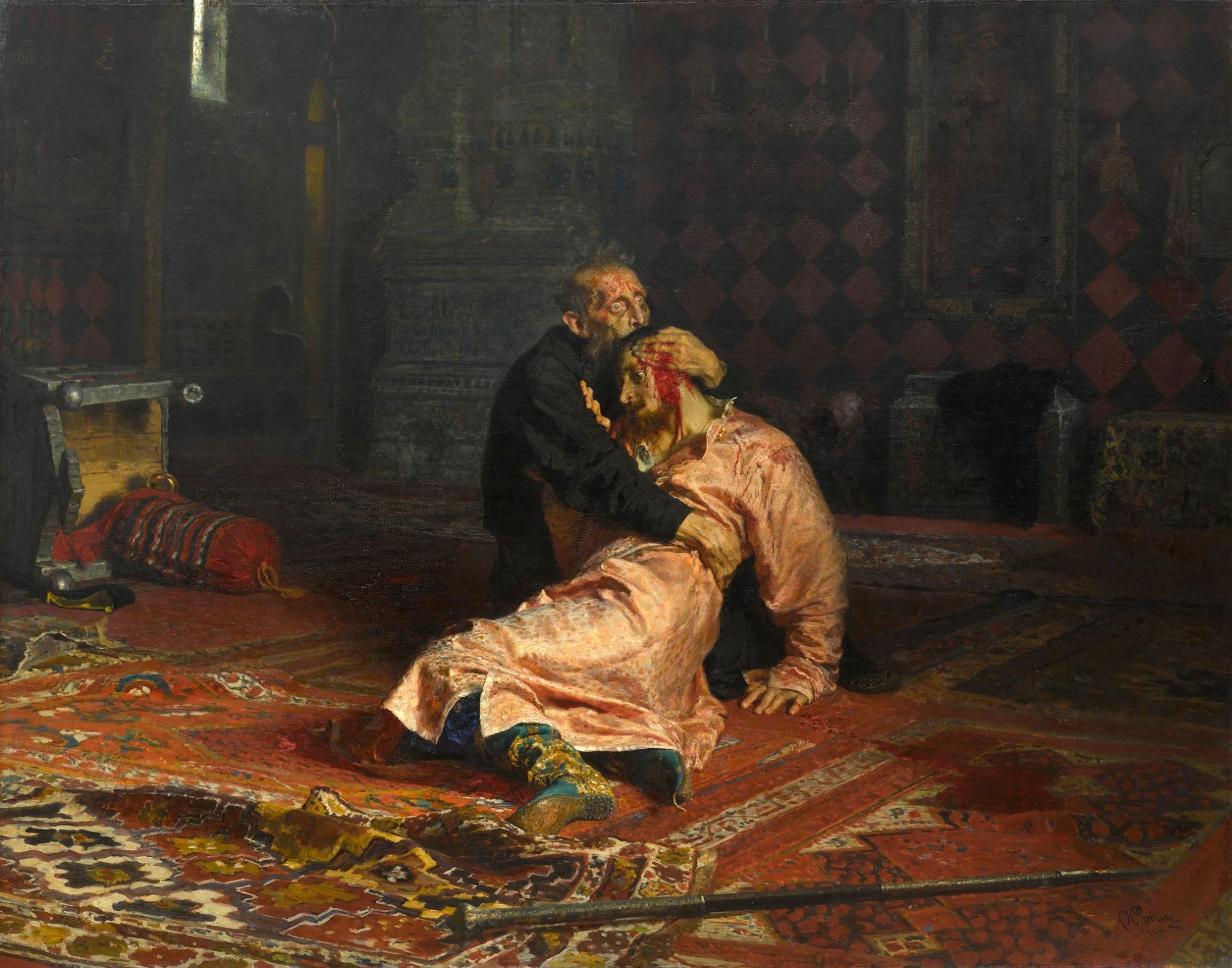
Ivan the Terrible and His Son Ivan, painted by Ilya Repin in 1885, is a harrowing portrayal of an infamous moment in Russian history. This painting, often referred to as Ivan the Terrible and His Son on November 16, 1581, captures the aftermath of the tsar’s fatal blow to his son. Through its detailed and emotionally charged composition, Repin’s work transcends mere historical representation, becoming a macabre exploration of madness, violence, and remorse.
The painting’s subject is rooted in a tragic incident. Ivan IV, known as Ivan the Terrible, struck his son, also named Ivan, in a fit of rage, leading to the latter’s death. This moment is enveloped in historical debate, but Repin’s interpretation is unequivocal in its horror and pathos. The artist’s choice to depict the moment just after the fatal blow serves to amplify the emotional intensity and the psychological complexity of the scene.
At the centre of the canvas are the figures of Ivan the Terrible and his dying son. Ivan IV, often depicted as a figure of overwhelming power and terror, here appears as a broken man. His eyes, wide with a mixture of shock, madness, and grief, stare out with a haunting intensity. The tsar’s hands, stained with blood, grasp his son in a desperate, almost futile attempt to reverse the irreversible. His face is a mask of agony, his mouth open in a silent scream, capturing the moment of his realisation and remorse.
The son, by contrast, lies limp and lifeless in his father’s arms. His face is serene, a stark contrast to the turmoil in his father’s expression. Blood trickles from his temple, staining his clothes and the floor beneath him. The juxtaposition of the serene acceptance of death in the son and the frantic desperation in the father creates a poignant tension, underscoring the painting’s macabre atmosphere.
Repin’s use of colour and light enhances the emotional gravity of the scene. The dominant reds and browns evoke a sense of blood and earth, grounding the scene in a grim reality. The dim, almost oppressive lighting casts deep shadows, emphasising the sombre mood and the isolation of the two figures in their private horror. The background, devoid of distracting details, further focuses the viewer’s attention on the central drama, creating a claustrophobic sense of intimacy with the characters’ suffering.
The composition itself is masterfully designed to draw the viewer into the psychological depths of the moment. The diagonal lines created by the figures’ bodies guide the eye from Ivan the Terrible’s anguished face to the peaceful visage of his son, reinforcing the narrative of cause and effect. The intensity of the physical connection between the two figures, with the father cradling his son’s head, suggests both a final act of love and a desperate clinging to what’s already been lost.
Beyond its immediate emotional impact, the painting invites deeper reflection on themes of power, guilt, and the human capacity for violence. Ivan IV’s reign was marked by ruthless political purges and the consolidation of autocratic power, and this personal tragedy can be seen as a microcosm of his larger legacy. The painting suggests that the tsar’s ultimate victim was not just his son, but himself, as he is consumed by the consequences of his own actions. The horrific event becomes a poignant metaphor for the destructive nature of unchecked power and the inescapable burden of guilt.
Repin’s work also engages with the broader cultural and historical context of its creation. Painted in the late 19th century, during a period of significant social and political upheaval in Russia, Ivan the Terrible and His Son Ivan can be seen as a commentary on the dangers of autocracy and the potential for reform. The painting’s macabre subject matter and emotional intensity resonated with contemporary audiences, reflecting the anxieties and aspirations of a society grappling with its own turbulent history.
Ilya Repin’s Ivan the Terrible and His Son Ivan is a powerful, macabre masterpiece that transcends its historical subject to explore universal themes of violence, remorse, and the human condition. Through its detailed and emotionally charged depiction, the painting captures the horror and tragedy of a singular moment while inviting profound reflection on the nature of power and guilt. Repin’s work remains a compelling and haunting portrayal of the darkest facets of the human psyche, resonating with viewers across generations.

 Wording