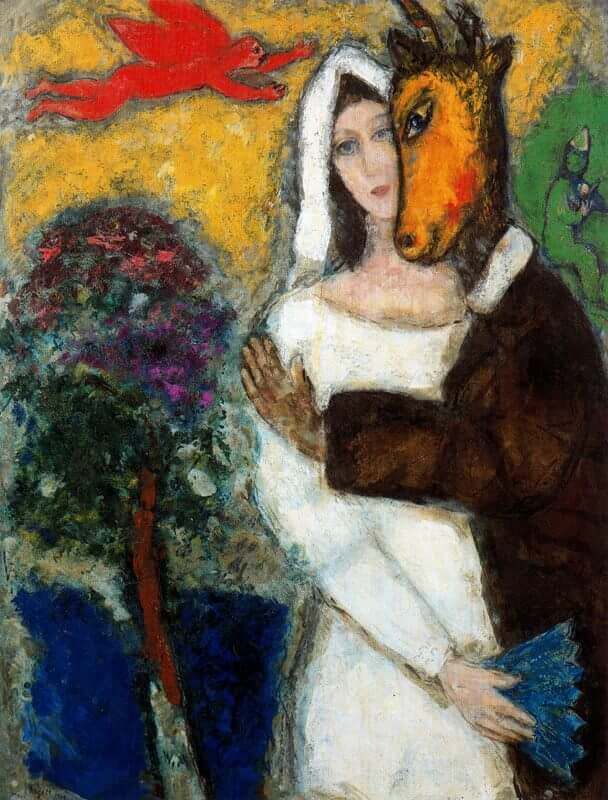
Marc Chagall’s painting A Midsummer Night’s Dream is a garish spectacle that fails to capture the essence of Shakespeare’s timeless play. Chagall, known for his vibrant colours and dreamlike compositions, seems to have let his whimsical tendencies run amok in this work, resulting in a piece that is as perplexing as it is unsatisfactory.
Firstly, Chagall’s overuse of colour is both overwhelming and disorienting. The painting’s palette, with its chaotic clash of reds, blues, and greens, lacks harmony and coherence. Instead of enhancing the fantastical elements of the play, the colours clash aggressively, distracting the viewer rather than drawing them into the narrative. Chagall’s insistence on employing such vivid hues comes off as a desperate attempt to compensate for the painting’s other deficiencies, rather than a thoughtful artistic choice.
Moreover, the composition of A Midsummer Night’s Dream is an absolute mess. The figures are haphazardly placed, with little regard for spatial logic or balance. This haphazard arrangement makes it difficult to discern any meaningful narrative or thematic connections between the characters and elements depicted. The viewer is left to decipher an incoherent jumble of figures and objects, rather than being guided through a cohesive visual story.
Chagall’s depiction of the characters from Shakespeare’s play is equally problematic. The figures lack the depth and complexity that one would expect from a work inspired by such a rich literary source. Instead, they are rendered in Chagall’s typical stylised manner, which, while effective in other contexts, here reduces them to mere caricatures. The ethereal beauty and nuanced emotions of Shakespeare’s characters are lost, replaced by exaggerated and superficial representations that do a disservice to the original work.
Furthermore, Chagall’s inclusion of random, unrelated elements adds to the painting’s overall disarray. The floating figures, animals, and bizarre objects scattered throughout the canvas bear little relation to the narrative of A Midsummer Night’s Dream. These extraneous details clutter the composition and dilute its impact, making it seem as though Chagall threw in whatever came to mind without any regard for thematic consistency or relevance.
The painting’s attempt at capturing the dreamlike quality of the play also falls flat. Rather than evoking a sense of enchantment and wonder, the work feels more like a chaotic fever dream. Chagall’s heavy-handed approach to surrealism undermines the delicate balance between reality and fantasy that is central to A Midsummer Night’s Dream. Instead of inviting the viewer into a magical world, the painting alienates them with its frenetic and disjointed presentation.
And so, Marc Chagall’s A Midsummer Night’s Dream is a disappointing and bewildering misinterpretation of Shakespeare’s beloved play. The painting’s chaotic composition, garish colour scheme, superficial character portrayals, and irrelevant details combine to create a work that is more confusing than captivating. Chagall’s signature style, which can be so enchanting in other contexts, here results in a piece that is ultimately a disservice to its literary inspiration. In layman’s terms, it’s rubbish.
Chagall’s work is not easily confined to a single genre, as it spans multiple art movements, reflecting a blend of Cubism, Fauvism, Symbolism, and Surrealism.
While he was influenced by Cubism, especially during his time in Paris, he never fully adopted the fragmented, geometric abstraction characteristic of the movement. His work incorporates elements of Cubism in its approach to form and perspective but remains more fluid and less rigidly structured.
His use of vibrant, bold colours is reminiscent of Fauvism. The Fauves, led by artists like Henri Matisse, emphasised painterly qualities and strong color over representational or realistic values. Chagall’s palette is exuberant and expressive, aligning with the Fauvist spirit.
His work is rich with personal symbolism and dreamlike imagery, placing him within the Symbolist tradition. His paintings often draw on Jewish folklore, Russian traditions, and his own life experiences, creating layers of meaning and emotional depth.
The dreamlike scenes, floating figures, and fantastical elements resonate with Surrealism. Though not officially part of the Surrealist movement, his work shares its interest in the subconscious, dreams, and the irrational. His unique style blends reality with fantasy, creating whimsical and often surreal compositions.
This art defies strict categorisation, reflecting a synthesis of these movements. His distinctive approach combines the structural experimentation of Cubism, the bold colour of Fauvism, the rich imagery of Symbolism, and the dreamlike quality of Surrealism, making his work uniquely his own.
And with that, I draw this discourse to a close. Regardless of dissenting voices, I hold steadfast to the belief that such endeavours, persisting even now with other so-called artists, amount to nothing more than insipid, uninspired drivel.

 Wording