
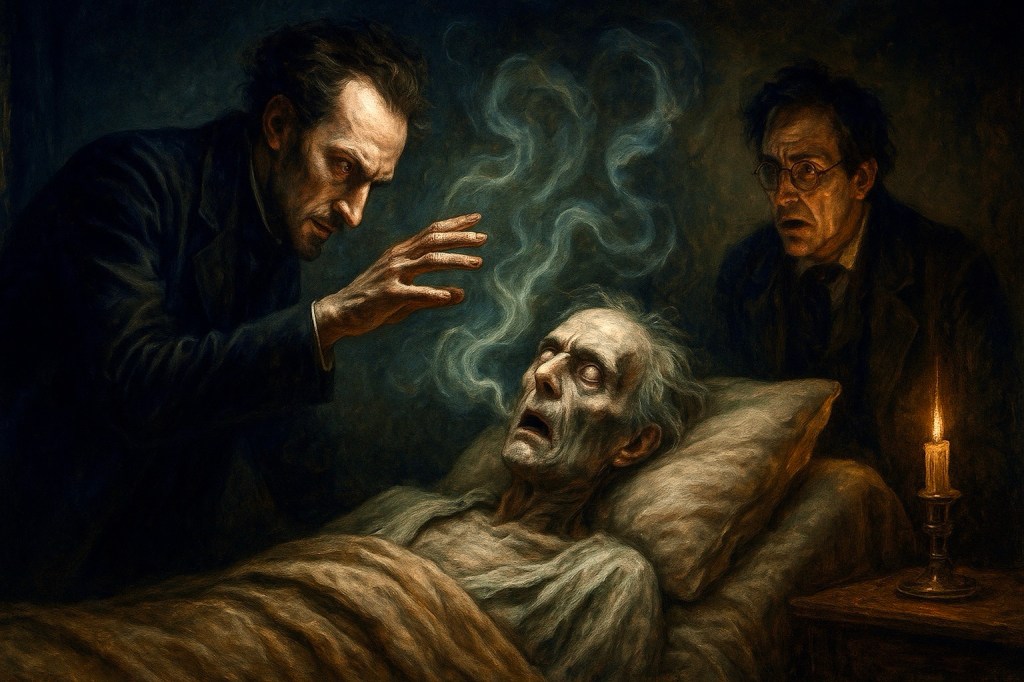
Imagine the audacious organisers of a Hen or Stag party, gleefully arranging for a Hypnotist solely to amuse themselves at the expense of their inebriated guests, who may be compelled to cluck like chickens or strike poses reminiscent of tea pots. The absurdity of such a spectacle is almost Poe-esque in its dark humour, a bizarre contrast to the eerie tale we’re about to explore. One wonders, with a mix of amusement and disbelief, if anyone has dared to orchestrate such an event in reality. Humans, in their eccentricity, often defy expectations, leaving us simultaneously amused and perplexed. Nevertheless, let us delve into Poe’s chilling narrative and contemplate the curious intersections of fiction and reality. Read on.
Edgar Allan Poe’s The Facts in the Case of M. Valdemar, first published in 1845, exemplifies his mastery of the macabre and the grotesque. This short story deftly intertwines scientific curiosity, mesmerism (hypnosis as we now know it), and the grim fascination with death to create a narrative that is as chilling as it is intellectually stimulating. The story’s detailed depiction of a man suspended between life and death under hypnosis challenges the boundaries of human experience and the natural order, compelling readers to confront their deepest fears and morbid fascinations.
At the heart of The Facts in the Case of M. Valdemar is the character of M. Valdemar, a terminally ill man who consents to be mesmerised at the moment of his death. Poe uses this premise to explore themes of control, the supernatural, and the limits of scientific intervention. The story opens with the narrator, a practitioner of mesmerism, explaining his intent to mesmerise Valdemar as he approaches death, revealing the unsettling blend of scientific inquiry and morbid curiosity. The narrator’s clinical detachment and Valdemar’s eerie compliance set the tone for a narrative that probes the unsettling edges of human experience.
Poe’s use of detail and descriptive language creates an atmosphere of dread and anticipation. For instance, as the narrator describes Valdemar’s condition, the graphic portrayal is both vivid and unsettling: “His face wore a leaden hue; the eyes were utterly lustreless; and the emaciation was so extreme, that the skin had been broken through by the cheek-bones.” This meticulous attention to physical decay enhances the story’s macabre quality, making the reader acutely aware of the fragility and grotesqueness of the human body.
The moment of mesmerism is depicted with a chilling precision that underscores the unnaturalness of the act. When Valdemar is put into a trance, his voice, described as “harsh and broken,” utters the haunting phrase, “I am dead,” blurring the lines between life and death. This declaration encapsulates the central horror of the story: the existence of a state that defies natural laws and human comprehension. Poe’s ability to convey the sheer unnaturalness of Valdemar’s condition speaks to his skill in evoking a sense of existential dread.
The story reaches its climax when Valdemar is finally awakened from his mesmeric state, leading to a grotesque and horrifying dissolution of his body. Poe spares no detail in describing this gruesome event: “For an instant, the whole body sank into a nearly liquid mass of loathsome – of detestable putrescence.” This graphic depiction of physical decay serves as a stark reminder of the inevitable and unchangeable reality of death. The grotesque transformation of Valdemar’s body underscores the futility of attempting to manipulate or escape the natural order, reinforcing the story’s macabre theme.
Poe’s The Facts in the Case of M. Valdemar serves as a powerful meditation on the limits of human knowledge and the inevitability of death. Through its detailed and macabre narrative, the story confronts readers with the uncomfortable truth that some aspects of human existence remain beyond our control and understanding. The interplay of scientific curiosity and supernatural horror in the story challenges the reader to consider the ethical and existential implications of attempting to transcend natural boundaries.
The Facts in the Case of M. Valdemar is a masterful exploration of the macabre, blending detailed descriptive language with themes of mesmerism, death, and the limits of human knowledge. Poe’s ability to evoke a sense of dread and horror through his meticulous attention to detail and his exploration of the unnatural highlights his prowess as a writer of the macabre. The story remains a compelling and disturbing examination of the intersection of life, death, and the unknown, leaving readers with a lingering sense of unease and contemplation.
You may want to think twice before agreeing to the suggestions of a stage hypnotist. Be warned.

 Wording