A short while ago, I accompanied my father to the doctor’s surgery, to his appointment for pre-scan blood tests. As we settled into the waiting room, I found myself without any reading material. Glancing around, I noticed a small, unassuming book on the table: Bambi. With a mischievous grin, I picked it up and waved it in the air, catching the attention of several other patients also awaiting their appointments.
“We could all use some entertainment,” I quipped, “How about a dramatic reading of Bambi?”
Laughter rippled through the room as my impromptu book club gathered an appreciative audience. Though tempted to follow through on my offer, I merely smiled and settled back into my chair, content with the brief moment of shared amusement.
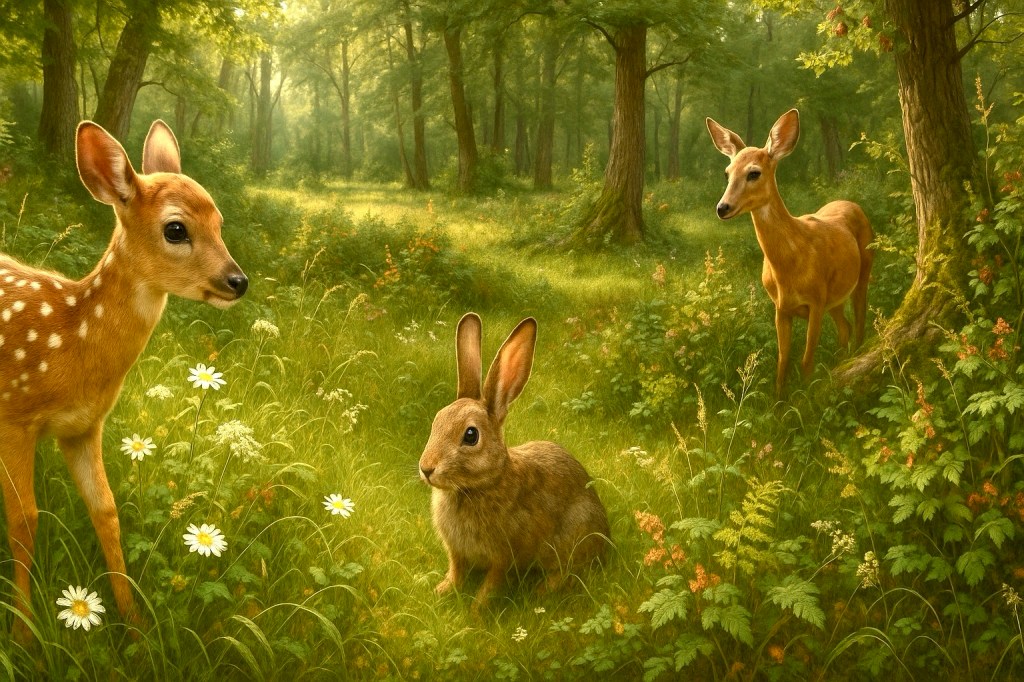
When one hears the name Bambi, images of an idyllic forest, charming woodland creatures, and heartwarming friendships typically spring to mind. However, a deeper dive into this classic tale reveals layers of complexity and dark humour that would make even the most ardent reader of Kafka nod in approval. Here, I offer a tongue-in-cheek analysis of Bambi, where nature’s brutal truths are juxtaposed with the naïveté of our titular buck.
At first glance, Bambi appears to be a simple story of a young deer navigating the trials and tribulations of forest life. Yet, when scrutinised through a more cynical lens, Bambi’s journey is less about pastoral splendour and more about the comedic missteps that make up the natural world. Consider the episode of Bambi learning to walk: a series of stumbles and falls that, if set to the right soundtrack, could rival any slapstick comedy. The animals in the forest, far from being his gentle mentors, often serve as unintentional jesters, highlighting the absurdity of nature’s pecking order.
Bambi himself is akin to the Forrest Gump of the animal kingdom. He wanders through life with a wide-eyed innocence, stumbling into significant events rather than orchestrating them. His encounters with fellow forest inhabitants often border on the absurd. Thumper, the rabbit, serves as a sort of hapless life coach, doling out advice that is equal parts endearing and unhelpful. One might argue that Thumper’s insistence on teaching Bambi to say “bird” is less an educational endeavour and more a misguided attempt at social engineering.
The pivotal moment in Bambi – the tragic demise of his mother – is often viewed through a lens of sorrow and loss. However, a more sardonic perspective might consider it an ironic commentary on nature’s brutal efficiency. In the wild, survival is a cutthroat affair, and Bambi’s mother’s fate is a stark, albeit darkly humorous, reminder of this fact. Her death serves as a morbid punchline to the joke that is Bambi’s early life – just when he starts to get the hang of things, nature pulls the rug out from under him.
Bambi’s foray into romance is yet another chapter in the book of nature’s cruel humour. His courtship of Faline is less a grand love story and more a farcical series of misunderstandings and near-misses. The forest’s version of romantic rivalry, with suitors clashing antlers in awkward battles, mirrors human romantic comedies where the protagonist bumbles his way through awkward dates and miscommunications. Bambi’s eventual triumph in love feels less like a victory of the heart and more like an accidental success.
Ultimately, Bambi concludes not with a triumphant note of harmony but with an acknowledgment of the cyclical, and often laughably futile, nature of life. Bambi assumes his father’s role as the Great Prince of the Forest, a title that sounds grander than the reality it represents. His promotion is less about merit and more about the inevitable passing of time, underscoring the absurdity of hierarchical structures in nature.
Bambi is a tale that, when viewed with a humorous and critical eye, transforms from a simple story of a deer into a rich tapestry of nature’s follies. It is a reminder that life’s journey, whether in the forest or beyond, is often a series of comedic blunders, ironic twists, and laughable misunderstandings. Bambi’s adventures, replete with their unintended humour, serve as a charming yet incisive commentary on the absurdity of existence in the natural world. So the next time you pick up Bambi, remember to look beyond the surface and appreciate the wit and humour nestled within its thickets.

 Wording