Lately, I find myself immersed in a sea of existentialist musings, possibly reflecting my own melancholic state of mind and sombre outlook on life. And the work I’m about to detail is hard to pin down to exactly which literary genre this introspective fluff belongs to – Existentialist? Modernist? Philosophical Fiction? Psychological Fiction? Perhaps it straddles all these categories at once, embodying the essence of each. Either way, this one was a struggle to get through, like wading through sticky porridge.
The Inferno by Henri Barbusse, originally titled L’Enfer in French, is a novel first published in 1908. The book explores themes of existential angst, human suffering, and the search for meaning within the confines of a claustrophobic setting.
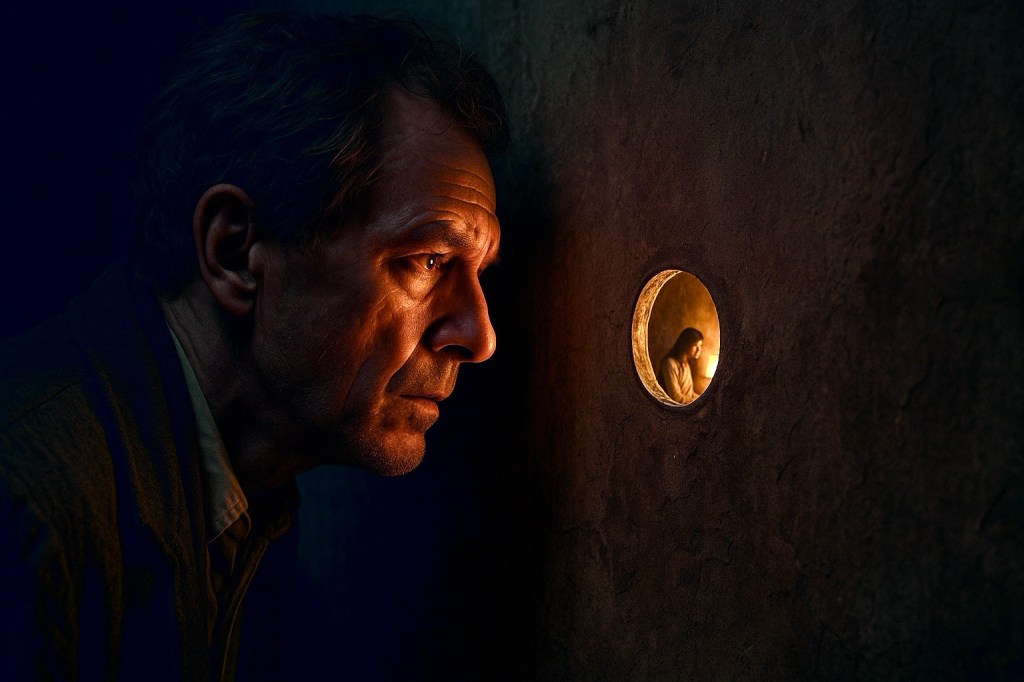
A little slice of existential despair served with a side of voyeurism. Here, Barbusse invites us to join his unnamed narrator in a Parisian boarding house where the wallpaper is drab, the tenants are drabber, and a convenient peephole provides endless entertainment – assuming your idea of entertainment includes profound human suffering and existential dread.
Our story begins with a man who, instead of opting for a healthy hobby like bird watching or stamp collecting, decides to spend his time spying on his neighbours. Through a hole in the wall, he witnesses a veritable buffet of human misery. From the mundane to the tragic, every scene is a poignant reminder of life’s cruelty and the questionable hygiene of Parisian lodgers. Think of it as reality TV, circa 1908, minus the dubious charm of modern editing.
Barbusse’s narrator is the ultimate antihero of existential literature. He doesn’t slay dragons or solve crimes; he sits, watches, and muses. As he peers through the peephole, he contemplates the meaning of life, only to conclude that it is, in fact, quite meaningless. In a time when people were busy inventing jazz and cars, our narrator chose the high road of staring into the abyss – and finding that the abyss has poor dental hygiene.
Isolation is a central theme, and no one does isolation quite like Barbusse’s narrator. He’s surrounded by people yet profoundly alone, an impressive feat that many introverts can only aspire to. Despite being in a bustling boarding house, he experiences a level of detachment that would make even the most ardent hermit proud. It’s a powerful reminder that true loneliness isn’t about physical solitude but about finding life so unappealing that even eavesdropping feels like a drag.
The ethical conundrums of voyeurism are hard to miss. Is it wrong to watch your neighbours through a hole in the wall? Barbusse’s narrator would argue that it’s simply a way to pass the time when you’ve exhausted all other forms of self-torment. In today’s world, he’d probably be an avid social media stalker, marvelling at the banalities of others’ lives while ignoring the growing pile of laundry in his own room.
Barbusse’s portrayal of the human condition is as bleak as a rainy Monday morning. Through the peephole, we see love, death, betrayal, and boredom – sometimes all in the same scene. It’s a veritable soap opera of despair, and Barbusse doesn’t shy away from the harsh realities of life. If you’ve ever felt that existence is an unending series of disappointments, The Inferno will feel like a warm, albeit slightly depressing, hug.
Barbusse’s writing style is a curious blend of lyrical beauty and brutal honesty. He describes the grimy details of boarding house life with the same eloquence one might reserve for a love sonnet. The juxtaposition of poetic language with grim content creates an atmosphere that is both haunting and, if you’re in the right mood, darkly humorous. It’s as if Barbusse is saying, “Life is terrible, but let’s at least enjoy the prose.”
When The Inferno was first published, it was a bit like dropping a philosophical stink bomb into the literary world. Some critics praised its daring themes and innovative style, while others were less impressed, possibly longing for the days when novels were more about dashing heroes and less about soul-crushing ennui. Regardless, its influence on modernist literature is undeniable. It paved the way for future generations of writers to explore the darker, dustier corners of the human psyche.
In summary, Henri Barbusse’s The Inferno is a masterclass in turning the mundane into the profoundly depressing. It’s a novel that asks big questions, like “What is the meaning of life?” and “Why can’t I stop watching these people suffer?” Barbusse’s work remains a timeless reminder that sometimes, the best way to understand life is to watch it through a tiny hole in the wall and conclude that it’s all quite hopeless – but beautifully written. So, next time you find yourself bored and introspective, remember: there’s always the messy, wonderful tragedy of being human.

 Wording