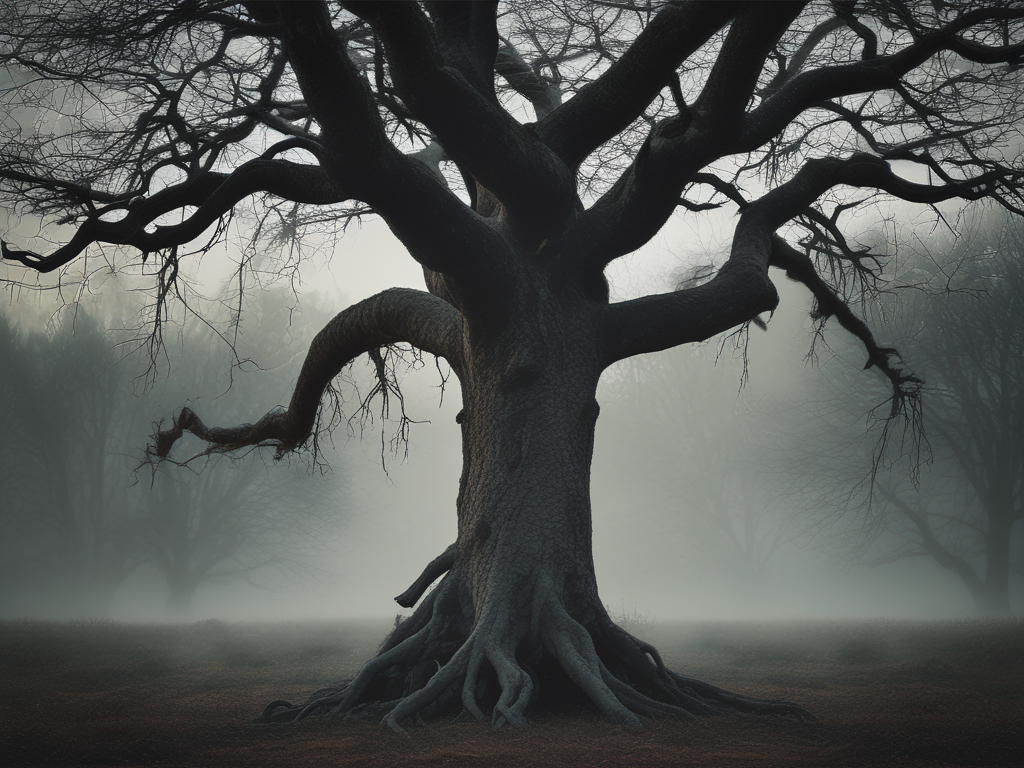
I have an enduring love for the countryside, especially those areas filled with ancient, brooding trees that seem to harbour their own secrets. One such tree caught my eye in the charming town of Cockermouth, Cumbria (UK). Its gnarled bark and twisted branches bore an uncanny resemblance to the features of an old witch, a sight both eerie and fascinating.
This experience can be attributed to a psychological phenomenon known as pareidolia, where people perceive familiar patterns, such as faces, in inanimate objects like clouds or trees. Our brains are hardwired to recognise these patterns, especially faces, as a crucial aspect of social interaction and survival. This is particularly relevant to my life, where navigating countless social interactions over the years often felt like a matter of survival.
But enough of my musings. The countryside’s enigmatic beauty and its ancient, watchful trees continue to captivate my imagination. So…
If you ever find yourself in the English countryside, beware of charming cottages with lush gardens and, most importantly, ash trees. M.R. James’ The Ash Tree teaches us that these seemingly innocuous plants might harbour more than just birds and squirrels. Let’s embark on a dissection of this classic ghost story, examining its botanical horrors and how James manages to turn the English countryside into a setting for shrieking terror.
A tree with a taste for drama:The Ash Tree revolves around the unfortunate Sir Richard Fell, who inherits a manor with an imposing ash tree looming nearby. This tree, unlike any ordinary tree, has a flair for the dramatic. Not content with merely swaying in the breeze, it harbours a sinister secret. You see, this ash tree isn’t just part of the garden decor – it’s the arboreal Airbnb for a host of vengeful supernatural entities.
James crafts the tree as a character in its own right, with more personality than some of the human characters. It creaks, it groans, and it drops ominous hints like a botanical Cassandra. One can’t help but wonder if the ash tree attended a school of dramatic arts. Its penchant for the theatrical would surely earn it a leading role in any horror movie today.
The story, with witchcraft and arboreal antics, reveals that the ash tree’s sinister nature stems from the hanging of a witch, Mrs. Mothersole, who curses the land and the tree with her dying breath. In true horror fashion, this curse doesn’t merely cause bad crops or ghostly apparitions – it summons a legion of spider-like creatures that call the tree their home. These aren’t your run-of-the-mill Halloween decorations; they’re arachnids on steroids, ready to scare the socks off any unsuspecting nobleman.
Mrs. Mothersole’s curse is a masterstroke of efficiency. Rather than haunting the manor herself, she delegates the task to her eight-legged minions. This outsourcing of vengeance is both practical and eco-friendly, utilising the local flora and fauna to execute her posthumous grudge. One can only imagine her satisfaction, chuckling from the afterlife as her arachnid associates unleash havoc.
The unwitting horticulturist, Sir Richard Fell, the story’s protagonist, is the quintessential unsuspecting heir in a horror tale. He inherits the manor and the ominous ash tree, blissfully unaware that he’s about to star in his own episode of When Trees Attack. His ignorance is almost endearing. When strange noises and sightings occur, he chalks them up to everything except the glaringly obvious supernatural threat.
Sir Richard’s journey from skepticism to sheer terror is both predictable and entertaining. His logical explanations and dismissals add a touch of humour, as the audience is always one step ahead, waiting for the moment when reality – and a horde of spiders – finally catches up with him. His slow realisation is a comedic buildup, akin to watching someone slowly realise they’ve been walking around with toilet paper stuck to their shoe.
The climax of The Ash Tree is a delightful mix of horror and absurdity. As the supernatural spiders make their grand entrance, the manor becomes a scene of chaotic terror. These spiders aren’t just lurking; they’re on a mission, and it’s a testament to James’ creativity that he turns arachnophobia into an art form.
Picture Sir Richard, finally putting two and two together, as he desperately tries to escape the wrath of the spiders. It’s a scene that would make any arachnophobe squirm and any lover of dark comedy chuckle. James masterfully balances the horror with just enough ridiculousness to keep the audience both horrified and amused.
The Ash Tree is a timeless tale that combines the mundane with the macabre, turning an innocent piece of countryside into a breeding ground for terror. With its dramatic tree, vengeful witch, and hapless protagonist, the story remains a delightful read for those who appreciate the finer points of horror with a humorous twist. Next time you find yourself near an ash tree, remember Sir Richard Fell’s lesson: sometimes, it’s not just the bark you need to worry about, but the bite as well.

 Wording