In the annals of British history, the year 1678 stands out as a time of unparalleled paranoia, where the English public was whipped into a frenzy over a fantastical and entirely fabricated threat: the Popish Plot. This elaborate tale, crafted by the masterful fabricator Titus Oates, involved a fictitious Catholic conspiracy to assassinate King Charles II and install his Catholic brother, James, Duke of York, on the throne. What follows is a detailed, examination of this bizarre episode, replete with intrigue, absurdity, and the all-too-human penchant for believing the unbelievable.
At the heart of the Popish Plot was Titus Oates, the architect of anarchy, and a man whose dubious honour lay in being one of history’s most inventive liars. Oates was a figure of contradictions: a man expelled from multiple educational institutions yet blessed with a vivid, if twisted, imagination. Like a Shakespearean villain, Oates spun a web of deceit so intricate that it ensnared the highest echelons of English society. One can almost picture him, cackling in glee, as he concocted stories of Jesuit assassins and Catholic infiltrators.
Oates claimed to have uncovered a grand Catholic scheme to murder King Charles II, leading to widespread panic. The sheer audacity of his fabrications is worthy of admiration. It’s almost as if Oates, upon being rebuffed by society for his lack of integrity, decided to exact revenge by seeing just how much nonsense people would believe. Spoiler alert: a lot.
Enter the hapless believers. The real humour in the Popish Plot lies not in Oates’ creation but in the reactions of the English public and government. It was a time when rationality took a backseat, and hysteria became the driving force. Imagine, if you will, an entire nation suddenly convinced that Catholic spies lurked around every corner, plotting regicide. The ensuing panic was nothing short of farcical.
Politicians, ever eager to capitalise on public fear, took Oates’ tales at face value. Parliament launched investigations, and innocent Catholics found themselves ensnared in a web of baseless accusations. Trials were held, often with little to no evidence, resulting in executions that can only be described as tragicomic. It’s as if the collective intelligence of the nation had taken a holiday, leaving behind a populace willing to believe that Jesuit priests were practicing their marksmanship on the palace grounds.
The Popish Plot set off a chain reaction of chaos, a domino effect of widespread chaos. Once Oates’ accusations gained traction, other opportunistic individuals joined the fray, adding their own embellishments to the already ludicrous narrative. A fellow named William Bedloe, not wanting to be outdone, concocted even more outlandish stories, and soon the realm was awash with tales of papal invasions and covert armies.
This wave of hysteria reached its peak with the execution of numerous innocent Catholics, including the respected Archbishop Oliver Plunkett. The irony of the situation was palpable: a nation known for its legal advancements and sense of justice was executing people based on the uncorroborated claims of a known liar. It was a dark comedy of errors, with lives lost to the absurdity of mass delusion – somewhat like the delusion of witches running rampant during James I reign and beyond.
As with all good farces, reality bites back – the inevitable denouement – the Popish Plot eventually unravelled. Oates’ inconsistencies became glaringly obvious, and his credibility plummeted faster than the stock prices of a defunct tulip company (more on tulips another time). By the time King Charles II personally interrogated Oates, the fabricator’s tale had more holes than a wheel of Swiss cheese. Yet, despite his exposure, Oates managed to evade the gallows, a testament to his slippery nature and the prevailing confusion.
The aftermath of the Popish Plot serves as a sobering reminder of the perils of mass hysteria and the gullibility of the human psyche. It is a story that underscores the importance of skepticism and the dangers of allowing fear to override reason. The tale of Titus Oates and his grand fabrication remains a cautionary, if darkly humorous, chapter in the history of human folly – yet we carry on with these mass delusions; there are a few currently.
The 1678 Popish Plot stands as a monument to the absurdity of human nature, where a nation’s fears were stoked by the vivid imaginings of a single, unscrupulous man. Titus Oates’ legacy is one of chaos, a reminder that sometimes the greatest threats to society are not from without but from within our own minds. As we reflect on this episode, let us do so with a smile, recognising the farcical elements of a time when England danced to the tune of a master storyteller’s deceit, and perhaps take solace in the hope that we might be wiser today – oh, too late. We’re no wiser at all. Are we?
Well, who was Oates? Well, I’ve done a little digging and it’s my yawning pleasure to furnish you with the following sketchy biography.
Titus Oates was an English perjurer and fabricator of the infamous Popish Plot, a fictitious Catholic conspiracy to assassinate King Charles II and overthrow the Protestant establishment. Born in 1649, Oates was a man of dubious character and a penchant for deceit. His early life was marked by a series of failures and scandals; he was expelled from various educational institutions, including the University of Cambridge, for misconduct and lying. He also had brief and turbulent stints in the Church of England, where you’ll find many other dubious characters, and the Navy.
In 1678, Oates found his dubious claim to fame by concocting a detailed and elaborate story of a Catholic plot against the king. He alleged that Jesuits and other Catholic factions were planning to murder Charles II and replace him with his Catholic brother, James, Duke of York. Oates’ allegations were supported by forged documents and false testimonies, which he presented with dramatic flair.
Oates’ fabrications were initially taken seriously, leading to widespread panic and the persecution of many innocent Catholics. Several people were executed, and the nation was plunged into a state of anti-Catholic hysteria. However, as inconsistencies in Oates’ story began to surface, his credibility waned. By the early 1680s, his fabrications were largely discredited.
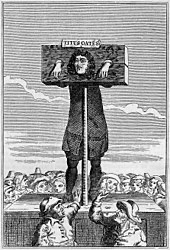
Despite causing immense harm and chaos, Oates avoided severe punishment for his lies. He was eventually imprisoned and pilloried but lived long enough to witness a reversal of his fortunes with the Glorious Revolution of 1688, which saw the Protestant William of Orange take the throne. Oates died in relative obscurity in 1705, remembered primarily as a masterful liar and the architect of one of England’s most notorious episodes of mass paranoia.

 Wording