What’s this? Another fable? Yes. Well, I’m working my way through them.
Some time ago, I found myself in the unenviable position of evicting an unwelcome tenant – or perhaps tenants – from our garage. A mouse, or maybe several, had taken up residence among the clutter. Rather than resorting to the traditional, lethal mousetraps, I opted for a more compassionate approach and invested in humane traps.
In due course, two of these crafty little interlopers were apprehended. I transported them far from our home, to the tranquil riverside. There, amidst the rustling leaves and the gentle flow of the water, I set the mischievous critters free, waving them off with my best wishes for their future adventures.
Aesop’s fable The Mouse and the Mousetrap provides an amusing yet profound commentary on the social dynamics of barnyard communities. At first glance, it may seem like a simple tale of a mouse’s misfortune, but a deeper analysis reveals layers of wisdom, humour, and barnyard bureaucracy that mirror our own human experiences.
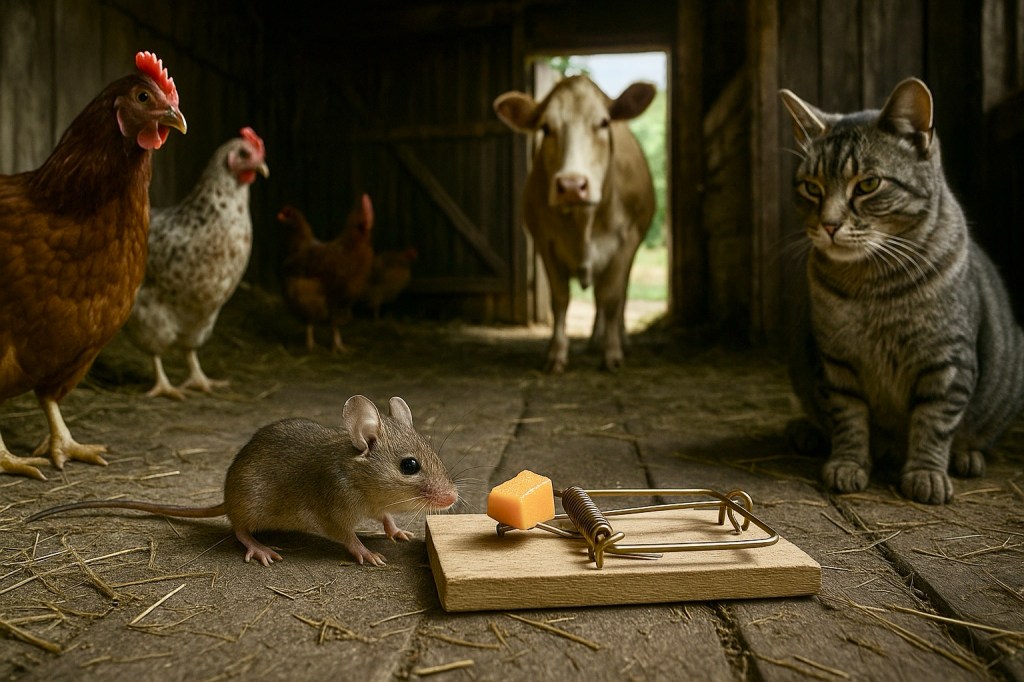
Our story begins in a pastoral utopia – an idyllic farm where the livestock live in a seemingly harmonious commune. The protagonist, a mouse of modest means and considerable paranoia, discovers a mousetrap. This mouse, whom we shall call Maurice for the sake of alliteration and amusement, becomes the herald of impending doom. With the zeal of a medieval town crier, Maurice scurries from barn to pasture, warning his fellow residents of the malevolent contraption that threatens his very existence.
First on Maurice’s tour of terror is Betsy the Cow – bovine nonchalance . Betsy, chewing her cud with the slow deliberation of a philosopher mulling over the meaning of life, listens to Maurice’s tale. Her response is an epitome of bovine apathy: “A mousetrap? That’s a problem for you, dear Maurice, not for me. I am too big to be concerned with such trivialities.” Betsy’s dismissive attitude is a humorous nod to the classic “not my problem” mindset that pervades many a corporate meeting room.
Next, Maurice approaches Henrietta the Hen – Gallus gallus domesticus indifference. Busy with her endless quest for the perfect worm, Henrietta barely glances up. “Maurice, I sympathise, but a mousetrap is not a hen trap. You must deal with your problems yourself.” Henrietta’s clucking indifference reflects the self-absorption often seen in those whose comfort blinds them to the perils faced by their neighbours.
Determined, Maurice then consults Percy the Pig, who, wallowing in mud, grunts, “A mousetrap is tragic, Maurice, but not a swine concern.” Percy’s begrudging sympathy is overshadowed by his unwillingness to engage in proactive measures. It’s the kind of response one might get from a colleague who offers thoughts and prayers instead of practical help.
Lastly, Maurice seeks out Doris the Sheep, who, while slightly more empathetic, is ultimately noncommittal. “Oh dear, a mousetrap sounds awful, Maurice. But what can a sheep do? I’ll keep you in my thoughts.” Doris’s woolly-headed response highlights the herd mentality that avoids action even in the face of evident danger.
As in all great tales of woe and folly, the climax is both inevitable and ironic. The mousetrap, set by the farmer to catch our hero, snaps shut – not on Maurice, but on the farmer’s wife who, in her attempt to inspect it, triggers a series of unfortunate events. The barnyard is thrown into chaos, as the once indifferent animals now face the repercussions of their inaction. Betsy’s milk spills, Henrietta’s eggs are scrambled, Percy’s pen is upended, and Doris’s wool is thoroughly dishevelled.
The moral of the story is clear: the peril of one is the concern of all. Aesop, with his trademark wit, reminds us that in our interconnected world, the problems of the smallest among us can ripple outward, affecting everyone. Maurice’s plight and the subsequent barnyard bedlam serve as a comedic yet poignant lesson on empathy, collective responsibility, and the folly of dismissive attitudes.
The Mouse and the Mousetrap is not just a fable but a satirical commentary on society’s tendency to ignore the troubles of others until those troubles become unavoidable. Through the lens of barnyard buffoonery, Aesop delivers a timeless reminder that true community means caring for each member, no matter how small or seemingly insignificant. So, next time you hear a mouse’s cry of distress, take heed – lest you find yourself ensnared in the mousetrap of your own making.

 Wording