Yesterday, I accompanied my dad to a hospital appointment. As we approached the main entrance, the vibrant display of a fruit and vegetable stall caught our eyes, its bounty of fresh produce enticing almost everyone. This stall, a regular fixture, offers an array of delectable wares that never fail to attract attention.
On previous visits, driven by a spontaneous urge, I cheekily asked to sample one of their cherries. To my surprise, I found myself utterly captivated by their luscious flavour. These cherries were simply irresistible! It’s curious, really – my estranged wife used to relish the occasional cherry, while I could never quite tolerate them. Now, I find myself baffled by my former aversion.
In the tale that follows, I am certain I would need rescuing from the fruity temptation that ensnared one of the characters. Enjoy this short – but sweet – journey!
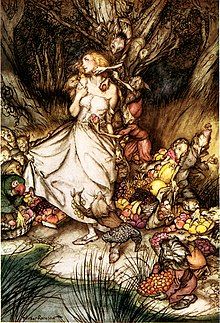
Christina Rossetti’s Goblin Market is an ostensibly simple poem about two sisters and their encounters with goblin merchants. However, beneath the surface lies a cornucopia of tantalising themes and allegories ripe for the picking. Let’s dissect this Victorian fruit salad, exploring its juicy components with a blend.
The goblin merchants – fruit peddlers of capitalist fiends? – in Rossetti’s poem are an eclectic bunch, hawking their fruits with the zeal of modern-day street vendors. They peddle an assortment of fruits that would make any organic market blush with envy. But are these goblins merely humble fruit sellers, or are they early prototypes of capitalist manipulators? Their aggressive marketing tactics – “Come buy, come buy” – resemble the relentless pop-ups on a shady website. Like those dubious adverts promising quick riches, the goblins’ fruits promise instant pleasure but come with hidden costs.
Lizzie and Laura are the poem’s protagonists, the original influencers, and their contrasting responses to the goblins’ wares make for a compelling narrative. Laura, the more impressionable sister, succumbs to the goblins’ enticing cries. Her experience with the goblin fruit is akin to a teenager binge-watching shopping channels at 3 a.m., eventually succumbing to the allure of a miracle product. Lizzie, on the other hand, is the Victorian era’s version of a skeptical Amazon reviewer, refusing to be swayed by the goblins’ flashy promises. Her resilience and eventual triumph could be seen as a metaphor for the power of a one-star review in a sea of five-star fakes.
The fruits, symbolic delicacies, in Goblin Market are not just any fruits; they are the artisanal, hand-picked, non-GMO symbols of temptation and desire. Each fruit, with its exotic name and luscious description, serves as a metaphor for forbidden pleasures. The goblins’ fruit basket includes items that would make even the most exotic produce section seem bland by comparison. Yet, just like that suspiciously perfect avocado that turns to mush in a day, the goblin fruits’ initial allure masks a rotten core.
Goblin Market can be read as a Victorian public service announcement, warning young women against the perils of succumbing to temptation. The goblins’ fruits could be seen as Victorian equivalents of today’s dangers – be it dubious diet pills or questionable Instagram influencers. Laura’s subsequent decline after consuming the fruit serves as a cautionary tale, much like those overly dramatic ‘after-school specials’ warning kids about the dangers of drugs and alcohol.
Lizzie’s role in the poem is a testament to the resilience and strength of women. Her defiance in the face of the goblins’ assault is nothing short of heroic. When Lizzie confronts the goblins to save her sister, she endures their abuse with a stoicism that could rival that of any action movie hero. Her subsequent rescue of Laura by enduring the goblins’ torments to bring back the antidote-laden fruit juice is a powerful statement on sisterhood and solidarity. It’s as if Lizzie channelled her inner superhero to deliver a swift kick to the metaphorical groin of patriarchal oppression. I’m not a feminist by any stretch, but using the language that is used in today’s world, I guess this is how Lizzie would be portrayed – though not so explicitly back in Victorian times.
The poem concludes with a picture of Victorian domestic bliss, where Laura and Lizzie, now grown, recount their tale to their children. It’s the poetic equivalent of a “happily ever after” with a side of moral instruction. This ending reinforces the poem’s status as a Victorian morality tale, complete with a neatly wrapped moral lesson suitable for all ages.
A tasty tale with lasting flavours, Goblin Market is a multifaceted work that blends rich symbolism with a compelling narrative. Rossetti’s poem is like a complex fruit tart, offering layers of sweetness, tartness, and the occasional bitter note. It serves as a delicious allegory on temptation, resilience, and sisterhood, wrapped in a Victorian veneer. So, the next time you encounter an overly eager salesperson or a suspiciously perfect piece of fruit, remember Lizzie and Laura’s tale, and proceed with caution – lest you fall into the goblins’ trap.

 Wording