Melmoth the Wanderer, the literary equivalent of a gothic cathedral designed by an architect who kept losing his blueprints and decided to wing it instead. Charles Maturin’s 1820 novel is a bewildering masterpiece, a labyrinthine fever dream that feels like it was concocted during an especially eccentric séance. Strap in for a rollercoaster ride through this bizarre, atmospheric, and occasionally bewildering tome.
If you ever wanted to read a book that makes you feel like you’re perpetually one chapter behind understanding what’s going on, Melmoth the Wanderer is your new best friend. The plot can be summarised as ‘Melmoth wanders,’ but that would be doing a disservice to Maturin’s gleeful abandon of linear storytelling. The novel leaps between multiple narratives, often without warning, leaving readers to piece together the plot like a literary jigsaw puzzle with half the pieces missing and a few extras from another puzzle thrown in for good measure.
Melmoth, the eponymous wanderer, is a man who sold his soul for an extended lifespan, only to spend centuries regretting his decision and attempting to offload his cursed immortality onto others. Think of him as the goth cousin of the Flying Dutchman, forever doomed to wander, but with more melodrama and fewer sea shanties.
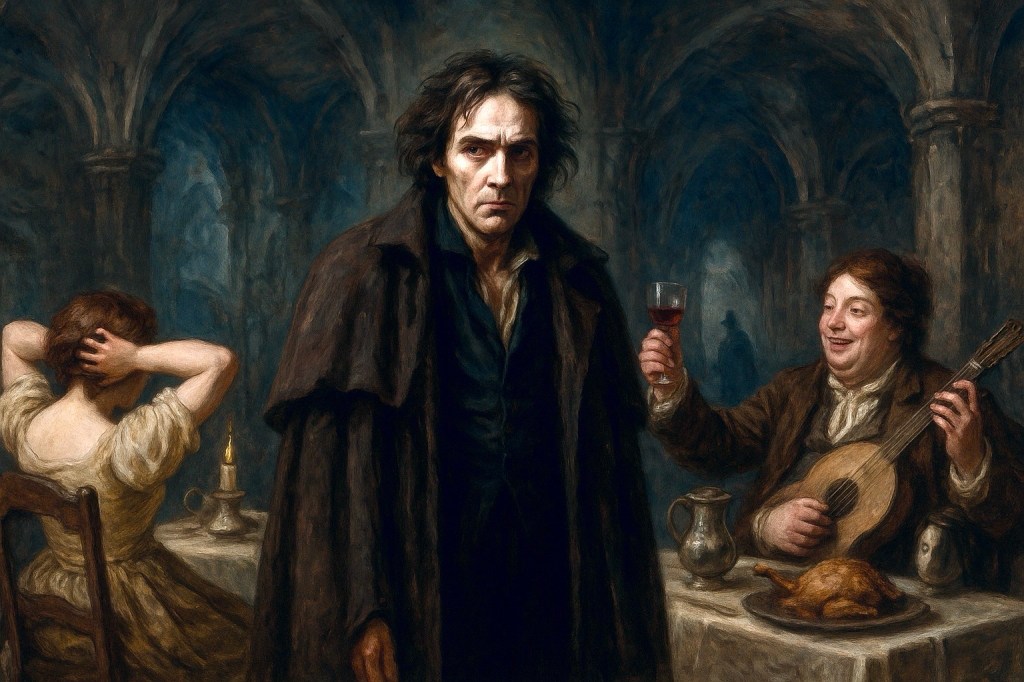
Maturin’s characters are a parade of peculiar personages, and a delightful menagerie of the macabre and the melodramatic. There’s Melmoth himself, the ultimate moody anti-hero, who could give Heathcliff a run for his money in the brooding stakes. His relentless pursuit of someone willing to take on his curse is both tragic and absurd, like a door-to-door salesman who simply won’t take “no” for an answer, but with existential despair instead of vacuum cleaners.
Then there’s Stanton, whose descent into madness is as swift as it is perplexing. His story is a swirling vortex of insanity that makes you wonder if Maturin was just seeing how many gothic clichés he could cram into one subplot. Add to this mix the unfortunate Monçada, the despairing Immalee, and a host of other characters who pop in and out of the narrative with the predictability of a haunted house’s jump scares.
Amidst the chaos, Maturin does grapple with some weighty themes. The novel is a meditation on the nature of evil, the burden of immortality, and the human condition’s intrinsic suffering. It’s also a treatise on the dangers of making Faustian bargains, which boils down to: if a creepy stranger offers you eternal life, maybe don’t take it.
However, these themes often play second fiddle to the novel’s primary focus: scaring the life out of readers. Maturin throws in every gothic element he can think of – storms, dungeons, mad monks, ghostly apparitions – creating a dense fog of atmosphere that can be both intoxicating and impenetrable.
Maturin writes with all the subtlety of a sledgehammer, with grandiose gothic gyrations. His prose is florid and overwrought, laden with so many adjectives and exclamations that it feels like he’s trying to win a bet on who can use the most purple prose in a single paragraph. This isn’t a bad thing, necessarily; part of the novel’s charm is its unrestrained excess. Reading Melmoth the Wanderer is like eating a ten-layer chocolate cake topped with whipped cream, cherries, and a gallon of syrup. It’s delicious in small doses, but a bit much if consumed all at once.
Despite (or perhaps because of) its convoluted plot, excessive characters, and baroque prose, Melmoth the Wanderer remains a seminal work in gothic literature. It’s a book that should come with a health warning for its potential to induce narrative whiplash, yet it’s precisely this quality that makes it so fascinating. You really should subject yourself to this madness.
In the end, Melmoth the Wanderer is an acquired taste, like stinky cheese or avant-garde jazz. You might find it baffling, overwhelming, and slightly nauseating, but once you get into the groove, it’s hard not to admire Maturin’s audacity. If nothing else, reading it will give you a new appreciation for the more straightforward horror stories on your bookshelf.

 Wording