Another of Aesop’s fables, beloved for their brevity and moral clarity, have taught children and adults alike the consequences of greed, laziness, and other human vices. One such tale, The Goose that Laid the Golden Eggs, stands out as a particularly feather-brained example of avarice leading to ruin. Let’s ruffle some feathers as we delve into the nuances of this classic story, exploring its characters, moral implications, and the hilarious folly of its protagonists.
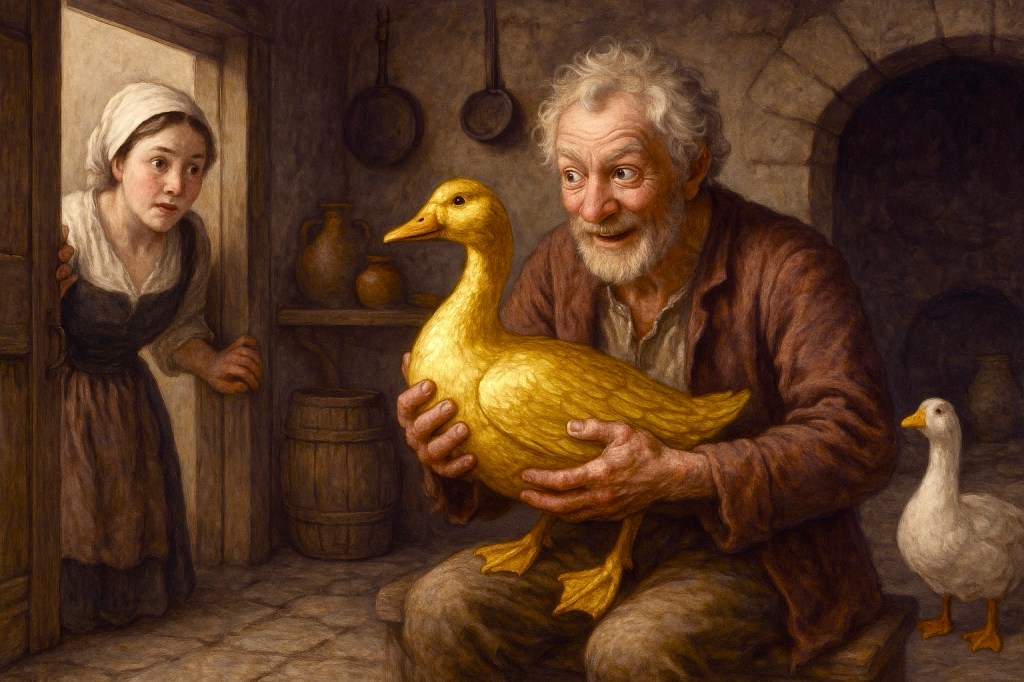
The fable introduces us to a farmer who discovers that his goose lays one golden egg each day. Rather than basking in the gradual accumulation of wealth, the farmer’s impatience gets the better of him. Driven by greed and a spectacular lack of foresight, he decides to kill the goose, hoping to extract all the golden eggs at once. To his dismay, he finds no treasure inside, and he’s left with nothing but a dead goose and a bitter lesson on the perils of impatience.
The real star of this tale, the goose, is a veritable marvel of avian biology. One has to wonder about the internal processes that allow this humble bird to produce golden eggs, a feat that defies all known laws of nature. Yet, for all its miraculous abilities, the goose is sadly a poor judge of character, naively continuing to lay its precious eggs for an owner who ultimately betrays it.
The farmer, a quintessential example of human folly, he embodies the worst traits of greed and shortsightedness. His decision to kill the goose is akin to burning down your house because you’re cold and need a fire. The farmer’s actions beg the question: did he even consider the logistics? Golden eggs aren’t known for their pliability; extracting them from a goose isn’t like shaking coins out of a piggy bank. One can almost picture the farmer, knife in hand, realising too late that he’s made a colossal blunder, standing over the carcass of his once-prosperous goose with all the regret of a child who traded their lunch for a handful of magic beans.
The moral of the story is clear: greed and impatience can lead to one’s downfall. But let’s not gloss over the sheer absurdity of the farmer’s logic. It’s as if he thought his goose was an avian version of Fort Knox, complete with an endless supply of golden eggs stashed inside. This fable serves as a timeless reminder that sometimes, the slow and steady accumulation of wealth is far superior to rash actions driven by greed.
From an economic standpoint, the farmer’s actions are a textbook case of poor asset management. The goose was a renewable resource, generating a steady stream of income (or golden eggs). Killing the goose for immediate gratification is the equivalent of liquidating a profitable stock for a short-term gain, ignoring the long-term benefits of compound interest. This fable could easily be retitled The Idiot’s Guide to Squandering Wealth.
Imagine being the goose in this story. One day you’re a prized asset, the next, you’re on the chopping block. If the goose had any sentient awareness, it would likely have packed up its golden eggs and flown south for the winter, far away from the farmer’s greed-driven insanity.
Word must have spread quickly through the local village about the farmer’s colossal mistake. It’s easy to picture the farmer at the local tavern, attempting to explain his actions while enduring the laughter and ridicule of his peers. “You did what? You killed the goose? That’s almost as bad as that time Bob traded his cow for magic beans!”
The Goose that Laid the Golden Eggs is a brilliant fable that combines humour, economic wisdom, and a stern warning against greed. The farmer’s actions serve as a comedic yet poignant reminder that impatience and avarice can destroy even the most miraculous of opportunities. So, next time you find a goose laying golden eggs, cherish it, nurture it, and above all, resist the urge to check its insides. After all, some mysteries are best left unsolved.
Much wants all and loses all

 Wording