One novel to concentrate on, however, an interesting link to another.
The Monk and the Hangman’s Daughter, a novella co-authored by Ambrose Bierce and Adolphe Danziger de Castro, presents itself as a brooding, gothic exploration of forbidden love, morality, and tragedy. However, upon closer inspection, it reveals itself as a delightful conundrum of overwrought melodrama, improbable character decisions, and enough existential angst to fill a medieval monastery.
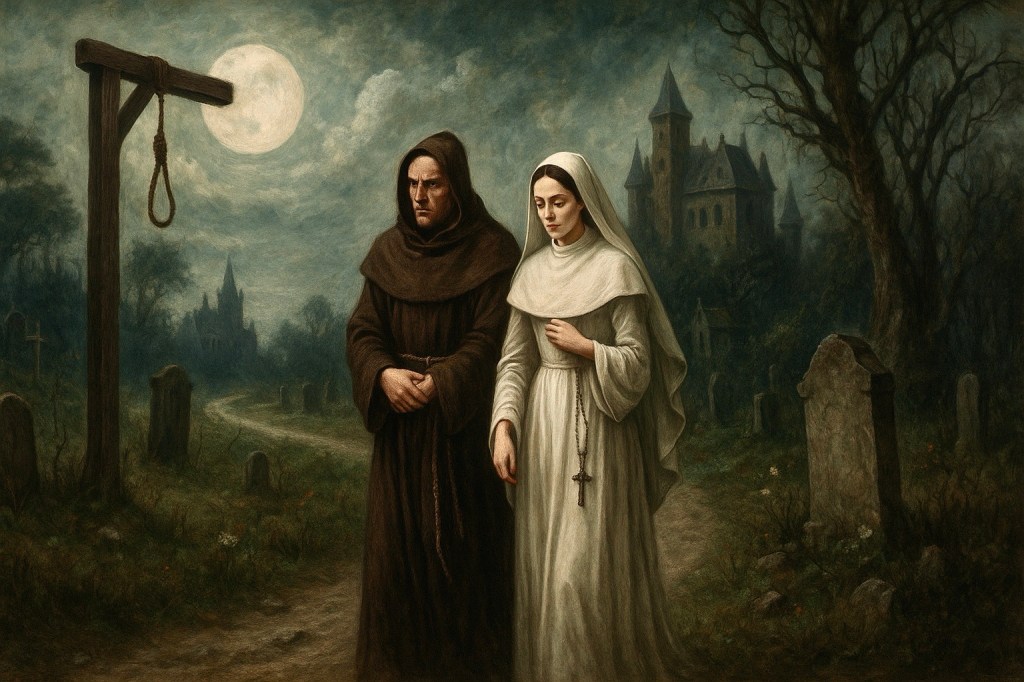
To begin with, we must examine the protagonist, Brother Ambrosius, whose name alone suggests he was destined to be a monk – or at least to spend his days contemplating whether to pronounce it with a flourish on the ‘o’ or the ‘i’. Ambrosius is portrayed as a man of deep piety and internal conflict, yet his ability to fall head-over-sandals for the eponymous hangman’s daughter, Benedicta, with the swiftness of a medieval romantic comedy, calls his dedication into question. One might argue that his character development is akin to watching paint dry – if the paint periodically engaged in impassioned soliloquies about virtue and sin.
Benedicta, the daughter in question, oscillates between being a symbol of purity and a catalyst for Ambrosius’ moral downfall. Her primary role seems to be wandering around looking forlorn and making the local population as uncomfortable as possible with her lineage, which, one imagines, she must bring up in every conversation. Her personality is as layered as a medieval tapestry – specifically one that has been left in the sun too long and faded to a monochromatic blur.
The novella’s setting is suitably grim: a Bavarian village where the sun rarely shines, the peasants perpetually scowl, and the local hangman doubles as a social pariah and the subject of endless village gossip. The atmosphere is so thick with gloom that one can almost hear the collective sigh of despair whenever a new scene begins. The monastery, which should be a place of refuge, instead becomes a hotbed of internal strife, with monks engaging in more backstabbing than a Shakespearean tragedy. One can’t help but wonder if the monks ever had time to do any actual monking, given their preoccupation with internecine power struggles and moral posturing.
The plot, such as it is, meanders through a series of increasingly implausible events. Ambrosius’ obsession with Benedicta escalates with the subtlety of a marching band in a library, culminating in a series of dramatic confrontations and moral reckonings that would make even the most seasoned soap opera writer blush. The hangman himself, a figure who should be imbued with an air of menace, instead comes across as the story’s most sensible character – if only because he seems fully aware of the absurdity surrounding him.
Stylistically, the novella is a buffet of gothic tropes and purple prose. Bierce and Danziger de Castro’s collaborative effort reads like two authors in a tug-of-war over who can outdo the other in creating the most lugubrious sentences. The prose often veers into the territory of unintentional parody, as if the authors were channeling their inner Edgar Allan Poe while simultaneously competing in a ‘who can write the most despondent description‘ contest.
The Monk and the Hangman’s Daughter is an exercise in gothic excess, a novella where the line between earnest drama and farce is as thin as a monk’s hair-shirt. Its value lies not in its literary merits but in its ability to entertain the reader with its sheer audacity and melodramatic flair. It is a work best enjoyed with a hearty sense of humour and a willingness to embrace the absurdity of a story that takes itself far more seriously than anyone else ever could.
Now then, there is an intriguing connection between Matthew Lewis’s The Monk and The Monk and the Hangman’s Daughter. Let’s delve into the timeline and potential influences.
Matthew Lewis’ The Monk, published in 1796, predates The Monk and the Hangman’s Daughter, which was published in 1892. The Monk is a seminal work in the gothic genre, known for its sensational and transgressive content. It features a character named Ambrosio, a monk who succumbs to temptation and engages in a series of morally corrupt actions, driven by his lust for a young woman, among other vices. This character’s journey is marked by intense internal conflict and a dramatic fall from grace.
In contrast, The Monk and the Hangman’s Daughter was originally written in German by Richard Voss in 1871 under the title Der Mönch von Berchtesgaden. Ambrose Bierce, with the assistance of Adolphe Danziger de Castro, adapted and translated the novella into English, adding his own stylistic flourishes and modifications. The plot, as we’ve already touched on, centres around Brother Ambrosius and his troubled relationship with Benedicta, the hangman’s daughter, emphasising themes of forbidden love, societal ostracism, and moral struggle.
Given that The Monk by Matthew Lewis came first, it is reasonable to consider the possibility of influence. The shared elements – monastic settings, the name Ambrosius/Ambrosio, and themes of forbidden desires – suggest that Bierce and Voss may have been inspired, consciously or unconsciously, by Lewis’ work. The name Ambrosius, while not uncommon, coupled with the similar thematic exploration, strengthens the case for literary borrowing or homage.
Moreover, the gothic genre thrives on certain tropes and motifs, such as the flawed clergy, the innocent maiden, and the clash between piety and passion. These recurring elements create a sense of continuity and intertextual dialogue among works within the genre.
While direct evidence of Bierce or Voss explicitly acknowledging Lewis’ influence may not be readily available, the chronological order and thematic parallels make it plausible that The Monk cast a long shadow over subsequent gothic literature, including The Monk and the Hangman’s Daughter. Thus, one can appreciate how literary ideas evolve and echo through time, enriching the gothic tradition.

 Wording
One thought on “Echoes of Forbidden Desire: A Gothic Connection”