Forgive me, but is Stella taking the pee out of the likes of Hardy here? Some say yay, and some say nay.
Stella Gibbons’ Cold Comfort Farm, published in 1932, stands as a triumphant parody that brilliantly dissects and mocks the overwrought romanticism of rural melodramas prevalent in early 20th-century literature. With a deft hand and a sharp wit, Gibbons transforms the grim and gritty landscapes of traditional agrarian novels into a playground for her satire, where her heroine, Flora Poste, brings modern sensibilities to a world sorely lacking them.
At the heart of the novel lies Flora Poste, a paragon of modernity and common sense, who finds herself thrust into the dilapidated world of the Starkadders. Gibbons crafts Flora with an almost anachronistic sharpness; she is an Austenian protagonist who has wandered into a Hardy novel. Flora’s interactions with the Starkadders are a highlight of Gibbons’ comedy, as her rationality clashes with their melodramatic gloom.
The Starkadders themselves are caricatures of rural novel archetypes. From the brooding Seth, obsessed with his own virility, to the witch-like Aunt Ada Doom, who terrorises the family with her cryptic lament, “There’s something nasty in the woodshed,” each character is a delightful exaggeration. Aunt Ada, in particular, epitomises the absurdity of clinging to past traumas as a form of power, her declaration becoming a running joke that punctuates the novel’s more ridiculous moments.
Gibbons’ parody extends beyond her characters to the very fabric of the narrative. She gleefully skewers the pastoral gloom that pervades works like those of Thomas Hardy and D.H. Lawrence. The rural setting of Cold Comfort Farm, with its dour descriptions and perpetual state of disrepair, is a deliberate overstatement, reflecting the exaggerated misery found in such novels.
Her prose, sprinkled with archaisms and faux-solemnity, lampoons the gravitas with which these stories often treat their subject matter. When Flora decides to ‘tidy up life’ at the farm, it’s as if she’s on a mission to declutter not just the physical space but the very genre itself. Her practical solutions to the Starkadders’ ludicrous problems feel like a breath of fresh air cutting through the stagnant moors of literary tradition.
Beneath its humorous exterior, and the subversive underpinnings, the novel offers a subtle critique of the genre it parodies. Gibbons challenges the notion that rural life is inherently tragic or noble. Through Flora, she suggests that many of the so-called inescapable fates of rural characters are, in fact, solvable with a bit of modern thinking and a lot of common sense. The novel implies that the romanticisation of rural suffering is both patronising and outdated.
Moreover, Gibbons plays with the idea of authorial control. By giving Flora the role of a fixer, she essentially positions her as a surrogate author, rewriting the Starkadders’ destinies and, by extension, the very narrative rules of the genre. This meta-narrative twist adds a layer of sophistication to the novel, inviting readers to question not just the story at hand but the nature of storytelling itself.
Even today, this novel remains a timeless piece of satirical literature. Gibbons’ ability to balance humour with critique ensures that the novel is not only a pleasure to read but also a thought-provoking commentary on literary conventions. Her sharp observations on human nature and societal norms transcend the specific genre she parodies, making the book relevant to any era.
Stella Gibbons’ Cold Comfort Farm is a masterful blend of comedy and critique. Through her sharp characterisation, mocking narrative style, and underlying subversion of genre tropes, Gibbons creates a work that is as intellectually stimulating as it is entertaining. It’s a delightful romp that leaves readers both laughing out loud and pondering the absurdities of literary traditions.
So, yes, Stella Gibbons is indeed making fun of authors like Thomas Hardy with Cold Comfort Farm. The novel serves as a satirical critique of the melodramatic and often overly sentimentalised depictions of rural life that were characteristic of Hardy and his contemporaries. Gibbons takes aim at the gloom and doom that permeates such works, presenting her own exaggerated version of the rural melodrama to highlight its absurdities.
Gibbons uses the novel to lampoon the exaggerated misery and intense emotional experiences that typify the novels of Hardy and others. Hardy’s works often feature tragic characters caught in the unforgiving grip of fate, suffering in a harsh rural environment. Gibbons mimics this by creating the Starkadders, a family seemingly entrenched in perpetual misery and bizarre eccentricities, but she infuses the narrative with a sense of ridiculousness that underscores the absurdity of such extreme depictions.
The characters in this work are clear parodies of those found in Hardy’s novels. Aunt Ada Doom, who insists on the vague yet ominous trauma of having seen “something nasty in the woodshed,” – as we’ve already touched on – parodies the way Hardy’s characters are often haunted by past traumas and dark secrets. Her constant repetition of this phrase, which paralyses the entire family, mocks the tendency to dwell excessively on past miseries.
Flora Poste, the protagonist, embodies a modern, pragmatic approach that contrasts sharply with the fatalistic attitudes of the Starkadders. Where Hardy’s characters often succumb to their grim destinies, Flora actively seeks to improve the lives of those around her, applying common sense and modern solutions to their problems. This clash highlights the exaggerated fatalism in rural novels and suggests that many of these issues are not as insurmountable as they are portrayed.
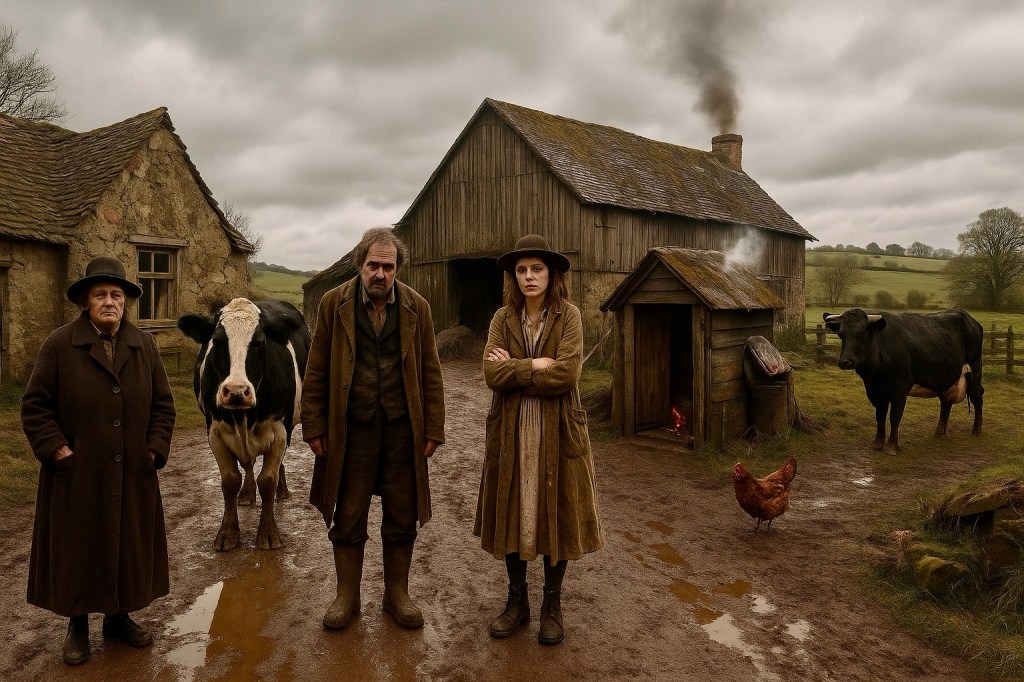
The setting of Cold Comfort Farm itself, with its dilapidated buildings and pervasive sense of decay, parodies the settings of Hardy’s rural England. Gibbons amplifies the bleakness to an absurd degree, making it clear that she finds such relentless pessimism unrealistic and overdone. The farm’s name itself is a play on this theme, suggesting a place where comfort is conspicuously absent, yet ironically highlighting the possibility of improvement.
Gibbons critiques the romanticisation of rural suffering, pointing out how authors like Hardy often idealise or overly dramatise the hardships of rural life. By bringing in Flora, who represents urban modernity and rationality, Gibbons suggests that the romantic view of rural life is outdated and in need of a pragmatic overhaul. This is a direct challenge to the idea that there is an inherent nobility in rural suffering.
In the story, Stella Gibbons skilfully uses satire to critique the overly sentimental and melodramatic portrayals of rural life found in the works of Thomas Hardy and similar authors. By creating exaggerated characters, a parodic setting, and a modern, pragmatic heroine, Gibbons exposes the absurdities of these literary conventions. Her novel not only entertains but also prompts readers to reconsider the romanticised gloom often associated with rural literature, advocating for a more balanced and realistic portrayal.
Being a big Hardy fan myself, having savoured his works to the nth degree (forgive the idiomatic expression – I do love a good idiom), I remain steadfast in my love of his works. Stella just needs to lighten up – well, if she weren’t dead that is.

 Wording