
More of Aesop. Those fables do come in handy when time and family commitments, not to mention tiredness, prevent me from reading or writing anything lengthy. Nevertheless, enjoy.
A tale as old as time, involving an overzealous cat, a community of beleaguered mice, and a peg. Let’s delve into the delightful absurdities and underlying wisdom of this narrative.
The story begins with a simple, almost pastoral image: a house over-run with mice. This house is not just any house; it is a veritable Disneyland for cats, brimming with potential for carnivorous festivities. The cat, upon hearing of this rodent utopia, is immediately seduced by the promise of an all-you-can-eat buffet. With a swift decision, she relocates, embodying the true spirit of opportunistic relocation, akin to a freelancer spotting an emerging market.
The Cat: Our protagonist is a model of feline cunning and determination. She displays an admirable work ethic, diligently hunting each mouse with the precision of a serial over-achiever. However, her gluttonous ambition is her undoing, leading to a drastic scarcity of her prey.
The Mice: Initially, the mice appear to be the helpless victims of this furry onslaught. However, they quickly exhibit a surprising level of strategic retreat, opting for a tactical withdrawal to their holes. This shows a commendable adaptability and collective wisdom, far exceeding that typically attributed to creatures often depicted as mere cheese enthusiasts.
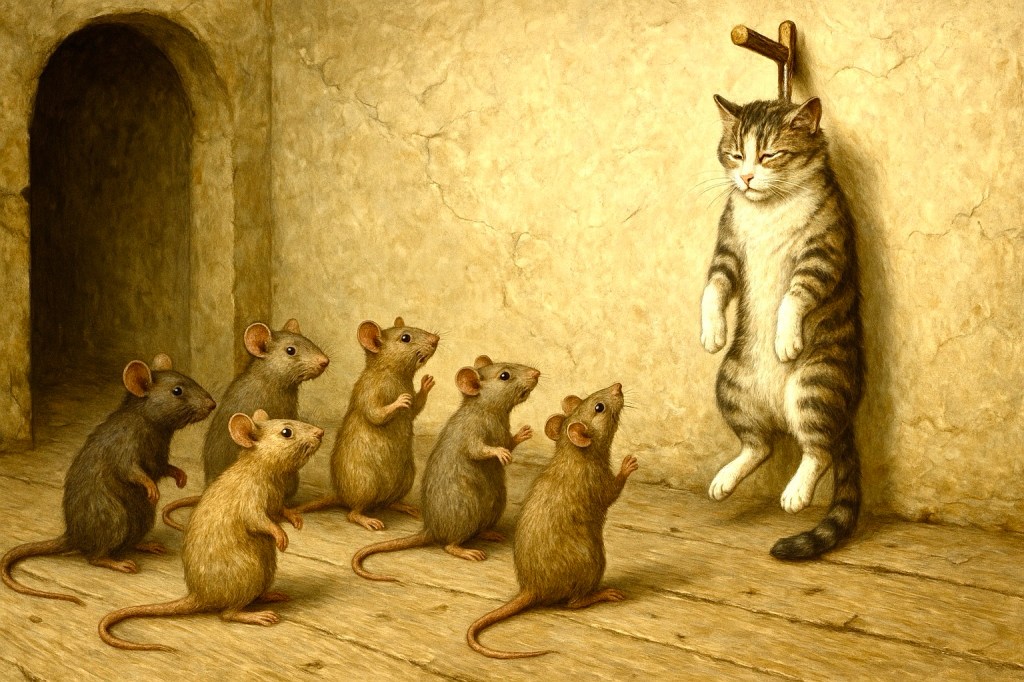
The plot takes a humorous twist when the cat, having exhausted the supply of incautious mice, concocts a scheme that would make Machiavelli proud. The image of her hanging from a peg, pretending to be dead, is simultaneously macabre and ludicrous. It’s a desperate act, revealing the extent of her fixation on her prey. The humour here is in the sheer audacity of the cat’s ploy; it’s as if she’s channeling her inner thespian, auditioning for a part in the animal kingdom’s rendition of How to Get Ahead in Advertising.*
The true climax, however, is the response of the mice. The clever mouse’s proclamation, recognising the cat’s ruse, is a masterstroke of wit and irony. It’s as if the mouse has been through a masterclass in critical thinking and stagecraft, and now stands ready to deliver a lecture on skepticism. The retort, “you may turn yourself into a bag of meal hanging there, if you like, yet you won’t catch us coming anywhere near you,” is not just a rejection of the cat’s deceit, but a triumphant declaration of intellectual superiority. It’s the rodent equivalent of a mic drop.
The moral, “If you are wise you won’t be deceived by the innocent airs of those whom you have once found to be dangerous,” is an evergreen nugget of wisdom. It’s a universal truth wrapped in the antics of our furry characters, reminding us of the perils of naivety and the importance of discernment. The cat’s feigned innocence, undermined by her previous predatory behaviour, serves as a cautionary tale about trust and vigilance.
This story is a charming blend of humour, wisdom, and animal antics. The cat’s transformation from predator to a peg-dangling performer is a delightful exaggeration, and the mice’s ultimate triumph is a celebration of collective intelligence over brute force. It’s a whimsical yet profound reminder that those who underestimate the perceptiveness of others do so at their peril. And so, we are left to ponder: in the theatre of life, it is often the smallest actors who deliver the most significant lines.
*A satirical and darkly comedic tone, dealing with absurd and morbid scenarios. In How to Get Ahead in Advertising, Richard E. Grant plays an advertising executive who develops a talking boil on his neck that eventually takes over his personality, leading to increasingly outrageous and darkly humorous situations.

 Wording