Victor Hugo’s The Last Day of a Condemned Man , 1879, is a remarkable piece of literature that, for all its gravitas and heart-wrenching subject matter, lends itself surprisingly well to a bit of humorous critique. Let’s dive into this sombre exploration of the human condition with a pinch of wit, a dash of sarcasm, and an analytical eye sharp enough to slice through the thick fog of existential dread.
So, the premise – an unending day of despair. The novel’s central conceit – a man’s final day before execution – couldn’t scream “page-turner” more loudly if it were written in neon letters. The story drips with bleakness and an overwhelming sense of doom, making it a perfect bedtime read for insomniacs or those wishing to ponder the futility of existence just before having a nap. Hugo manages to stretch this singular day into an eternity of angst, which is quite the literary feat. He takes the reader on a rollercoaster ride, albeit one that only goes downhill and into a pit of unrelenting despair.
Our hero, or rather anti-hero, remains unnamed, perhaps to ensure that he can be a universal stand-in for all of humanity. This everyman is condemned not just by the judicial system but by Hugo himself to a life of introspective misery. His musings are profound, yet one can’t help but wish he’d occasionally ponder something lighter – like the merits of different croissant fillings. Alas, Hugo gives us no such reprieve. Our protagonist’s incessant brooding on death, justice, and the cruelty of man’s law might have you wondering if the book itself is a form of punishment.
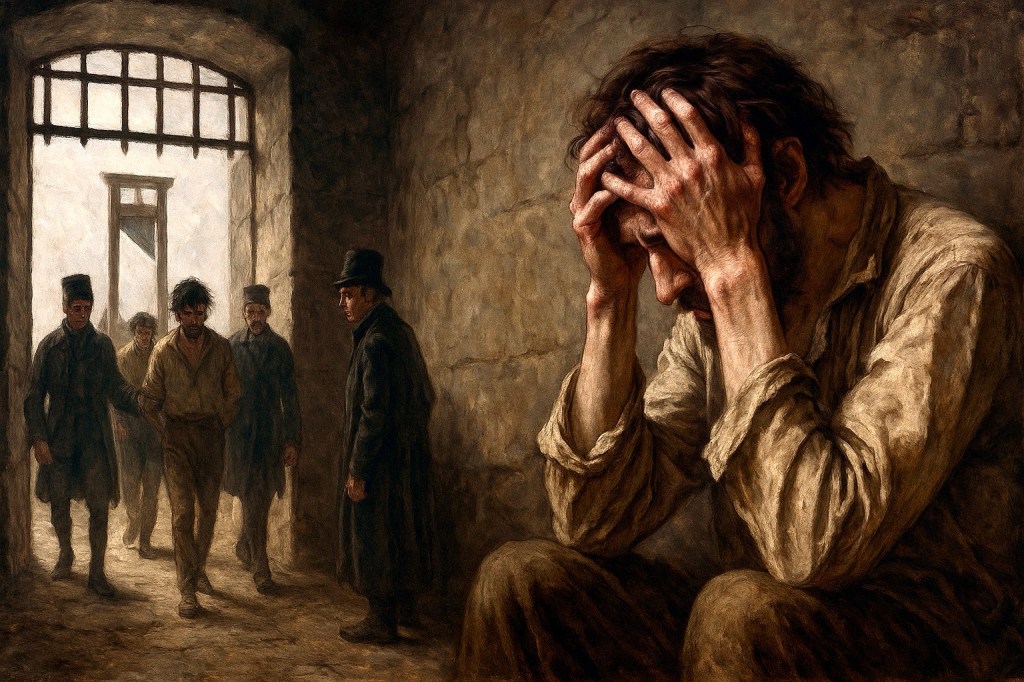
The setting, a gloomy masterpiece, is meticulously crafted to enhance the novel’s oppressive atmosphere. Hugo’s depiction of the prison is so vivid, you can almost smell the damp stone and feel the chill of the chains. It’s the kind of place that makes you thankful for your own humble abode, no matter how cramped or cluttered. Yet, amidst the gloom, there’s a certain charm to Hugo’s detailed descriptions. It’s as if the prison itself is a character – a really depressing, soul-crushing character, but a character nonetheless.
Hugo’s exploration of themes such as the death penalty, the value of human life, and the hypocrisy of justice is as subtle as a guillotine blade – a veritable comedy of morals. He leaves no stone unturned and no societal flaw unexposed. His stance against capital punishment is clear and vehement. However, there’s a certain irony in the fact that he drives this point home with all the subtlety of a sledgehammer, ensuring that even the most inattentive reader couldn’t miss it. It’s like being lectured by your most earnest, over-caffeinated tutor – well-intentioned, but after a while, you might find yourself longing for a tea break.
Victor Hugo’s style is unmistakably his own. His prose is dense, florid, and at times borders on the melodramatic. One might say Hugo never uses one word when twelve will do. His ability to wax poetic about the grim and the gruesome is unparalleled. While some might call it overwrought, others might appreciate the rich tapestry of language that envelops the reader like a heavy, albeit beautifully embroidered, shroud.
The culmination of The Last Day of a Condemned Man is both inevitable and yet profoundly impactful. Spoiler alert: the condemned man meets his end. The build-up to this moment is intense, as Hugo masterfully drags out the suspense. By the time you reach the final page, you might feel an odd sense of relief – not just for the protagonist, but for yourself as well. You’ve survived the emotional gauntlet Hugo set before you, and now you can return to the relative lightness of your own life.
In sum, The Last Day of a Condemned Man is a masterclass in creating a singular mood – one of unrelenting darkness. It’s a powerful, thought-provoking work that spares no punches. Yet, if approached with a sense of humour, it also offers a certain absurd, almost farcical charm. Hugo’s dedication to his theme is admirable, even if it sometimes feels like being bludgeoned with a very sombre, very French baguette. If nothing else, it’s a stark reminder of the power of literature to evoke deep emotional responses – even if those responses are occasionally mixed with a bemused grin at the sheer melodrama of it all.

 Wording