
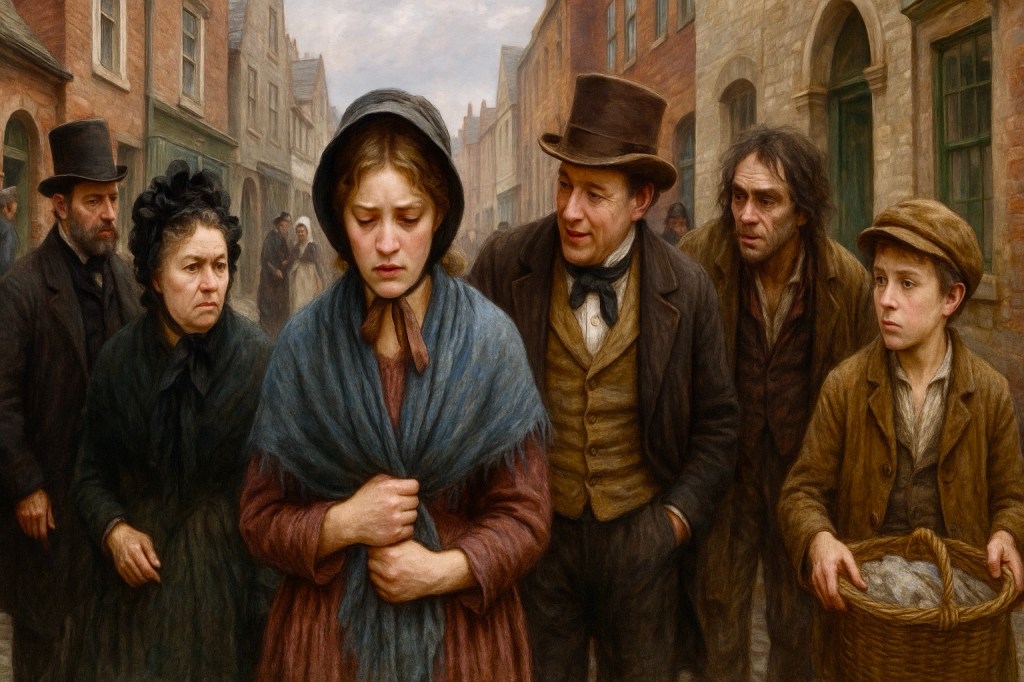
Elizabeth Gaskell’s Ruth is a novel that offers a buffet of Victorian sensibilities, served with a side of moral quandaries and a garnish of melodrama. Let’s dive into this delightful dish and dissect its flavours, shall we?
Ruth Hilton, our heroine, is the quintessential ‘fallen woman’ who, despite her circumstances, manages to retain an almost saintly level of innocence. Imagine Snow White, but with a stronger backbone and slightly less interaction with woodland creatures. Ruth’s naivety is both endearing and, at times, facepalm-inducing. You can almost hear readers collectively groan as she trusts yet another ill-intentioned man. “Oh Ruth, dear, no. Don’t go into the metaphorical dark alley of life!”
Enter Mr. Bellingham, a character so oily, he should come with a health warning. He’s the kind of cad that gives cads a bad name. His seduction of Ruth is less a romantic conquest and more a cautionary tale about the dangers of men who use too much pomade. Bellingham’s eventual desertion of Ruth is as surprising as the ending of a Scooby-Doo episode – villains will villain, after all.
Hypocrisy: thy name is Society. Gaskell paints Victorian society with a brush so sharp it could double as a scalpel. The double standards are thicker than a Dickens novel. When Ruth’s ‘situation’ becomes public, society clutches its pearls so hard they turn into diamonds. Yet, the same society gives men like Bellingham a free pass to go gallivanting off to their next social misadventure. If hypocrisy were a sport, Victorian society would win gold, silver, and bronze.
Then we have the supporting cast, including the virtuous and occasionally vexing Mr. Benson. He is a clergyman so saintly, even Mother Teresa would tell him to lighten up. His sister, Faith Benson, embodies the ‘disapproving aunt’ trope with such fervour, one half-expects her to break into a rendition of Stop In The Name of Love whenever Ruth steps out of line.
Jemima Bradshaw, another key player, is like the Victorian Daisy Buchanan, but with a conscience. She grapples with her feelings for Mr. Farquhar and her complex friendship with Ruth, ultimately emerging as a character of significant depth and empathy. She’s the kind of friend you want in your corner – loyal, honest, and only mildly exasperated by Ruth’s occasional lapses in judgment.
Despite its somewhat preachy tone, Ruth offers an engaging critique of societal norms and the brutal realities faced by women of the era. Gaskell’s writing is as rich as a Victorian plum pudding, dense with detail and flavoured with sharp social commentary. While the pacing can sometimes feel like waiting for a horse-drawn carriage in the rain, the narrative’s emotional depth makes it worth the wait.
Ruth is a delightful dance through Victorian society’s drawing rooms and dark corners. Gaskell’s ability to weave humour, pathos, and social critique into her narrative makes this novel a timeless tale of resilience and redemption. So, if you’re in the mood for a story that mixes moral dilemmas with a dash of Victorian melodrama, grab a cup of tea, settle into your cosiest armchair, and let Ruth sweep you away.

 Wording