Once again, time is against me so I’m going to share another gem with you from Aesop’s Fables; I could literally read and write about these tales all day long.
The Mischievous Dog, offers a blend of humour, wisdom, and canine shenanigans that deserve a thorough, albeit lighthearted, analysis. Through the tale of a misbehaving mutt, Aesop delivers a cautionary tale about the consequences of one’s actions and the societal response to persistent troublemakers.
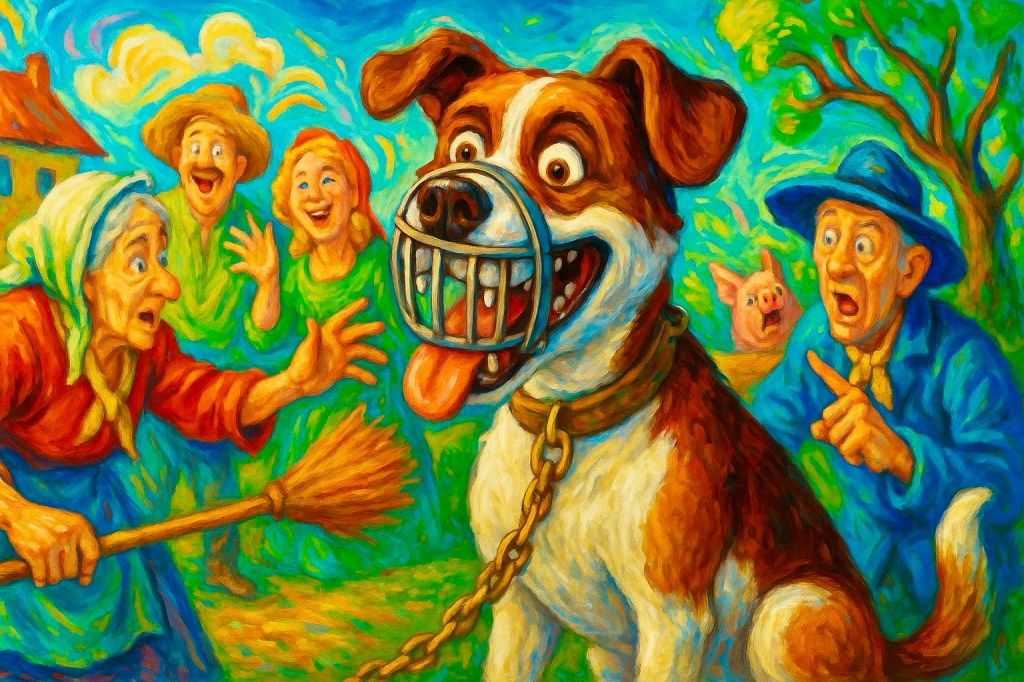
A slight paws for reflection. The fable revolves around a dog known for his love of biting people indiscriminately. As a solution, his owner decides to hang a bell around the dog’s neck to warn people of his approach. Rather than taking this as a sign to mend his ways, the dog revels in the attention the bell brings him, prancing around town with an air of self-importance. However, an older, wiser dog soon sets him straight, explaining that the bell is not a badge of honour but a mark of shame.
Our protagonist, the mischievous dog, is a veritable canine chaos agent, an embodiment of anarchic energy and a poster dog for the live fast, annoy often philosophy. His transformation from a simple troublemaker to an inadvertently self-advertising nuisance demonstrates the folly of misunderstanding one’s reputation.
In a classic case of human error in pet management, the owner’s attempt at a practical solution – using the bell as a warning system – backfires spectacularly. This character represents well-intentioned but ultimately flawed approaches to behavioural correction.
The wise old dog serves as the voice of reason, delivering the fable’s moral punchline with the gravitas only an experienced canine can muster. He underscores the difference between fame and infamy, a lesson often lost on the youthful and exuberant – but then most of life’s lessons are lost on today’s youth.
At its core, the fable explores themes of reputation, societal response to deviance, and the misunderstandings that arise from self-perception versus public perception. The dog’s obliviousness to the true meaning of his bell symbolises the often misplaced pride people take in their notoriety, confusing negative attention with genuine admiration. The fable suggests that true wisdom lies in understanding the nature of one’s reputation and striving to improve it rather than basking in the glow of infamy.
A multifaceted symbol, the bell represents both a warning to others and a signal of the dog’s misbehaviour. It is a classic example of how tools intended for public safety can be co-opted by the very individuals they are meant to control. In a modern context, it’s akin to a hacker wearing their arrest as a badge of honour.
Each bite the dog delivers symbolises a breach of social contract, a breakdown in the expected norms of behaviour. They are the physical manifestations of the dog’s disregard for societal rules, and the bell becomes the narrative consequence of these breaches.
The humour in fable arises from the sheer absurdity of the dog’s misunderstanding and the human-like vanity it exhibits. The image of a dog strutting around, jingling with misplaced pride, is inherently comedic. It’s a classic case of dramatic irony, where the audience understands the situation far better than the protagonist. Additionally, the wise old dog’s blunt revelation serves as a humorous reality check, the fable equivalent of a mic drop.
Aesop’s The Mischievous Dog masterfully combines humour and moral teaching, wrapped in the deceptively simple narrative of a dog and his bell. Through this tale, readers are encouraged to reflect on their own actions, the perceptions of others, and the true nature of reputation. In analysing this fable, we not only get a chuckle out of the dog’s antics but also gain a timeless lesson about the consequences of our behaviour and the importance of self-awareness.
So, next time you hear a bell, think not of the ice cream man, but of the mischievous dog and ponder – are you wearing your bell with misplaced pride?

 Wording