I recently delved into the profound depths of Death of a Salesman, and now, it’s time to turn our attention to another masterpiece of the stage. Much like my previous posts, this exploration is woven from a tapestry of thoughts and reflections I’ve accumulated over the last few years – some have made it all the way from my youth. Only in the past few months have I embarked on the meticulous task of refining and sharing them – often I use the time I spend on these posts to keep my demons at bay; if I’m writing and distracting myself thinking about my passion for art, then I’m not cutting myself, or dwelling on how sweet a length of rope and a noose would be.
Prepare for an eclectic journey through the works of illustrious playwrights such as Shakespeare, Marlowe, and Wilde, among others. However, a word of caution – my enthusiasm often propels me into lengthy digressions. These musings, therefore, will require significant rewriting and embellishing before they are ready for your perusal.
I’ve also stated in past posts that I’m not particularly interested in modern literature, artworks, plays and music, however, there are a few that are deserving of my time and effort. The Crucible is one such play. Here we go.
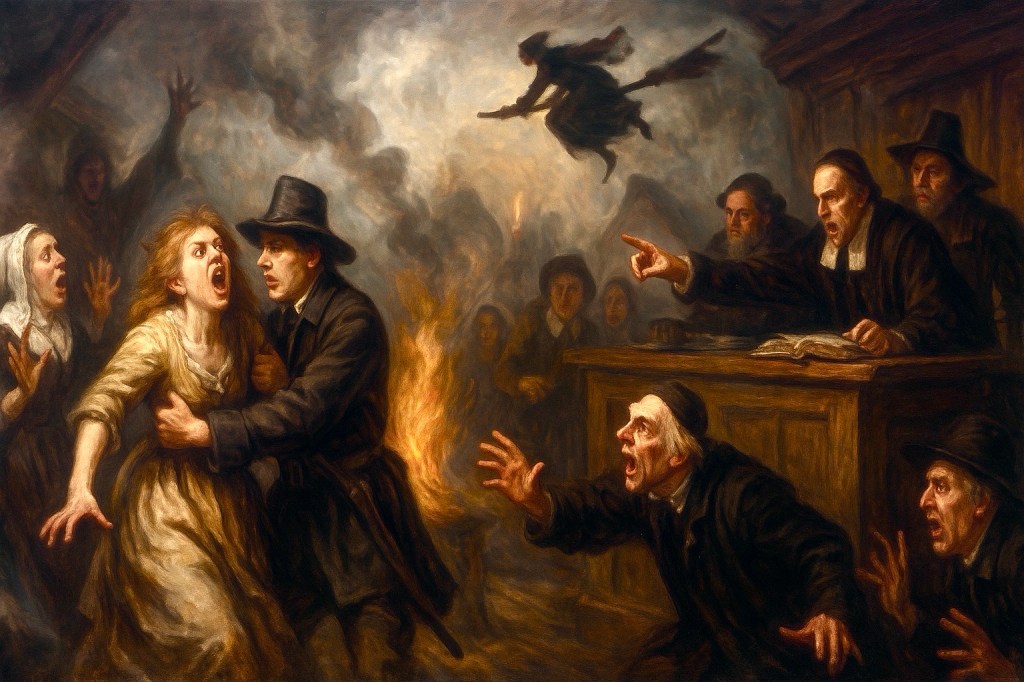
The Crucible – Arthur Miller’s dramatic retelling of the Salem witch trials, where Puritanical fervour, teenage rebellion, and good old-fashioned hysteria blend into a frothy brew of accusations, confessions, and some of the finest finger-pointing in American literature. This play is a veritable casserole of chaos, served with a side of McCarthyism allegory that is as subtle as a sledgehammer wrapped in a subpoena.
From the outset, we are introduced to the Reverend Parris, a man so paranoid that he makes modern conspiracy theorists look like rational skeptics. Parris is deeply concerned about his daughter Betty’s mysterious illness, which has nothing to do with witchcraft unless by witchcraft you mean a well-timed nap to avoid household chores. His first thought is not, “Let’s get a doctor,” but rather, “Oh no, my career!” Clearly, his priorities are in line with the finest traditions of empathetic parenting.
Enter Abigail Williams, the play’s resident manipulative teenager, who could give Verruca Salt from Charlie and the Chocolate Factory a run for her money. Abby is less of a character and more of a force of nature – a hormonal hurricane hell-bent on seducing John Proctor and ruining everyone else’s lives in the process. She’s the kind of person who, if she had access to social media, would ignite global conflicts with a few well-placed tweets.
John Proctor, our flawed hero, is caught in a web of his own making. He’s a man of integrity, or at least he would be if he could keep his pants on. His affair with Abigail is the scandal that sets the entire plot in motion, proving once and for all that the road to hell is paved with adultery and poor decision-making. Proctor spends most of the play trying to redeem himself, but it’s hard to root for a guy who only finds his moral backbone when faced with a literal noose.
Elizabeth Proctor, John’s wife, is the epitome of the wronged woman. She’s stoic, virtuous, and about as warm as a New England winter. One might argue that Elizabeth’s frigid demeanour makes her husband’s infidelity almost understandable. But this is the 1690s – therapy isn’t an option, so why not resolve marital issues with a good old-fashioned witch hunt?
The supporting cast of characters in Salem is a veritable parade of puritanical paranoia. There’s Tituba, the Barbados-born scapegoat who gets the witch-hunting party started, and the Putnams, who turn vengeance into a full-time occupation. Thomas Putnam’s land grabs make modern real estate moguls look like charity workers. His wife, Ann, blames witchcraft for the loss of her babies, which makes you wonder if she’s ever heard of genetic predisposition.
Then there’s Reverend Hale, the expert on witchcraft who shows up with books heavy enough to flatten a witch, only to realise that maybe, just maybe, everyone’s overreacting a tad. Hale’s transformation from zealous witch hunter to guilt-ridden critic of the trials is as speedy as it is unconvincing. One minute he’s all “Burn the witch!” and the next he’s “Wait, what if we’re the bad guys?”
The climax of the play is as melodramatic as a soap opera season finale. The courtroom scenes are a circus of absurdity, where spectral evidence (a.k.a. “I saw Goody Proctor’s spirit dancing with the devil!”) is taken as gospel truth. Danforth, the deputy governor, presides over the trials with the kind of judicial prudence that would make Judge Judy weep. His unwavering belief in the infallibility of the court is both hilarious and horrifying, like watching a dog chase its tail with lethal consequences.
In the end, The Crucible is a masterclass in how to turn a historical event into a cautionary tale about mass hysteria and the dangers of extremism. Miller’s dialogue crackles with intensity, even as his characters’ motivations sometimes stretch credulity. The play’s moral lessons are as relevant today as they were in the 1950s, proving that humans have a remarkable talent for repeating their mistakes.
So, if you enjoy watching a small town implode under the weight of its own absurdity, The Crucible is your ticket to ride. Just remember to bring a healthy dose of skepticism and a sense of humour – you’ll need both to survive the witch-hunting shenanigans of Salem.
A little of how this play came to be.
The play is widely understood as an allegory for the anti-communist hysteria of the 1950s, particularly the activities of Senator Joseph McCarthy and the House Un-American Activities Committee (HUAC). Miller wrote the play during a time when the United States was gripped by fear of communism, leading to a period known as the Red Scare. Many individuals were accused of being communists or communist sympathisers, often with little or no evidence, resulting in ruined careers and lives – a notable casualty just happens to be a performer that my father likes to listen to, Paul Robeson. Look him up, if the name is unfamiliar to you. I could expand on that but the post is long enough as it is.
The Crucible uses the Salem witch trials of 1692 as a metaphor for the McCarthy era. In the play, Miller draws parallels between the irrational fear and unjust persecution during the witch trials and the similar atmosphere of suspicion and accusation during the Red Scare. In Salem, the fear of witches and the devil led to a frenzy of accusations, much like the fear of communism during the McCarthy era, which led to widespread paranoia and suspicion. Individuals in Salem were accused of witchcraft with little evidence, often based on personal vendettas or unfounded suspicions, just as many were accused of being communists with equally flimsy evidence during the Red Scare. Both events caused significant harm to individuals and society, fostering a culture of fear, conformity, and suppression of dissent.
Miller himself was directly affected by McCarthyism; he was questioned by HUAC in 1956 and convicted of contempt of Congress for refusing to name others who had attended meetings with him (no smoke without fire though, right?). His experiences and observations during this time significantly influenced his writing of The Crucible. The play serves as a powerful critique of the dangers of hysteria, mob mentality, and the violation of civil liberties, emphasising the importance of due process and the rule of law.
There have been many instances of hysteria/moral panic over the centuries, and this is something I was interested in at school. It’s something I may well take a look at in future posts.

 Wording
I’ve never read this or seen the play performed, but enjoyed and appreciated your post. I’ve always thought that Miller’s works would be too heavy for me, and I can see that the allegory would have gone over my head.
And on a personal note, I’m sorry you are struggling. You’re right, art is worth feeling passionate about and a wonderful distraction. Having the opportunity to experience other lives through books is a joy.
Thank you, Rose and bless you. Slipping pieces of my grief into my posts helps me to express those bottled up emotions, especially if I think very few people are reading them – hence the subtitle of my blog.
It’s a privilege to enjoy and think about pieces of art, and have the opportunity to share something of what artists put into their work. I’m passionate about literature, mostly classic; they take me to times where, no matter the genre, things seemed simpler.
As for Miller, I think if you familiarise yourself a little with him, this play certainly wouldn’t go over your head – would we have any art to enjoy if the producers weren’t inspired to do so, either by personal experience or observations of the world around them? I’m prattling, which I tend to do. The play is very easy to read, and if you’re a fan of theatre, it’s well worth a look.
Once again, thank you for engaging.
There is a lot of freedom to express yourself through blogging. I like knowing that I’m in a community of readers and am just another reader here, not Rose from a particular work place or family or anywhere else, so am much more open than I usually am in day to day life, too. I’ve heard it called the hairdresser effect, you just sit down and spill your guts in the chair while someone cuts your hair.
Funnily enough, I went to an op shop yesterday after reading your post and found a copy of The Crucible for $1. I had no real intention of reading it but sometimes things are just meant to be. I’ll let you know how I get on with it.
Ah, the Hairdresser effect, yes. Sharing with someone who is not a part of their daily life might feel safer, as the hairdresser is unlikely to share their secrets with mutual acquaintances. It’s similar to a blogging platform, yes, apart from the fact that you can get away with the more sensitive or controversial opinions with your barber than you can writing anything publicly – which is something we have a problem with here in the UK sadly. I’m assuming you’re in Australia having looked at the stats on my blog? Forgive me if I’m wrong.
I’m guessing your ‘op shop’ would be a charity shop? I’m always poking my nose around those, as now and again there are some incredible finds as far as books are concerned. There’s actually a book shop in a town near where I live that relies entirely on small donations, at one’s discretion, and you can take as many books as you like; I’ve never failed to leave without something interesting.
On the subject of your serendipitous find, do please let me know how you get on with it – I’ll look forward to your thoughts. As a rule, I’ve never really been excited by modern or post-modern literature or other art form, however, another interesting piece of work published in 1952 by Samuel Beckett, is ‘Waiting for Godot’. The play is of absolute no value to me whatsoever, apart from its existential quality, but there’s just something about it I can’t leave alone. Now and again, I allow myself a glance at something like that. If you haven’t read the play, or watched the play as yet, then give it a go – you’ll never get back the time you spend watching it, but its draw is fascinating. There’s one or two versions of it on YouTUbe if you’re interested.
It’s time I shut up now. Good luck with The Crucible and many thanks for the comments.
Well, it is true that regardless what the hairdresser thinks of their client and their opinions, they only have to bear with them for a short time.
Yes, I’m Australian. Some of my opinions would be controversial if I was a public figure, but I’m not. I argue for my causes in person but my blog isn’t generally the place, no point lambasting people who are just looking for books they might enjoy. But to your point, an unpopular opinion can sink public figures here in certain circles, too, written or otherwise.
I should say Thrift Shop or Charity Shop instead of Op (Opportunity) Shop. Here, they are usually run by church groups for charity or to raise money for a local hospital. I have a few favourite haunts where I know I’ll get a good haul. I came back with four other books as well as The Crucible, although I only intended to donate my bags and leave. Famous last words!
I haven’t read or watched Waiting for Godot although it is on my radar. Spoiler alert, I know Godot never makes it onto the stage! Story of most of our lives, I think, waiting, waiting, waiting for something or other. I’ll check out YouTube, anyway, it’s time I find out what actually happens for myself.
The ‘Op-shop’ tickles me. I like it. Trouble is though, there are an increasing number of them, which means, more books from likely house clearances, and some absolute gems to come across – my library is expanding! I keep promising myself that I will discipline myself and perhaps only pick up one a week. Like that’s going to be easy to stick to!