
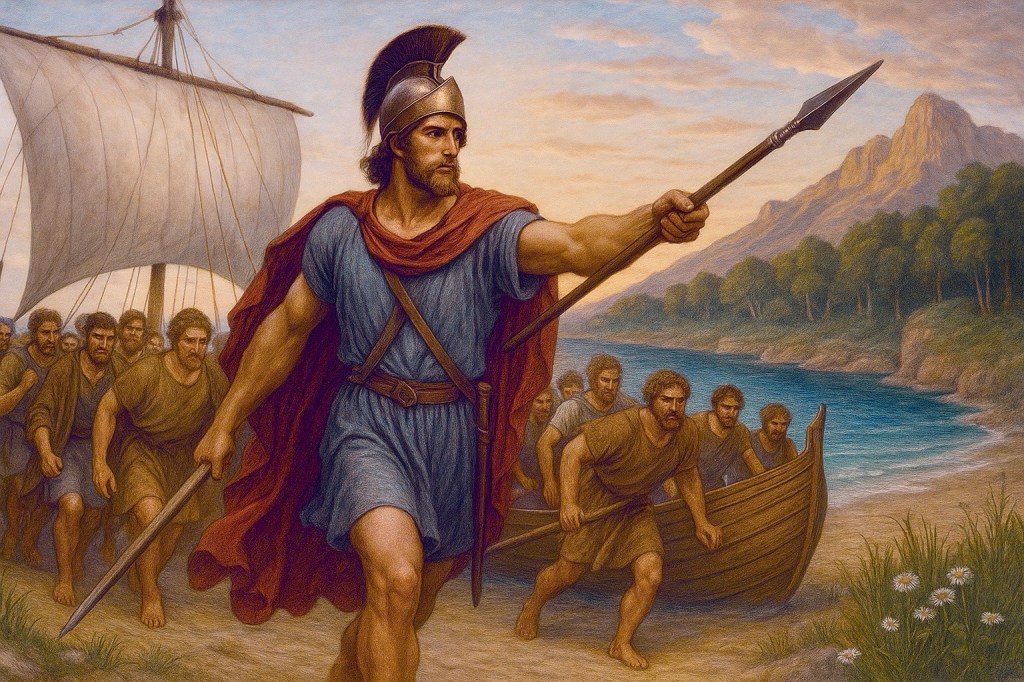
As a child, I was utterly captivated by the enchanting world of old stop-motion movies. Films like Jason and the Argonauts, Sinbad the Sailor, and Jack the Giant Killer held me spellbound with their wondrous creatures and fantastical monsters. Each film was a gateway to a realm where mythical beings came to life, and heroes embarked on epic quests. In those days, CGI was a concept yet to be imagined, but it didn’t matter; the magic of those handcrafted special effects was nothing short of extraordinary – especially through the wide-eyed wonder of a child. And I never realised that Jason was such a cad!
The Life and Death of Jason by William Morris is a grand, sprawling epic that attempts to repackage the ancient Greek myth of Jason and the Argonauts in a Victorian wrapper. If you’re in the mood for a long, elaborate journey where the hero’s moral compass is as reliable as a broken GPS, then buckle up! Morris takes you through a tale of love, betrayal, and, naturally, lots of sailing – because nothing screams epic adventure like being stuck on a boat with a bunch of moody Greeks.
Our hero Jason decides he needs the Golden Fleece (a fancy rug), an object so mysterious that nobody really knows what it is, but everyone assumes it must be fabulous. It’s a bit like that one piece of furniture in a catalogue that you convince yourself will complete your living room, only to realise it’s too big and doesn’t match the curtains. Morris does a commendable job of stretching this quest out over several books, packing in enough sea monsters and awkward encounters to keep things lively – or at least as lively as it gets when half the characters are perpetually seasick.
Enter Medea, the girlfriend who cooks, cleans, and dabbles in magic, the witchy princess of Colchis, who falls head over heels for Jason. She’s basically the original ride-or-die girlfriend, willing to betray her family, dabble in dark magic, and generally cause havoc just to help Jason score some ancient fleece. You can’t help but wonder if she’d have been better off with a nice, simple chap who actually appreciated her instead of Jason, who, as we’ll see, doesn’t exactly win Boyfriend of the Year.
So, Jason, now armed with his precious fleece and a magical girlfriend, heads back to Greece. Does he live happily ever after? Of course not! Instead, Jason pulls the classic midlife crisis move and trades Medea in for a younger model, Glauce, the princess of Corinth. It’s the ancient Greek equivalent of getting a sports car and ignoring your wife. Naturally, Medea doesn’t take this well – there are only so many curses and murders a relationship can survive before it hits rock bottom.
Morris’s poem dives into some deep themes like heroism and fate, but let’s be honest – the real takeaway is that Jason’s moral integrity is flimsier than the Argonauts’ sail in a storm. As he shifts from dashing hero to self-serving cad, you start to wonder if the real villain isn’t the sea monsters but Jason’s own terrible decisions. Medea’s revenge might be over-the-top, but in the context of Jason’s behaviour, you’re almost rooting for her.
Morris’s writing is rich, descriptive, and flows like a river – sometimes sweeping you along in its current, other times making you wish you had a canoe to paddle your way out. He’s got a knack for painting vivid scenes, but occasionally you might find yourself wondering if we really needed quite so many descriptions of the sea. It’s clear Morris had a thing for classical epics, though one suspects he might have overdone it on the Homer binge-watching before penning this tome.
In the end, The Life and Death of Jason is a fascinating, if slightly overstuffed, retelling of a classic myth – a Victorian epic with a side of Schadenfreude. Morris brings the ancient tale into the Victorian era, complete with all the drama, intrigue, and bad relationship choices you could ask for. If nothing else, it’s a great reminder that heroes aren’t always heroic, witches make terrible enemies, and that some quests are better left to someone else. If you can get through all the maritime misadventures, you’re in for a tale that’s both grand and oddly relatable – because who hasn’t been betrayed by a Jason or two? And, thank you, Ray Harryhausen.

 Wording