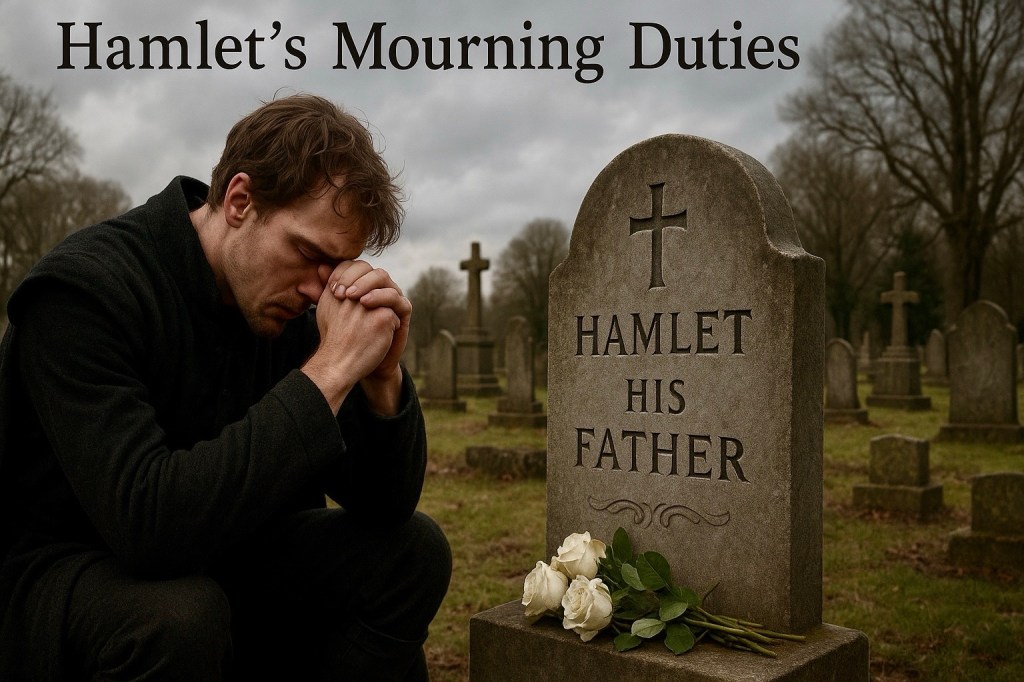
In recent weeks, I’ve found it increasingly difficult to sit and focus on any substantial reading. Instead, I’ve resorted to cherry-picking snippets here and there, if only to fill the hours. Given the events of the past month, my thoughts have been heavily preoccupied with mortality, and much of my reading has taken on a sombre tone. Perhaps this isn’t the healthiest approach, but that’s simply where my mind has been… and to some extent, still is. Navigating the loss of a parent is no easy task – perhaps no harder than losing any other loved one – yet this time, it has felt different. Anyway, one of my favourite plays was always Hamlet, and what continues to resonate with me is the profound depth of grief Prince Hamlet endures, especially after confronting the ghost of his father and learning the harrowing truth. Before Hamlet discovers the wrongdoing, his grief is palpable. He’s drained. That’s relatable.
In the play, King Claudius makes a speech to Hamlet in Act 1, Scene 2, following the death of Hamlet’s father, King Hamlet. Claudius attempts to console Hamlet, but his speech also reveals a lot about his character and the political context of the play. Let’s analyse the speech, focusing on its themes, tone, and underlying motives.
“Tis sweet and commendable in your nature, Hamlet, To give these mourning duties to your father; But you must know, your father lost a father, That father lost, lost his, and the survivor bound In filial obligation for some term to do obsequious sorrow. But to persever In obstinate condolement is a course of impious stubbornness; ’tis unmanly grief. It shows a will most incorrect to heaven, A heart unfortified, a mind impatient, An understanding simple and unschooled: For what we know must be, and is as common as any the most vulgar thing to sense, Why should we in our peevish opposition Take it to heart? Fie! ’tis a fault to heaven, A fault against the dead, a fault to nature, To reason most absurd: whose common theme Is death of fathers, and who still hath cried, From the first corse till he that died today, ‘This must be so.'”
Death is a natural process and Claudius emphasises that death is an inevitable part of life. He reminds Hamlet that every son loses a father and that this has been a universal experience since the beginning of time. By doing this, Claudius attempts to normalise the death of King Hamlet, reducing its significance and implying that Hamlet’s grief is disproportionate.
Claudius characterises prolonged grief as “unmanly,” an expression of weakness that contrasts with the ideals of stoic masculinity. By labelling Hamlet’s grief as “impious stubbornness” and “unmanly grief,” Claudius is trying to shame Hamlet into conforming to societal expectations, which demand that men suppress their emotions and maintain a strong, composed demeanour.
Claudius argues that excessive mourning is a “fault to heaven” and a sign of a rebellious will that goes against divine order. He suggests that Hamlet’s grief is not only unnatural but also morally and spiritually wrong, as it defies the will of heaven, which has decreed death as an inevitable part of life.
By urging Hamlet to move past his mourning, Claudius is also subtly reinforcing the importance of political stability. Claudius himself has quickly moved on from his brother’s death, marrying Gertrude and taking the throne (Henry VIII popped into my mind, and the biblical excuse he used as one of the means to attempt to have his marriage to Catherine of Aragon annulled). Hamlet’s continued grief threatens to disrupt the court’s facade of stability and order.
The tone of Claudius’ speech is manipulative and patronising. Claudius tries to present himself as a caring and reasonable stepfather, but his true aim is to control Hamlet’s behaviour. He uses a condescending tone, dismissing Hamlet’s grief as childish and unmanly, while positioning himself as the voice of reason and authority.
There is also a subtle threat embedded in the speech. Claudius’ insistence that Hamlet’s grief is against both heaven and nature serves as a reminder of his own power and the expectations Hamlet must meet. By framing Hamlet’s mourning as a failure of duty, Claudius is pressuring him to conform to the new order under his reign.
Claudius’ speech is driven by several motives. Claudius has recently taken the throne, and Hamlet’s visible mourning poses a threat to the legitimacy of his rule. By urging Hamlet to cease his grief, Claudius is attempting to neutralise any potential opposition to his authority.
Claudius wants to ensure that the court sees him as a competent and caring ruler. His speech is a public performance meant to demonstrate his concern for Hamlet while also establishing his dominance.
As we later learn, Claudius is guilty of murdering King Hamlet. By downplaying the significance of the king’s death and urging Hamlet to move on, Claudius is also trying to alleviate any suspicion or guilt that might arise from Hamlet or others in the court. It’s clear fairly early on that Prince Hamlet sees through this.
Claudius’ speech to Hamlet about the loss of his father is a complex mix of manipulation, political strategy, and personal guilt. While it appears to be a consoling speech, it is actually an attempt to control Hamlet and secure Claudius’ own position as king. The speech reflects Claudius’ cunning nature and foreshadows the tension that will develop between him and Hamlet as the play progresses.
At one point in the play, Hamlet comes upon Claudius in the act of praying. Is this a sign that Claudius is being tormented by the weight of his own guilt? Does remorse gnaw at his conscience, forcing him to seek divine forgiveness, or is his prayer an empty gesture, devoid of true repentance? The scene raises profound questions about Claudius’ inner turmoil and the complexity of his moral struggle. Hamlet feels a surge of intent to kill Claudius when he finds him praying. However, Hamlet hesitates and decides to wait, reasoning that if he kills Claudius in the act of prayer, Claudius’ soul might be cleansed of sin and granted forgiveness by God. Hamlet wants Claudius to suffer the same damnation as his father, who was murdered without the chance for confession. Therefore, he resolves to wait until Claudius is in a state of sin, ensuring his damnation. This moment highlights Hamlet’s internal conflict and deep desire for justice, not just in life but in the afterlife as well.
And, that’s all I have on that snippet of the play for now.

 Wording
Just a Bouy has quickly become one of my favorite blogs. Thank you.
Thank you, Blake, that’s much appreciated.
I am not familiar with this play/story but the reminder to Hamlet that his father also lost his father, leaving aside the remainder of the quote, is so terribly sad. I don’t think I’d really thought about my own grandfather’s death in that context until I lost my own father, but afterwards, I did.
I agree with Blake’s comment, too, your posts are wonderful.
Balke was an interesting fella, for sure. Do you mean this quote: “I have seen my father’s spirit ascend, and he was a good man.”? I think this statement reflects Blake’s deep spirituality and belief in visions and the afterlife. His father’s death had a profound impact on him, but he viewed it through a mystical and spiritual lens, consistent with his artistic and visionary nature. And thank you for the compliments, Rose, I do try. Glad they’re appreciated..Bless you.
Oh, Rose, I think I misunderstood! When you mentioned Blake I thought you meant William Blake? I think now you’re referring the comment by the other blogger, Blake! How silly I am! 🙂 I actually looked for his blog but it tells me it’s no longer there? Nevermind. Thanks again.
Who’s William Blake? 😆
Yes, I did mean blogger Blake.
I think some people have accounts so they can read blogs and comment without actually adding posts themselves.
See, my brain immediately leapt to Wm. Blake! 😀 I realised ‘blogger Blake’ may just be viewer, but it all makes it worthwhile.