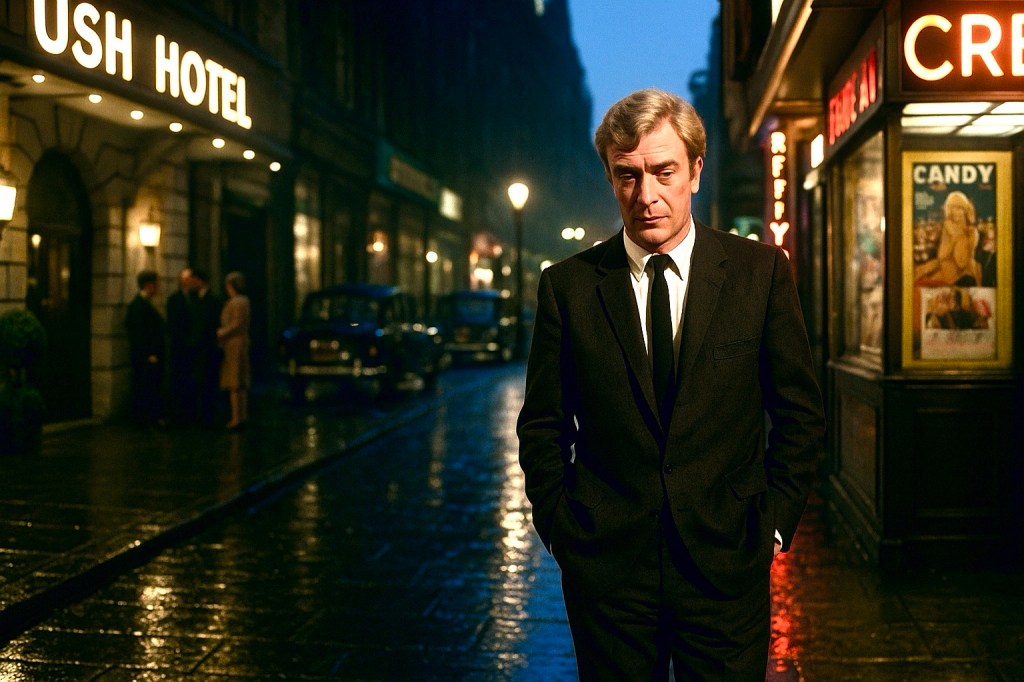
A few days ago, quite by accident, I found myself watching a movie that reignited memories of a play I had already delved into some time ago. As the familiar story unfolded on screen, I felt the urge to revisit and refine my previous thoughts. Out came the metaphorical polish for an old essay, and here we are again. So, without further ado, ladies and gentlemen, I present to you the one and only Alfie Elkins – charming, reckless, and eternally flawed.
When Alfie (1966) strutted onto screens with Michael Caine in the title role, it brought to life Bill Naughton’s play about a man who seemed to embody the very spirit of the Swinging Sixties. Alfie Elkins is not just a character – he’s an emblem of the post-war bachelor lifestyle, one that values freedom, no-strings-attached flings, and an utter disregard for the emotional carnage left in his wake. But here’s the twist: while Alfie swaggers about, seducing and philosophising with a cheeky smirk and an endless supply of one-liners, the story quietly unravels him, revealing an emptiness that no amount of winking at the camera can conceal.
From the outset, Alfie, the original lovable cad, fancies himself a philosopher of pleasure, a man who’s figured out the secret to life – at least according to his own self-indulgent moral code. He’s that charming rogue every man wants to have a pint with, and every woman ought to run away from. Caine’s portrayal of Alfie blends a winning mixture of charm and insensitivity, leaving us both amused and horrified by his casual disregard for emotional ties. He strolls through London, treating women like interchangeable accessories in a lifestyle curated solely for his own amusement, all while narrating his thoughts directly to the audience with a wink and a grin.
However, for all his bravado, Alfie is a man who suffers from profound self-delusion. He believes he’s mastered the game of life, but really, he’s a puppet to his own emotional shortcomings. He’s not free at all – he’s shackled by his own avoidance of responsibility, unable to form real, lasting connections. He breaks the fourth wall constantly, as if inviting us into the inner workings of his brilliant mind. The tragedy, though, is that the audience can see what he cannot: he’s teetering on the edge of emotional disaster.
This question, What’s it all about, Alfie?, famously sung in the film’s theme song, strikes at the heart of Alfie’s existential dilemma. He lives his life assuming he knows the answer – maximising pleasure, minimising responsibility, and avoiding any kind of emotional entanglement. What could be simpler? But as the film progresses, the hollowness of his philosophy becomes painfully clear. Women come and go, and Alfie remains emotionally stunted, content to coast through life with no obligations.
Except, of course, life has a way of sneaking up on you. The series of emotional landmines Alfie steps on – including an abortion, an estranged child, and several failed relationships – begin to chip away at his carefree facade. By the end, Alfie is left asking the very question he’s avoided his entire life: What’s it all about? The realisation that his life lacks true meaning and connection hits him with the force of a cold slap, yet he’s still incapable of fully processing it.
Nowhere is the tragic impact of Alfie’s selfishness more evident than in his affair with Lily, the wife of his hospital mate, whom he seduces with the same ease that has worked for him so many times before – charm meets consequence. This episode represents one of the most devastating and sobering moments in the film. Unlike Alfie’s usual conquests, Lily is not a young, starry-eyed girl dazzled by his charm – she’s a married woman who knows full well the gravity of their actions, yet still falls under Alfie’s spell.
When Lily becomes pregnant, Alfie’s detached and cavalier attitude is shattered by a grim reality: she decides to have an abortion. It’s a chilling moment, both for Alfie and the audience. For the first time, he is confronted with the real consequences of his casual encounters. The abortion, carried out in a cold, impersonal environment, strips away any veneer of charm. Alfie is forced to witness the emotional and physical trauma Lily endures – damage that he has directly caused, despite his previous belief that his way of life was consequence-free.
Lily’s pain – and the abortion – serve as a powerful symbol of the emotional wreckage Alfie leaves behind in his pursuit of freedom. It’s a rare moment when Alfie, who is usually so glib and self-assured, is completely out of his depth. He is shaken, not by guilt, but by the sudden realisation that his actions have real, devastating consequences for the people he carelessly discards.
Perhaps the most ironic aspect of Alfie’s character is his complete estrangement from the one person who should represent his shot at redemption – his own child. Alfie treats women as disposable, but his son is a different kind of loss. Early on, Alfie casually abandons any responsibility for the child he fathered with Gilda, treating the boy as yet another inconvenience. But when Gilda moves on and the boy grows closer to her new partner, Alfie suddenly wants to play the role of father. This newfound desire comes too late, of course, and he is denied the chance to connect with his son.
Here, Alfie’s estrangement from his child is symbolic of the wider emotional chasm in his life. He has spent so much time avoiding responsibility that, when he finally wants to embrace it, the opportunity has passed. Alfie’s desire to be a father isn’t rooted in love or maturity – it’s another attempt to regain control. But just like with the women he leaves behind, Alfie finds that his attempts to avoid commitment only result in him being isolated and alone.
From play to screen. While the film stays true to the spirit and plot of Bill Naughton’s original play, there are some important differences that affect how Alfie’s character and the story come across. The play is more introspective, focusing on Alfie’s monologues and his direct conversations with the audience. It’s in these moments that we really see Alfie’s delusions at play – his musings are not just cheeky but reveal a man deeply out of touch with his own emotions.
The film, while retaining these moments of introspection, broadens the scope. With the vibrant backdrop of 1960s London, we get a more dynamic look at Alfie’s world, filled with bustling streets, smoky pubs, and an endless parade of women. This visual expansion softens some of the play’s raw emotional edges, and the film’s use of Caine’s natural charisma makes Alfie more likable, even as his actions grow more repugnant.
One of the most striking differences is how the abortion scene is handled. In the play, it’s described through Alfie’s monologue, leaving much to the imagination. The film, however, shows the event with chilling clarity, adding a visceral weight to Alfie’s realisation that his carefree lifestyle has irreversible consequences. The medium of film allows for this moment to unfold with quiet devastation, contrasting with Alfie’s usual flippant demeanour.
As the story progresses, Alfie’s emotional unravelling becomes impossible to ignore. What began as a celebration of bachelorhood slowly morphs into a portrait of isolation. The film’s most powerful moments come not from Alfie’s witty commentary or sexual escapades, but from the silences – the moments where Alfie, once so sure of himself, stares into the void of his own making. He may continue to break the fourth wall, but by the end, we’re no longer in on the joke. The film forces us to witness Alfie’s realisation that his so-called freedom has left him profoundly alone.
Alfie is left asking the big question: “What’s it all about?” And the answer is clear – life, it turns out, is about more than just pleasure. It’s about the connections we make, the responsibilities we take on, and the love we share. Alfie’s tragedy is that he learns this too late, stranded in the wreckage of his hedonistic lifestyle.
In the end, Alfie serves as both a cautionary tale and a tragic character study. Michael Caine’s portrayal captures the duality of Alfie’s character – his charm and wit, but also his deep emotional emptiness. The film remains faithful to the play’s core themes, though it adds a cinematic layer of gloss that softens some of its darker tones. Yet, the message is unmistakable: Alfie, the original bad boy bachelor, may have walked through life with a swagger, but he’s ultimately a prisoner of his own emotional shortcomings. What’s it all about, Alfie? It’s about realising, far too late, that the game you thought you were winning has no prize at all.

 Wording
I’ve never seen this film but feel as if I’ve met some real-life Alfie’s, who don’t appear to realise what they’ve missed out on in life and who they’ve missed out on being.
One or two female Alfies, too.
Oh, there are plenty Alfie’s on either side of biology!