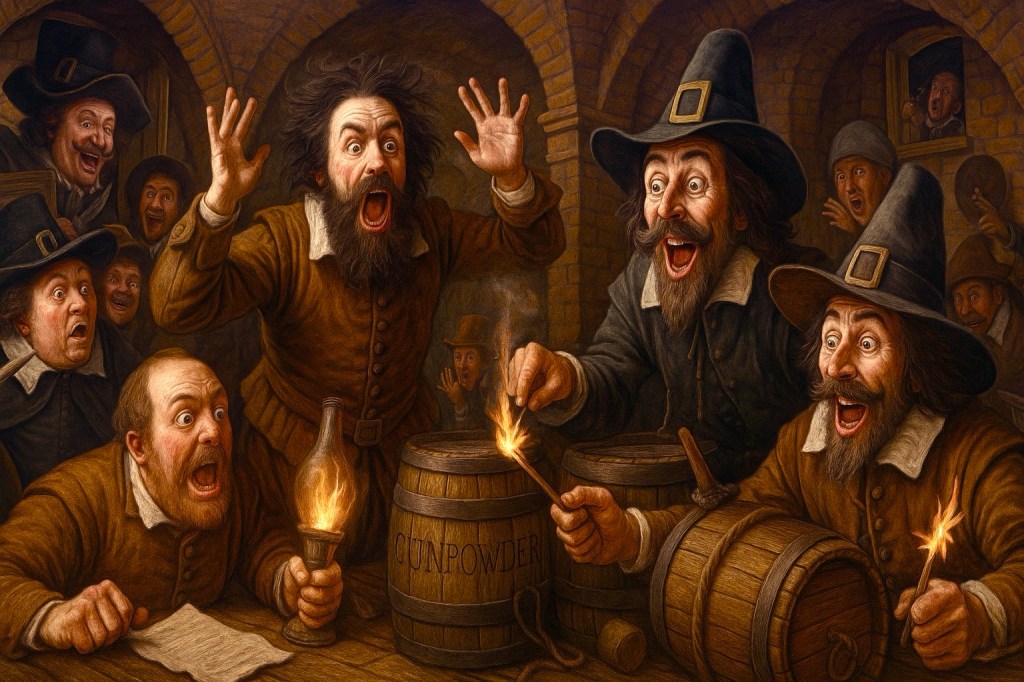
If you ask the average Briton who led the Gunpowder Plot, chances are they’ll mutter “Guy Fawkes” while half-heartedly stirring their tea. Fireworks, effigies, and a roaring bonfire dedicated to burning Mr Fawkes have immortalised him as the nation’s favourite terrorist (or anti-hero, depending on how rebellious you’re feeling). But the truth is, Guy Fawkes was little more than a hired hand – a middleman with a bag of gunpowder, if you will. The real mastermind of the operation was a charismatic Catholic gentleman named Robert Catesby. Yet, thanks to a twist of fate, Fawkes now has fireworks in his honour, while Catesby remains as forgotten as last week’s leftovers.
So, let’s put down the sparklers, peer past the smoke, and ask ourselves: why do we celebrate the bloke who failed to light the fuse, rather than the man who actually planned the whole scheme?
Robert Catesby: A Catholic with a Mission (or a Vendetta?)
In the turbulent waters of 17th-century England, religious tolerance was about as rare as a quiet night in the Globe Theatre. Catholics lived in constant fear of persecution under Protestant rule. Enter Robert Catesby – a man with a bone to pick and, more importantly, a vision. Catesby was charismatic, noble, and thoroughly fed up with the anti-Catholic sentiment that plagued England. He wasn’t just another disgruntled subject; he was a man with purpose.
Unlike Fawkes, who was essentially contracted as the ‘guy’ (no pun intended) to handle explosives, Catesby was the heart and soul of the plot. He planned it, recruited for it, and threw his money into it. Without Catesby, the Gunpowder Plot would have been a half-baked idea tossed around a smoky inn. He wasn’t merely interested in blowing things up; he had a grand design: to kill King James I, incite a Catholic uprising, and restore the faith to a persecuted people. Catesby was not just after rebellion; he was chasing a revolution.
If only the story had ended there – with Robert Catesby receiving quiet applause as England’s great Catholic saviour. But alas, it went spectacularly wrong, and Fawkes was the unfortunate face left holding the metaphorical bomb bag.
Guy Fawkes: The Hapless Henchman or Daring Fall Guy?
Here’s the irony of the whole affair: while Catesby was busy stirring up political turmoil and rallying conspirators, Fawkes was simply… following orders. Fawkes was the plot’s powder man, chosen for his experience with explosives, a valuable (if niche) skillset for those seeking to assassinate a monarch by turning Parliament into smithereens. But he was hardly the brains of the operation.
So why does poor Fawkes get all the attention? Timing, as they say, is everything. On 5 November 1605, the night before the opening of Parliament, Fawkes was caught in the act, standing watch over 36 barrels of gunpowder. His arrest made headlines – at least, by 17th-century standards – and while Catesby was off making an attempted getaway, Fawkes was the one dragged before the king. Imagine a team project where one person does all the planning, and the other just shows up on presentation day. Then, when it all falls apart, guess who gets the blame? Fawkes essentially became a scapegoat with a catchy name.
Why We Should Honour Catesby (But Probably Won’t)
Historically, we do love a figurehead for our failures, and poor Fawkes has become the poster child for the failed assassination attempt. But make no mistake: it was Catesby who assembled the team, poured his wealth into the mission, and inspired others to follow his vision, even as the plan slowly unravelled. If anyone deserves a nod for audacity and ambition, it’s Robert Catesby.
Imagine, for a moment, if ‘Catesby Day’ replaced ‘Guy Fawkes Night’. Instead of an anonymous Guy effigy, we’d build a Catesby likeness, complete with a noble (yet slightly manic) expression, placed atop the bonfire with great ceremony. A more accurate reflection of the plot, perhaps, but alas, Catesby’s name lacks the alliterative charm of ‘Guy Fawkes.’ Besides, the rhyme scheme of “Remember, remember, the fifth of November, Catesby’s treason and plot,” doesn’t quite have the same ring to it.
The Legacy of Failure
It’s a historical curiosity that a monumental failure like the Gunpowder Plot should be so celebrated. In a sense, we’re commemorating the failure of an attempted mass murder – an unsettling concept, no doubt. But Catesby and his conspirators, perhaps, would take solace in knowing that their attempt has endured in British culture, even if it’s as a cautionary tale. Catesby might even appreciate the irony: his plot failed spectacularly, but his cause – Catholic equality/emancipation – continued to simmer, even if it took centuries to reach the tolerance he envisioned.
In Defence of the Forgotten Visionary
By all rights, Robert Catesby should be the one etched into British memory. He wasn’t the lackey found lurking in the basement; he was the visionary who aimed to rewrite England’s destiny. Fawkes may have been the public face, but it was Catesby who gave the Gunpowder Plot its purpose, direction, and ambition. His name should be remembered for his convictions, not for the actions of his less-than-brilliant partner.
So, this 5th of November, as you watch the fireworks and smell the burning wood, spare a thought for Robert Catesby, the forgotten man behind the infamous plot. After all, the most powerful figures in history are often those who remain out of the spotlight. Guy Fawkes may have had the gunpowder, but Robert Catesby had the spark.
So, what was the problem with Catholics in early 17th-century England? It was a time when choosing the wrong religion wasn’t just a personal inconvenience; it was practically a crime against the state. Under the reign of James I, Catholicism was about as popular as a dead rat in a teapot – as children, we weren’t allowed to say the word ‘rat’ out loud; we had to spell it, R.A. T – added for absolutely no reason at all. Catholics, suspected of being more loyal to the Pope in Rome than to the King in London, were subjected to all sorts of creative indignities, not least of which was the dreaded recusancy fine. In other words, they were charged for refusing to attend Church of England services, as if missing a state-mandated Sunday sermon was some kind of audacious act of treason.
For context, these fines weren’t some gentle slap on the wrist. No, recusancy fines were hefty and could ruin a family’s finances faster than a weekend spree in London. Imagine the absurdity of being a devout Catholic who’s just trying to stay true to their faith and then receiving an invoice from the government because you missed a rousing Anglican sermon. The fine was effectively a membership fee for a club you didn’t even want to join. If you failed to cough up the cash, you could expect to be stripped of property, or even thrown in jail. These were fines with teeth – by which I mean they’d take your house and your horse if you couldn’t pay.
Of course, the government’s official stance was that these fines were in place to encourage conformity, but that’s putting it mildly. They weren’t encouraging anything; they were grinding Catholics down. The entire policy was rooted in paranoia that Catholics might conspire to overthrow Protestant rule. With memories of the Catholic Queen Mary I and her penchant for burning Protestants still fresh, the establishment wanted Catholicism stamped out – or at least financially crippled into meek submission.
Then there was the Oath of Allegiance, which Catholics had to swear, essentially pledging that they wouldn’t try to assassinate the king or overthrow the government. While that might seem reasonable to us, it was a big ask at the time, as it implied that Catholics were inherently suspicious characters who had to be legally bound not to blow things up. It’s a bit like asking every guest at a dinner party to sign a form promising they won’t pilfer the silverware. Quite the warm welcome!
So, in the years leading up to the Gunpowder Plot, Catholics in England were like beleaguered characters in a tragicomedy. They were persecuted, harassed, fined, and suspected at every turn. They couldn’t attend their own mass without looking over their shoulders, and they had to pay up for skipping the one they didn’t want to attend. They were a marginalised community who had everything to lose and little to gain, and they were under immense pressure to conform while desperately clinging to their faith.
This bubbling resentment, and perhaps a touch of exasperated humour in the face of such oppression, helped set the stage for Robert Catesby’s infamous plot. For Catesby and his band of conspirators, the Gunpowder Plot wasn’t just about blowing up Parliament; it was about putting a stop to the exhausting cycle of fines, suspicions, and coercion. You might even say that the Gunpowder Plot was the 17th-century equivalent of telling the establishment, “I’ve had enough of your nonsense, thank you very much.” Incidentally, we couldn’t be blamed for saying exactly that to our current lot!
So, if we look back at the Gunpowder Plot with a little empathy, it’s almost understandable why they tried. Not saying we’d have packed 36 barrels of gunpowder ourselves, but if we’d been fined half a year’s wages for not attending a service we had no faith in, we’d at least think about it.
A few years ago, a television drama was made called, Gunpowder, which I thought wasn’t too bad, although perhaps a little historically incorrect: the execution of Margaret Clitherow.
The depiction in Gunpowder of a female relative of Robert Catesby being publicly pressed to death has a basis in historical fact. Robert Catesby, played by Kit Harrington, (the Bastard from Game of Thrones, in case you didn’t know) was related to a woman who suffered this brutal fate. Her name was Margaret Clitherow, a Catholic martyr who was pressed to death in 1586 – though it happened almost twenty years before the events of the Gunpowder Plot, so she wasn’t directly involved in the plot itself. Catesby, however, was connected to her by marriage; Margaret Clitherow was the sister-in-law of his wife, Catherine Leigh, making her part of his extended family.
Margaret Clitherow, known as the ‘Pearl of York,’ was a devout Catholic at a time when practicing Catholicism in England was perilous business. Under Queen Elizabeth I, Catholicism was effectively outlawed, and attending mass could lead to fines, imprisonment, or worse. Clitherow’s crime was that she harboured Catholic priests in her home and held secret masses, which, under Elizabethan anti-Catholic laws, was considered an act of treason.
In March 1586, she was arrested, and when she refused to plead to the charges – knowing that a plea would put her family and friends at risk of being implicated – she was sentenced to “peine forte et dure,” a rare but horrific form of execution by pressing. This method of execution involved placing a heavy door over the accused’s body and slowly piling it with rocks until they were crushed to death. Margaret Clitherow endured this terrible punishment in public, suffering for about fifteen minutes before she succumbed, all for her refusal to deny her faith or betray her community. She was later canonised as a saint by the Catholic Church in 1970.
The choice to depict this in Gunpowder may have been slightly anachronistic but was intended to show the severe reality of anti-Catholic persecution that deeply influenced Catesby’s motives. The gruesome death of Clitherow was likely part of the collective trauma and memory among Catholics, including Catesby, underscoring the hostility they faced. While the real Catesby didn’t witness his relative’s pressing first-hand, the story of Margaret Clitherow’s martyrdom would certainly have resonated within his family and contributed to his conviction that reform could not be achieved peacefully.
The depiction in Gunpowder captures the essence of what it meant to be Catholic in Elizabethan and Jacobean England: risking life and limb simply for practicing one’s faith. Margaret Clitherow’s death serves as a powerful, if horrific, reminder of the suffering Catholics endured, and in this context, it’s understandable why someone like Catesby might ultimately resort to desperate and drastic measures.
Now I’m a Catholic by default, and although at this moment I’m spiritually homeless (I have no church locally that I’d like to attend, so I travel to the City of Durham and hold my breath while I take communion in the Anglican Cathedral there once a week), I abhor the idea of Bonfire Night – why should I celebrate the oppression of my distant brothers and sisters in faith?
Bonfire Night can carry a dark tone for us Catholics, given its origins in a time of harsh anti-Catholic repression. For those who know the history, the festivities can feel like an annual commemoration of a brutal crackdown on people of faith – a day when one particularly desperate plot to resist a lifetime of oppression failed spectacularly, with severe repercussions for Catholics across the country.
For Catholics, Bonfire Night isn’t just about fireworks and fun; it’s a reminder of the hardships that Catholics faced under Protestant rule. The idea that the British establishment responded to the Gunpowder Plot not with empathy but with even stricter laws – laws that made practicing Catholicism almost impossible – turns the bonfire celebrations into a bitter irony.
And let’s not forget that Catholics were once required by law to celebrate Bonfire Night! The Observance of 5th November Act, passed in 1606, actually made it mandatory for people to celebrate the plot’s failure, which must have been particularly galling for those who secretly sympathised with Catesby’s cause or at least understood his motivations. Imagine being a devout Catholic forced to celebrate your own marginalisation!
In modern times, Bonfire Night has largely lost its original religious and political connotations. Most people today don’t even connect it to anti-Catholic sentiment; they just see it as a fun tradition. But for those who know the history – especially Catholics who have lived with that legacy – opting out of Bonfire Night can be a personal, quiet act of respect and remembrance for those who suffered under the weight of oppressive laws.
It’s fair to say, then, that for many Catholics, the best way to “remember, remember” the 5th of November is simply by choosing not to celebrate it.
In summary, the Gunpowder Plot wasn’t quite the legendary tale of Guy Fawkes we’ve come to know, but rather the brainchild of Robert Catesby, a man with a flair for drama, a devotion to his Catholic faith, and a remarkably loose grip on the concept of subtle resistance. Catesby, unlike the hapless Guy, was the true mastermind, plotting to rid England of the persecution his fellow Catholics suffered, like being fined into oblivion for skipping Anglican services, and having to pledge in writing that they wouldn’t blow up the king – a pledge many might have signed with their fingers crossed.
While Guy Fawkes has become the reluctant face of Bonfire Night, history has quietly forgotten Catesby, the visionary behind the gunpowder stockpile. And if we’re honest, the treatment of Catholics back then was as subtle as a sledgehammer, exemplified by the horrific punishment of his martyred relative, Margaret Clitherow, who was literally pressed to death for hosting a mass or two.
Today, though Bonfire Night is all sparklers and fireworks, for Catholics, it can feel a bit like celebrating an annual reminder of state-sanctioned persecution. So, for those in the know, perhaps the best way to get through the 5th of November is to take a step back, skip the bonfire, and maybe give a nod to Catesby – the original spark behind a plan that was, admittedly, far too ambitious to handle.
Don’t get your fingers burned!

 Wording
Fascinating!
Spelling r.a.t. made me smile, I wonder if the origin was someone saying ‘rats’ with intent?
Mostly my mother, who would cringe with a passion at the word! Needless to say, we’d occasionally tease her by repeating it within earshot – always followed by a quick and sharp telling off!