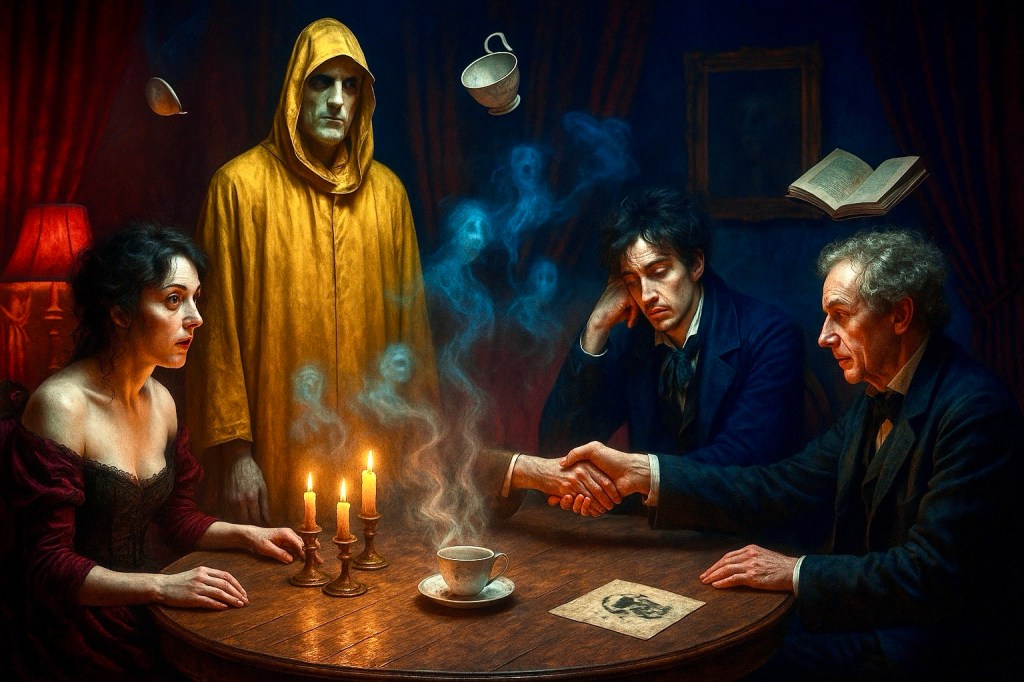
The unifying thread in the best stories is a mysterious, fictional play – also called The King in Yellow – which is said to drive anyone who reads it into a state of gibbering madness. Of course, Chambers teases us with snippets of this forbidden text but never lets us see the full thing, much like an infuriating restaurant that insists on telling you about their legendary dessert without ever actually serving it. We are left to piece together its horrors from the shattered minds of those unfortunate enough to have perused its pages, which is both tantalising and deeply unfair.
The idea of a book so dangerous it unravels reality is deliciously unsettling, and I can’t help but think that Lovecraft took one look at this concept and muttered, “Yes, I’ll be having that.” The creeping dread, the whispered insanity, and the sense of something vast and incomprehensible lurking just beyond human understanding all feel like the grandparent of the Cthulhu Mythos. But where Lovecraft would later commit fully to the horror of the unknown, Chambers pulls a narrative sleight-of-hand that still bewilders me to this day.
The opening stories of the collection are as rich and evocative as an absinthe-fuelled nightmare in Montmartre. The Repairer of Reputations is a personal favourite – one of the earliest examples of the unreliable narrator in horror fiction, starring a megalomaniacal lunatic convinced he’s destined to rule America with the help of an ominous suicide chamber. It’s the kind of story that makes you wonder if you accidentally inhaled laudanum fumes while reading it. It’s insane, paranoid, and utterly glorious.
The Mask follows, an eerie little tale about alchemy, doomed love, and the ability to turn people into statues, which sounds a lot like what Medusa was up to but with more ennui. Then there’s In the Court of the Dragon, featuring one of the most sinister organists in literature – because if anyone is going to be an agent of cosmic doom, it’s a church musician. The Yellow Sign, arguably the most famous of the bunch, introduces us to a grotesque, unsettling watchman who seems to be a harbinger of doom, creeping into an artist’s dreams with the persistence of an unpaid tax bill.
These first four stories are chef’s kiss levels of excellent – soaked in decay, despair, and an omnipresent sense of dread. They make you feel as if you’ve glimpsed something truly awful just out of the corner of your eye, only to turn and find it’s vanished. If the book had continued in this vein, we’d be talking about it in the same breath as The Call of Cthulhu. But alas…
At this point, it all goes a bit…French, and one might reasonably expect more tales of existential horror, further explorations of the dreaded play, or at least another creepy, looming figure in a decrepit New York apartment. Instead, the book takes a sharp left turn into wistful love stories set in bohemian Paris.
Now, I’m not opposed to a bit of turn-of-the-century French romanticism, but reading these later stories after the psychological horror of the first half feels like being promised a haunted house experience and instead being taken to a quaint little café where everyone is discussing art and unrequited love. It’s as though Edgar Allan Poe began writing a chilling ghost story and then suddenly decided he’d rather be Oscar Wilde. The tonal shift is so jarring that I had to check whether I’d accidentally picked up a completely different book halfway through.
These latter tales are, in their own right, charming enough – full of doomed artists, lost loves, and people sighing dramatically at the Seine – but they belong in another collection entirely. The connective tissue between them and the first half is tenuous at best, like a rickety bridge held together with a bit of string and a prayer.
The King in Yellow is a strange, frustrating, brilliant, and inconsistent read. The first half is an eerie, unsettling precursor to cosmic horror, filled with an atmosphere of creeping madness and unseen terrors. The second half feels like an entirely different author took over, one who had no time for cursed plays and eldritch nightmares but a great fondness for melancholic artists with fragile hearts.
It’s a book I simultaneously adore and want to shake by the shoulders. If you go in expecting a fully realised horror mythos, you may be left bewildered. If you accept it for what it is – a literary chimera, part horror, part romantic melodrama – you might just fall under its peculiar, inconsistent spell. Either way, The King in Yellow is worth reading, if only to experience that rare literary phenomenon: a book that both terrifies you and makes you wonder if you accidentally wandered into the wrong genre.

 Wording