The Life of a Stupid Man was published posthumously in 1927, the same year Ryūnosuke Akutagawa took his own life. That makes this work seem like a literary suicide note – one final, unfiltered outpouring of his disillusionment and despair. It wasn’t crafted for an audience so much as exhaled, a last gasp of a man who had already decided there was nothing left worth saying.
Knowing this while reading makes every sentence feel heavier, every vignette more haunting. There is no sense of a future, no attempt at resolution – just a collection of thoughts and memories left behind, like abandoned possessions in an empty house. It is as if he was tidying up the clutter of his own mind before departing, leaving behind only the bare essentials: regret, exhaustion, and the quiet certainty that none of it mattered in the end.
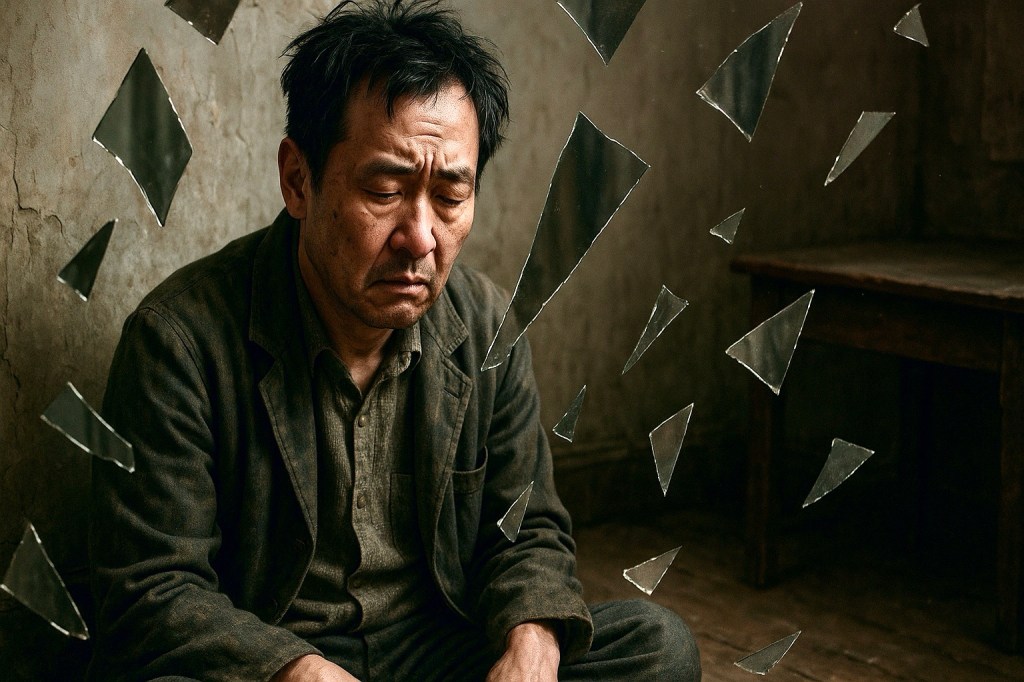
The Life of a Stupid Man is less a story than a collection of brittle, splintered memories, like shards of glass from a broken mirror – each reflecting a different fragment of a wasted, tormented existence. Reading it feels like peering into the mind of someone who has already given up, who drifts through the wreckage of his own life without the strength to salvage anything from it. Akutagawa does not so much narrate as he mutters to himself, flicking through the pages of his past with the same weary indifference one might leaf through an old diary before tossing it onto a dying fire.
The structure is jagged, deliberately fragmented, like the consciousness of someone caught between the waking world and feverish nightmare. Moments of childhood, relationships, fleeting joys, humiliations – each given only as much attention as a passing thought before another takes its place. The result is a haunting, elliptical work, one that drips with existential fatigue. Akutagawa has no patience for coherence because coherence is a luxury for those who still believe life holds meaning. His protagonist – who is, of course, Akutagawa himself – wanders through the ruins of his past like a man in a bombed-out city, looking for something of worth amid the rubble and finding nothing but dust.
I recognise this kind of exhaustion. I know what it is to exist in a world that has long since ceased to be hospitable, to feel that life is not lived but endured. There are times when past and present blur, when memories surface not as warm recollections but as accusations, proof of one’s own failure. Like Akutagawa, I have spent years shackled to ghosts – those of my own making, and those I inherited. He feared the spectre of madness, the idea that some hereditary curse would consume him from within. My own demons have different names, but I have known the same quiet terror of feeling my own mind turn against me.
Akutagawa’s prose is precise, cutting, never indulgent. He doesn’t wallow in despair, doesn’t beg for sympathy. If anything, there is a cruel detachment in the way he catalogues his suffering, like a doctor clinically noting the symptoms of a terminal disease. There’s no attempt to shape his pain into something noble, no effort to extract meaning from it. He simply observes, as though he has already accepted that life is little more than an accumulation of regrets, a ledger of disappointments that ends in a final, decisive failure.
What lingers most about The Life of a Stupid Man is its stark, unvarnished honesty. There is no redemption here, no last-minute revelation that makes suffering worthwhile. Just the slow, inevitable slide into the abyss. It is the literary equivalent of staring into a dimly lit mirror and realising that whatever light once existed in your eyes has long since flickered out.
I don’t know if Akutagawa found peace in the end. I doubt he believed in such things. But in these pages, he leaves behind something brutally real – an unflinching testament to what it means to be consumed by one’s own mind. And for those of us who have known the weight of such thoughts, his words are not merely literature. They are a mirror, held up to the darkest corners of our own existence.

 Wording