There are few stories in the Gospels that capture the heart of human longing quite like that of Zacchaeus, the despised tax collector who climbed a tree to see Jesus. It is a tale of transformation, of a man lost in the world but found by grace. When I reflect on this account from Luke 19:1–10, I see more than just a wealthy man seeking a glimpse of a famous rabbi – I see the universal yearning to be seen, known, and loved.
A Man of Status, Yet an Outcast
Zacchaeus was, by all accounts, a man of influence. As chief tax collector in Jericho, he had power and wealth, but at a terrible cost. Tax collectors in first-century Judea were regarded as collaborators with the Roman oppressors, often accused of extortion and greed. His position would have afforded him luxury, but it also brought isolation. He was an outcast, rich in possessions but bankrupt in companionship and honour.
Yet, for all his status, Zacchaeus was small – not just in stature but, one could argue, in the eyes of his community. When he heard that Jesus was passing through Jericho, something stirred in him. Perhaps he had heard of this teacher who ate with sinners, who touched the unclean, who spoke of a kingdom where the last would be first. Perhaps, deep down, he longed for a different kind of wealth – one that could not be measured in coins.
Climbing Above the Crowd
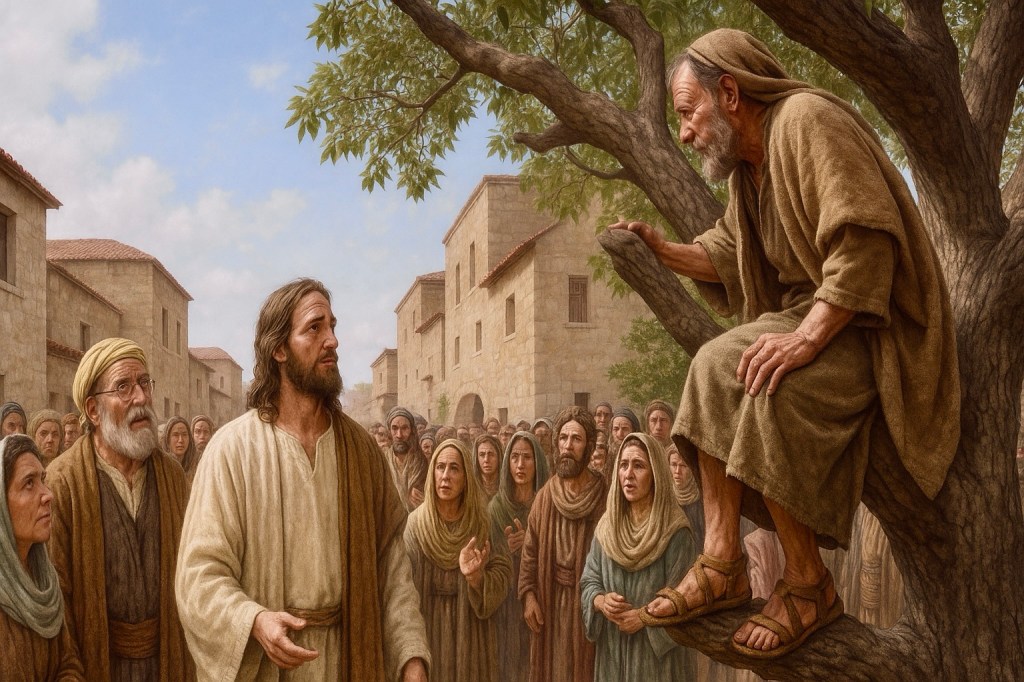
Unable to see over the heads of those who despised him, Zacchaeus did something extraordinary—he climbed a sycamore tree. It is a striking image: a grown man, a wealthy official, clambering up into the branches like a child. Dignity was cast aside in favour of a desperate, unashamed pursuit of Jesus.
This moment speaks profoundly to me. How often do we, like Zacchaeus, find ourselves blocked by the weight of our past, our reputation, or the judgment of others? The crowd was a physical and symbolic barrier – one that told Zacchaeus he was too sinful, too undeserving, too small to stand among them. Yet he refused to let the crowd define his fate. Instead, he lifted himself above their scorn, seeking Jesus with a heart that, perhaps for the first time, was truly open.
The Gaze of Grace
Then comes the moment that changes everything. Jesus reaches the spot, looks up, and calls Zacchaeus by name:
“Zacchaeus, come down immediately. I must stay at your house today.”
There is no rebuke, no conditions, just an invitation. Jesus, the Son of God, sees him – not as a hated tax collector, not as a sinner to be condemned, but as a man worth knowing, worth saving.
I imagine the sheer shock and wonder Zacchaeus must have felt in that instant. For years, he had likely lived with the knowledge that people muttered his name in disgust. And yet here was Jesus, calling him with love and urgency, not just acknowledging him but choosing to be his guest.
The crowd grumbles, of course. “He has gone to be the guest of a sinner!” they murmur, unable to comprehend a love that reaches beyond moralistic boundaries. But Jesus does not waver, and neither does Zacchaeus.
A Heart Transformed
Faced with such overwhelming grace, Zacchaeus responds not with words but with action. He pledges to give half of his possessions to the poor and to repay anyone he has cheated four times over – far beyond what Jewish law required. This is not mere remorse; it is repentance in its truest form. He does not justify himself, nor does he seek a private moment of forgiveness – he proclaims his transformation publicly, in front of those who had condemned him.
And Jesus affirms it:
“Today salvation has come to this house, because this man, too, is a son of Abraham. For the Son of Man came to seek and to save the lost.”
These words strike deep. In them, Jesus restores Zacchaeus not only to God but also to his people. The phrase “son of Abraham” is not mere sentiment – it is a declaration that Zacchaeus, the outcast, is fully part of the covenant, the family of faith. He is no longer just a tax collector; he is a redeemed man, brought home by grace.
What This Story Teaches Me
Every time I return to this passage, I find myself identifying with Zacchaeus in different ways. I know what it is to feel small, to feel unworthy, to be trapped by the weight of my own past. I know what it is to long for a glimpse of something greater, to climb above the noise of the world in search of meaning.
But most of all, I am struck by the way Jesus sees him – sees all of us. The world defines people by their worst mistakes, their failures, their reputations. Jesus, however, looks beyond all of that and calls us by name, offering a place at His table.
Zacchaeus teaches me that no one is too far gone, too lost, or too despised to be transformed by grace. He reminds me that seeking Jesus often requires humility and boldness, a willingness to rise above the crowd and risk looking foolish in the pursuit of something greater.
And, perhaps most importantly, Zacchaeus’ story is a reminder that the love of Christ does not merely forgive – it restores. It lifts the lowly, rewrites the narrative, and invites even the most unlikely souls into a new life.
And that, to me, is the very heart of the Gospel.

 Wording