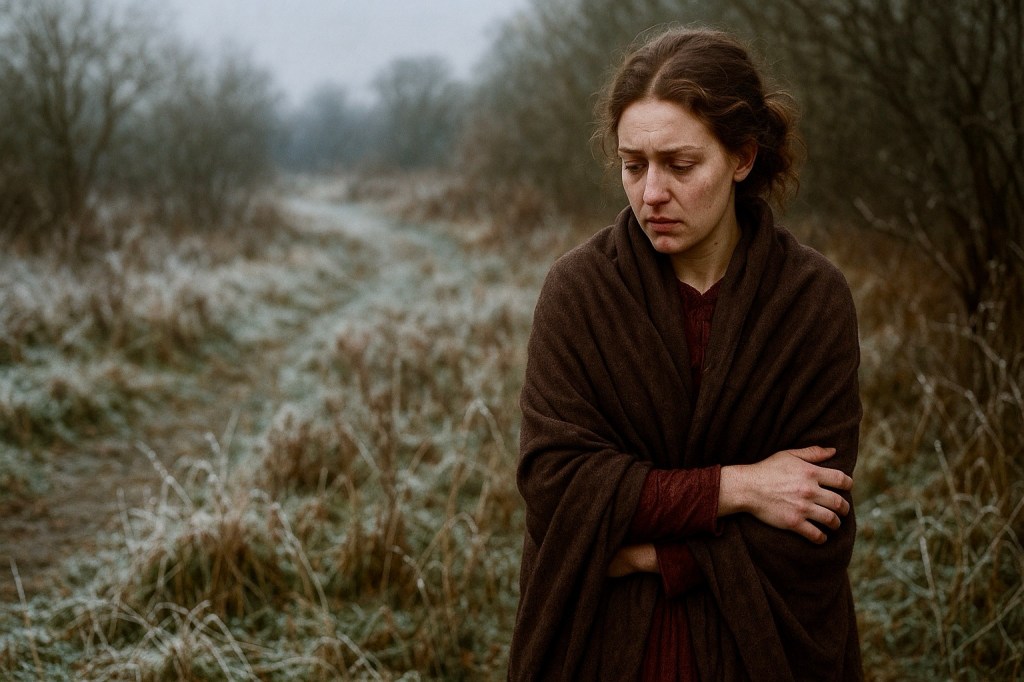
Christina Rossetti’s A Daughter of Eve is a lamentation in miniature, a bitter draught distilled into three stanzas, each drop heavy with regret. It is the wail of one who has slept too long beneath a summer sun and awoken to find the warmth fled, the landscape altered beyond retrieval. The speaker’s grief is not loud but weighted, a stone pressing upon the chest, a sorrow that does not storm but settles – like frost creeping through the bones.
The poem’s opening lines are a confession, an indictment of self:
‘A fool I was to sleep at noon,
And wake when night is chilly‘
This is no ordinary sleep, no mere lapse into rest; it is a heedless surrender, a failure of vigilance. There is something almost Biblical in the phrasing, an echo of the foolish virgins who let their lamps go out. The midday slumber is an abandonment of duty, a negligence of life’s brief and golden allotment. The speaker’s awakening is no gentle rousing but a rude, piercing realisation – the cold moon stands where once the sun burned high. The world has turned, indifferent to their drowsing.
The poet does not let us linger in this imagery of slumber and cold alone; she presses upon us the deeper wound, the metaphor of wasted or squandered love:
‘A fool to pluck my rose too soon,
A fool to snap my lily.‘
What a cruel irony – to pluck a flower too soon, thinking to possess it, only to find it withers in the hand. There is something almost violent in the act of ‘snapping’ the lily, as though the speaker, in haste or folly, has not merely harvested but ruined something delicate, something that needed time to unfurl. There is no sense of another’s betrayal here, no faithless lover to bear the brunt of blame; rather, it is the speaker’s own impetuousness that has led to this barrenness, this ‘comfortless cold.’
The second stanza takes the metaphor of the neglected garden and extends it to a more profound devastation:
‘My garden-plot I have not kept;
Faded and all-forsaken,‘
A garden untended becomes a place of decay, not through any active destruction but through sheer abandonment. How easy it is to imagine the speaker walking through the ruins of what was once lush, once fertile, now overrun with weeds and emptiness. Rossetti, ever the master of subtle yet searing despair, then delivers one of her most gutting lines:
‘I weep as I have never wept:‘
Here, grief is fresh, raw, unprecedented. There is no old wound reopening, no accustomed sorrow; this is something new and terrible, something beyond past sorrows, an epiphany of loss. And the cause?
‘Oh it was summer when I slept,
It’s winter now I waken.‘
Could there be a more perfect summation of regret? The speaker has lost not merely a season but an entire state of being. The warmth, the possibility, the vibrancy of youth or love – all gone. And now, awakening comes not with the dew of dawn but with the ice of winter. How bitter that moment of comprehension must be.
The final stanza offers no solace, no glimmer of redemption. There is no quaint hope of spring, no soft promise of time’s restorative touch. To those who would offer such comforts, the speaker has only this:
‘Talk what you please of future Spring
And sun-warmed sweet tomorrow:—‘
The caesura here, the pause after ‘tomorrow,’ is a chasm of disbelief. How cruelly hollow such reassurances sound to one who has lost all. The speaker does not rail against fate; they do not curse or cry out. Instead, they are stripped bare, desolate, without even the desire to feign hope:
‘Stripped bare of hope and everything,
No more to laugh, no more to sing,
I sit alone with sorrow.‘
This is no youthful, melodramatic grief, no outburst of self-pity. This is something more ancient, more final. Hope is not merely bruised but gone; joy is not merely absent but impossible. It is a portrait of one who does not even have the energy to rage against loss but merely to sit in it, like Job upon his heap of ashes.
There is something strikingly Romantic in Rossetti’s imagery, but unlike Keats or Shelley, there is no grandeur in this decay – no beauty in this sorrow. The poem is austere in its grief, like a tree in winter stripped of even the last withered leaf. Love, innocence, opportunity – all were given, squandered, lost. The world turns on, indifferent to the one left behind.
In A Daughter of Eve, Rossetti does not merely craft a lament; she chisels out a tombstone. This is the poetry of reckoning, of bitter hindsight, of knowing that the past cannot be rewritten. And perhaps that is the poem’s deepest wound – that we, too, recognise this truth, and that one day, we may find ourselves waking into winter, with only sorrow for company.

 Wording