Reading Gogol’s Diary of a Madman is like stepping onto what you think is a quaint cobbled path, only to find it’s actually a rickety conveyor belt leading straight into the abyss. One minute, you’re chuckling at a disgruntled clerk grumbling about his superiors, and the next, you’re clutching your head, wondering if you, too, have started hearing dogs whisper government secrets. It’s the sort of book that makes you question whether you should be laughing, crying, or checking yourself into a quiet retreat in the countryside for a nice long lie-down.
Gogol was writing during the Romantic period, but he was about as Romantic as a damp sock in a thunderstorm. Whereas the Romantics were busy penning grand odes to nature, sublime landscapes, and soulful heroes staring wistfully into the distance, Gogol was more interested in grotesquery, absurdity, and the sheer bureaucratic misery of everyday life. If the Romantics were composing symphonies of the human spirit, Gogol was in the corner, playing a broken kazoo and cackling at the lot of them.
He was pushing back, no doubt – shoving us away from Romantic idealism and straight into the gutter, where human folly is laid bare in all its ridiculous, tragic, and occasionally dog-letter-writing glory. In a way, Diary of a Madman is the perfect antidote to Romantic heroism: instead of a noble, tortured soul finding transcendence in nature, we get a deranged office worker claiming the Spanish throne. It’s less Byron in exile, more Bloke in a padded cell. And honestly, I rather think that’s what makes it so brilliant.
Gogol’s Diary of a Madman is, to put it lightly, a rather colourful descent into lunacy – akin to watching a man attempt to waltz down a staircase while wearing a blindfold and roller skates. It is, without doubt, one of the most unsettlingly comic, psychologically astute, and darkly absurd pieces of literature ever to tumble out of a writer’s mind. Reading it is like biting into what you think is a chocolate biscuit, only to discover it is, in fact, a lump of coal dipped in treacle – baffling, bitter, but oddly compelling.
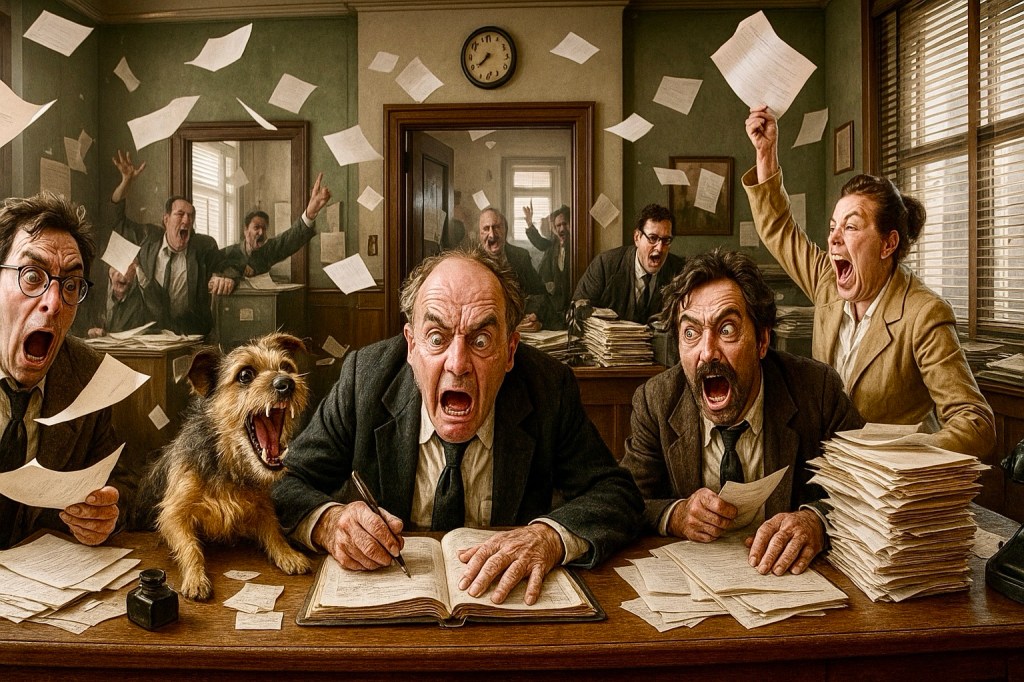
The story follows Poprishchin, a petty civil servant whose days are spent sharpening quills and suffering the indignities of being lower than pond scum in the great bureaucratic food chain. He is the sort of man who, in today’s world, would most certainly be found ranting on X (Twitter) about how the manager at Greggs refuses to acknowledge his rightful status as Emperor of Spain. His diary entries begin with the mundanities of his work, his unrequited love for the boss’s daughter, and his general feelings of existential grubbiness. But soon, things take a turn for the surreal – dogs start writing letters (which, I must say, is as alarming a literary event as encountering a talking haddock – and I’ve tried putting a pen into the paw of my pup but she just tries to eat it), and Poprishchin becomes convinced he is of royal blood.
What makes Diary of a Madman so brilliant is Gogol’s ability to have us chortling at Poprishchin’s absurdity while simultaneously feeling the cold breath of dread creeping down our necks. It’s the literary equivalent of laughing at a clown until you realise the clown is sharpening a knife. We chuckle at his pretensions, his misanthropic musings, his wild claims – but underneath it all, there’s an unsettling truth. Poprishchin’s madness is not just the result of a disordered mind, but of a disordered society, one that grinds the individual into dust beneath the boot of bureaucracy. His delusions are, in many ways, the only logical response to a world that refuses to see him as anything more than a human paperweight.
Gogol’s satirical brilliance lies in how deftly he skewers the rigid hierarchy of Tsarist Russia. Poprishchin’s obsession with rank is not just a quirk; it is an affliction imposed by a society that sees a man’s worth as directly proportional to the fanciness of his hat. The more he is dismissed and humiliated, the more his mind unravels – until, in a final act of mental acrobatics, he crowns himself Ferdinand VIII of Spain, proving once and for all that if you tell a man he is nothing for long enough, he will construct an elaborate fantasy in which he is everything.
By the time we reach the final diary entries – gibbering, desperate, and barely coherent – the comedy has all but drained away, leaving us with a stark portrait of isolation and despair. Poprishchin’s fate is not merely a personal tragedy but a warning: when a society values form over substance, status over soul, and bureaucracy over humanity, madness may not be the exception but the inevitable result.
In short, Diary of a Madman is a masterclass in satirical storytelling, a tragicomedy of the highest order, and an eerily prescient study of the fragile human mind under oppressive systems. It is as funny as it is unnerving, as ridiculous as it is profound – a bit like watching a man argue with a lamppost and suddenly realising that, against all odds, he might actually have a point.
As an aside, just as Gogol gave the Romantics a firm shove into the absurd, Austen took one look at the Gothic movement, rolled her eyes, and decided to have a good old-fashioned piss-take with Northanger Abbey. It’s as if she saw all these breathless heroines fainting in moonlit corridors and said, “Right, enough of that nonsense.”
The whole novel is a glorious satire – Austen takes the classic Gothic tropes (mysterious mansions, sinister aristocrats, and ominous secrets) and gleefully dismantles them. Poor Catherine Morland, bless her, is so enamoured with The Mysteries of Udolpho that she starts seeing conspiracies where there are none, convinced that General Tilney is a villain ripped straight from the pages of Radcliffe. It’s the literary equivalent of watching someone work themselves into a frenzy over a creaky floorboard, only for it to turn out to be a perfectly innocent case of shoddy craftsmanship.
But what makes Northanger Abbey such a delight isn’t just the satire – it’s that Austen does it with such an affectionate smirk. She’s mocking the excesses of Gothic fiction, yes, but she also understands why people love it. It’s the same way one might laugh at someone for taking Wuthering Heights too seriously while secretly enjoying a bit of Heathcliffian melodrama on a rainy evening.
So in a way, Gogol and Austen were kindred spirits – both saw the prevailing literary trends of their time and decided to twist them into something far more subversive. The difference is that Austen did it with a knowing wink, while Gogol did it with a maniacal cackle and a handful of talking dogs.

 Wording