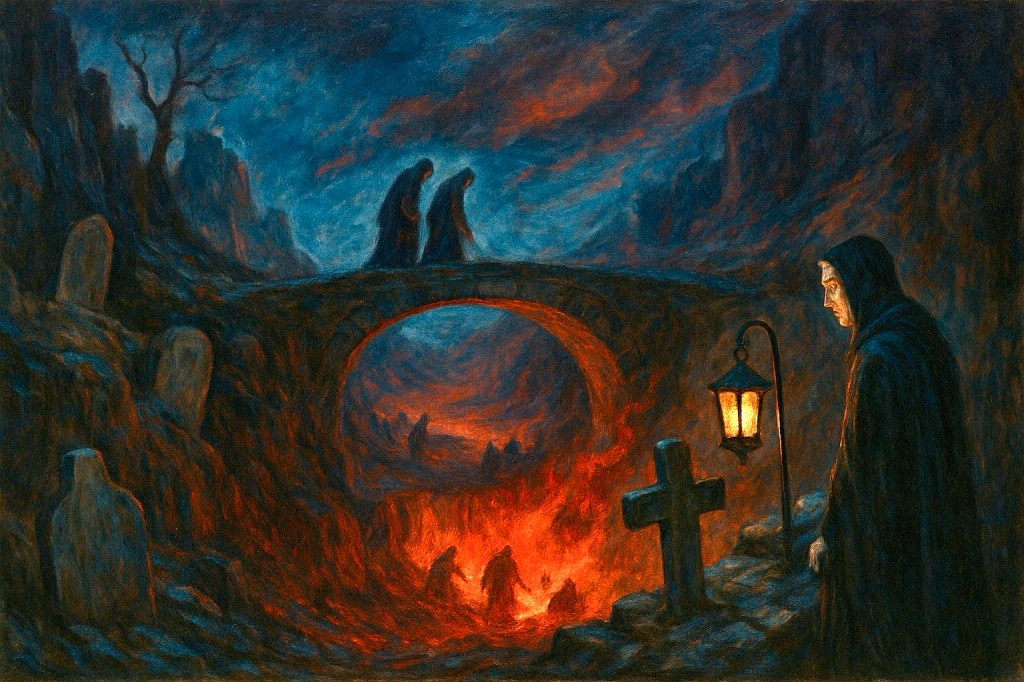
Here we are once more, arm in arm with Dante, descending into the infernal depths — and I must confess, my curious little obsession with the notion of Hell continues to bloom like a thorny rose. Perhaps it’s the slow march of time, or the creak in my knees, but I do find myself pondering the great exit door of life with increasing regularity. Mortality, once a distant rumour, now taps politely (and occasionally not so politely) at the edge of my thoughts.
When first I opened Dante’s Inferno, I felt much like a man poking his head into a dark, creaking cellar — heart in mouth, half-expecting a spider to leap onto his nose. I knew I would find vice, corruption, and the like, but the meticulous architecture of Hell astonished me. Dante, with the precision of a master builder, crafted a system so elaborate that even the Swiss would nod in admiration.
It would be remiss of me not to mention that, throughout Inferno, Dante encounters a veritable parade of over 160 characters, all ranging from mythological figures and biblical personages to his own Florentine enemies — and friends, when it suited him to throw a friend under the bus (or under the Minotaur, as it were). These characters are not merely filler; each one acts like a grim signpost, their lives and sins laid bare as a warning to us all. If we think we can swagger through life with a few ‘minor’ sins tucked under our belt, Dante’s Hell, laid out as neatly as a lawyer’s indictment, is ready to tell us otherwise.
The journey begins in the Vestibule, that grim waiting room for the lukewarm — those spineless souls who, like fence-sitters at a political rally, never chose a side. They chase banners endlessly, as if hell itself were run by a demented football club. Even here, Dante pulls no punches: he possibly nods toward Pope Celestine V, who abdicated rather than face the tough decisions of his office. A small misstep? Think again. In Dante’s moral ledger, indecision is the first cowardice.
Crossing the Acheron with Charon at the oars (a grumpy boatman who would turn away even a fully paid fare) we reach Circle One: Limbo. Here dwell the virtuous pagans — Homer, Horace, Ovid, Plato, Aristotle — grand names who seem out of place in such grim surroundings, like professors at a school disco. Their only crime? Being born too early for baptism. Here, Dante’s sadness is palpable; he respects these figures, even loves them, yet consigns them to an eternity without God’s presence. It’s a melancholy that hangs over the first circle like mist over a battlefield.
Then down we tumble — and tumble is the right word, for descent in Inferno is always a collapse into worse sin — into the circles where vice’s ugly head rears higher. In Circle Two, we find the lustful whirling about like leaves caught in a gale, with poor Francesca da Rimini and Paolo Malatesta eternally buffeted by their illicit passions. Here, Dante faints from pity — and well he might, for who among us hasn’t been knocked sideways by the foolishness of love?
By the time we reach Circle Three and Ciacco the Glutton, lying in muck like a pig that’s overindulged at the trough, the comedic edges of Dante’s vision sharpen. Hell, while tragic, also has the grim humour of a Punch and Judy show. Circle Four, with the greedy pushing weights around in endless futility, reminds us that chasing wealth is like chasing smoke — you may well grab a handful, but you’ll find it slipping between your fingers soon enough.
Now, Circle Five, with its wrathful souls thrashing about in the Styx like angry toddlers in a bath, shows that rage is not merely a passing outburst but a chain wrapped tight around the soul. And here Filippo Argenti, Dante’s old political enemy, is treated with a special dose of Schadenfreude — proving that even in matters of divine justice, personal grudges might just sneak through the net.
When we hit Circle Six, the tone shifts. We meet the heretics entombed in burning sepulchres — their punishment as final as a closed book. Farinata degli Uberti stands defiant amidst the flames, a reminder that even the proudest fall in the end. Circle Seven, the domain of violence, sees Dante facing the bloodied banks of the river Phlegethon, guarded by Centaurs. Here too is Pier della Vigna, a suicide turned into a thorny tree, whispering of his ruin. It’s a dire warning: despair may feel like an end, but Dante shows it is merely the beginning of a far darker path.
And then comes the Eighth Circle, Malebolge — and what a ghastly innovation it is! Like a nightmarish shopping centre of sins, Malebolge consists of ten bolge (Italian for ‘ditches’ or ‘pouches’) each housing its own brand of fraudster. If Hell were a corporation, Malebolge would be the middle management — brimming with flatterers, corrupt officials, hypocrites, thieves, and worse.
Each bolgia brings its own parade of miscreants:
- Jason, charming and abandoning women faster than a reality TV star.
- Pope Nicholas III, wedged upside down in a baptismal font, feet afire.
- Ulysses, burning for his reckless curiosity.
- Bertran de Born, wandering about with his own severed head swinging like a lantern.
And of course, let us not forget Capocchio, the alchemist Dante meets in the tenth bolgia — a figure half-satirical, half-sympathetic, writhing in disease alongside other falsifiers. If we think dabbling in lies, cheats, and half-truths is a light matter, Dante reminds us with brutal clarity: it’s a disease of the soul, rotting it from within.
By the time we reach Circle Nine, the Lake of Cocytus, Hell has frozen over — quite literally. Betrayers of family, country, guests, and benefactors lie trapped in ice, gnashing their teeth in impotent rage. Count Ugolino gnaws on the skull of his betrayer like a dog with a bone. And at the very centre, Satan himself, enormous and grotesque, chews eternally on Judas, Brutus, and Cassius — the ultimate traitors.
The structure of Dante’s Hell teaches us that sin is not an accident, but a choice — a habit, a deformation of the will. Much like a weed left to strangle a garden, unchecked vice leads from one small wrong to ultimate damnation. And Dante’s characters, each recognisable in their human frailty, hold up a mirror to us.
We would be wise, dear reader, not to scoff at these poor, damned souls — for as sure as eggs is eggs, were Dante to visit our modern world, he might find new bolge to house us: perhaps a bolgia for compulsive smartphone scrollers, another for politicians who break promises faster than they make them.
All in all, Dante’s Inferno is not merely a medieval horror story. It is a map of the human condition, written with a poet’s grace and a preacher’s sternness. It reminds me — and ought to remind us all — that life is no casual stroll through a rose garden. Every choice, every action, every sin matters. And Hell, far from being some cartoonish fire-pit, is as real as the choices we make every day.
Tread carefully, then, my friends. As Dante shows, it is a long, hard road to climb back out.
The following is a list of all the characters Dante meets in Inferno:
Vestibule (The Indifferent / Opportunists)
- Charon – Ferryman of Acheron
- The Uncommitted – Souls who took no moral stand in life (e.g., Pope Celestine V, possibly alluded to but not named)
Circle 1: Limbo (Virtuous Pagans and Unbaptised Infants)
- Homer – Epic poet
- Horace – Roman poet
- Ovid – Roman poet
- Lucan – Roman poet
- Electra – Mother of Dardanus
- Hector – Trojan hero
- Aeneas – Trojan hero and ancestor of Romans
- Caesar – Roman general and dictator
- Camilla – Warrior maiden from Aeneid
- Penthesilea – Queen of the Amazons
- Latin Saladin – Sultan of Egypt and Syria
- Avicenna – Persian polymath
- Averroes – Islamic philosopher
- Hippocrates – Father of medicine
- Socrates – Greek philosopher
- Plato – Greek philosopher
- Aristotle – Greek philosopher
- Cicero – Roman orator
- Seneca – Roman philosopher
- Euclid – Greek mathematician
- Ptolemy – Greek astronomer and geographer
Circle 2: Lust
- Minos – Judge of the damned
- Semiramis – Assyrian queen
- Dido – Queen of Carthage
- Cleopatra – Queen of Egypt
- Helen of Troy – Cause of the Trojan War
- Achilles – Greek hero
- Paris – Trojan prince
- Tristan – Knight of the Round Table
- Francesca da Rimini and Paolo Malatesta – Lovers murdered for their adultery
Circle 3: Gluttony
- Ciacco – Florentine glutton
Circle 4: Greed (Hoarders and Wasters)
- Plutus – Guardian of the Fourth Circle
Circle 5: Wrath and Sullenness (The River Styx)
- Phlegyas – Ferryman of the Styx
- Filippo Argenti – Wrathful Florentine nobleman
Circle 6: Heresy
- Farinata degli Uberti – Epicurean heretic and political leader
- Cavalcante de’ Cavalcanti – Father of Guido Cavalcanti, Dante’s friend
- Epicurus – Greek philosopher (mentioned, not encountered)
- Pope Anastasius II – Heretic pope (controversially identified)
Circle 7: Violence
- Minotaur – Guardian of the Seventh Circle
- Centaurs (including Chiron and Nessus) – Guardians of the violent
- Alexander the Great – Tyrant (possibly identified)
- Dionysius of Syracuse – Tyrant
- Attila the Hun – King of the Huns
- Pier della Vigna – Suicidal minister of Frederick II
- Jacopo da Sant’Andrea and Lano da Siena – Profligates
- Capaneus – Blasphemer against Zeus
- Brunetto Latini – Sodomite and Dante’s mentor
- Guido Guerra, Tegghiaio Aldobrandi, and Jacopo Rusticucci – Florentine sodomites
Circle 8: Fraud (Malebolge)
Bolgia 1: Panderers and Seducers
- Venedico Caccianemico – Panderer from Bologna
- Jason – Greek hero and seducer
Bolgia 2: Flatterers
- Alessio Interminei – Flatterer from Lucca
- Thaïs – Courtesan from Eunuchus by Terence
Bolgia 3: Simoniacs
- Pope Nicholas III – Corrupt pope
Bolgia 4: Diviners, Astrologers, and Magicians
- Amphiaraus, Tiresias, Aruns, Manto – Mythological soothsayers
- Michael Scot and Guido Bonatti – Historical astrologers
Bolgia 5: Grafters
- Senator of Lucca – Unnamed grafter
Bolgia 6: Hypocrites
- Caiaphas – High priest who condemned Jesus
- Catalano and Loderingo – Jovial Friars
Bolgia 7: Thieves
- Vanni Fucci – Thief who curses God
- Cacus – Centaur thief
- Agnello, Buoso, Puccio Sciancato, Cianfa, and Francesco de’ Cavalcanti – Florentine thieves
Bolgia 8: Fraudulent Counsellors
- Ulysses and Diomedes – Greek heroes who used deception
- Guido da Montefeltro – Military strategist and Franciscan friar
Bolgia 9: Sowers of Discord
- Muhammad and Ali – Religious schismatics
- Bertran de Born – Instigator of political discord
Bolgia 10: Falsifiers
- Griffolino d’Arezzo – Alchemist
- Capocchio – Alchemist and Dante’s former acquaintance
- Master Adam – Counterfeiter of coins
- Sinon the Greek – False witness in the Trojan War
- Myrrha – Impersonator
Circle 9: Treachery (Cocytus)
Caina (Betrayers of Kin)
- Mordred – Traitor to King Arthur
- Camicion de’ Pazzi – Murderer of a relative
Antenora (Betrayers of Country)
- Bocca degli Abati – Traitor in the Battle of Montaperti
- Count Ugolino – Betrayed by Archbishop Ruggieri
Ptolomea (Betrayers of Guests)
- Friar Alberigo and Branca d’Oria – Traitors whose souls are in Hell while their bodies live
Judecca (Betrayers of Benefactors)
- Satan (Lucifer) – Emperor of Hell, eternally chewing on:
- Judas Iscariot – Betrayer of Christ
- Brutus and Cassius – Betrayers of Julius Caesar

 Wording