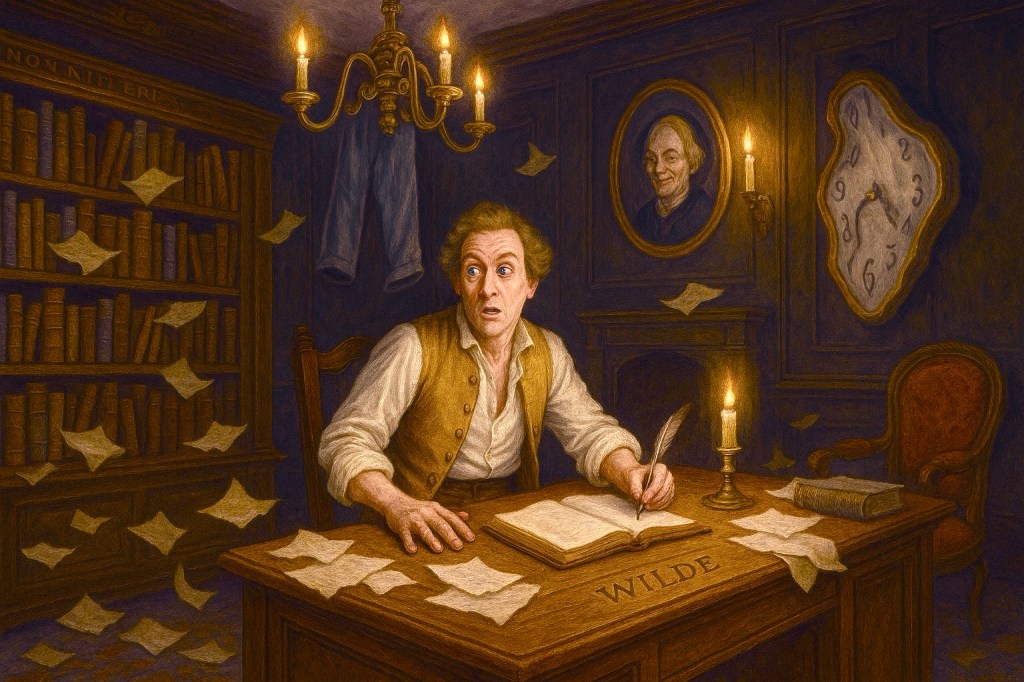
I must begin, dear reader, with a warning: Tristram Shandy is not a novel – it is a literary striptease performed by a madman with a feather quill and far too much time on his hands. Approaching it as one might approach a standard narrative is like bringing a map to a dream: utterly useless and likely to get you laughed at by the locals.
Reading Laurence Sterne’s magnum opus is a bit like trying to have a serious conversation with someone who keeps stopping to tell you about their uncle’s war injury, the philosophy of names, and why the placement of commas is a moral issue. And yet, I loved it. I loved it like a vicar loves a scandal – ashamedly, obsessively, and with far more sniggering than is seemly.
The book is ostensibly an autobiography, but calling it that is like calling a whoopee cushion a piece of furniture. Our narrator, Tristram, is determined to tell the story of his life, but the poor soul can barely get past the idea of being born without digressing into a treatise on noses, Latin philosophy, or his father’s alarming obsession with etymology. The man writes like he’s trying to avoid the actual story at all costs, zigzagging about like a squirrel on espresso.
It’s delightfully rude, too – not in a smutty, wink-wink-nudge-nudge seaside postcard sort of way, but in the intellectual strip-club sense. It’s full of innuendo dressed in scholarly robes. Sterne is the kind of writer who’d recite Horace, then draw a giant willy in the margins with an asterisk and footnote. It’s all very highbrow until it isn’t, and then suddenly you’re giggling like a schoolboy behind a chemistry textbook.
Structurally, Tristram Shandy is a glorious middle finger to the novel as a form. Sterne gleefully breaks every rule that hadn’t even been written yet. He inserts blank pages, black pages, wobbly lines, missing chapters, and entire digressions about how much he’s digressing. It’s as if the book itself is allergic to coherence. Reading it is like attending a dinner party where the host spends three hours introducing the cheese course, then forgets to serve it.
And yet, it works. There’s method in the madness. Beneath the footnotes, false starts and typographic tomfoolery lies something oddly sincere: a meditation on life’s absurdity. Sterne knew full well that life rarely unfolds in neat chapters. It’s all interruptions and misunderstandings and conversations about completely irrelevant things while something important goes unnoticed in the corner.
The characters, when they do appear in between the tangents, are gloriously strange and strangely glorious. One uncle builds miniature battlefields to relive military glories he never quite achieved; another insists on proving the moral superiority of long names. Everyone is earnest, mad, or both. Frankly, it feels like family Christmas with a thesaurus.
If you’re looking for a plot, you’ll be disappointed. If you’re looking for meaning, profundity, and a bit of intellectual foreplay, you’ll find yourself unexpectedly delighted. Tristram Shandy is a book that doesn’t so much tell a story as invite you to join in the act of storytelling – preferably with a strong drink and a flexible sense of patience.
It is the literary equivalent of being seduced by someone who keeps pausing mid-kiss to explain the history of kissing. Frustrating? Absolutely. But also – dare I say it – bloody brilliant.

 Wording