I’ve long suspected that my toaster is plotting something. Not out of any deeply held belief in sentient kitchenware, you understand, but because it simply feels too knowing. Its chrome glint catches the morning light with what can only be described as smugness. It pops the toast an inch too soon, as if to say, “Timing is subjective, darling.” I wouldn’t be surprised if it knows more about me than most of my family.
This is the curious thing about objects. They may not breathe, or bleed, or update their LinkedIn profiles – but by Jove, they live. Not in the animated Disney crockery sense (though one does wonder what Beauty and the Beast might’ve looked like in Croydon), but in a quieter, more dignified fashion. Objects outlast us. They carry the weight of our grubby fingerprints and our grand delusions. They’re the silent librarians of human folly.
The Life of an Object: From Factory to Familiar
Every object begins its life in a flurry of purpose. A teapot is born to pour. A chair to bear the bum of the nation. But as we all discover eventually, purpose is not destiny – it’s just the first job on the CV.
I once had a spoon that belonged to my grandmother. Silver-plated, slightly bent at the neck like an old headmistress. She used it for stirring her tea with the sort of solemnity that implied she was conducting a séance with the Earl Grey. After she passed on (the grandmother, not the spoon), it came to live with me. And suddenly, it wasn’t just a spoon. It was her spoon. Memory wrapped itself round that bit of cutlery like ivy on an old gravestone.
We think of objects as tools, but they are, quite often, time machines. A worn book smells of decades. A record crackles with ghosts. Even the humble mug – chipped and stained like a rugby player’s smile – can carry you back to a cold morning in 1998 when someone first handed it to you, steaming with kindness.
The Emotional Infrastructure of Everyday Tat
Now, don’t get me wrong – I’m not a hoarder. At least, not the dangerous kind. But I have been known to keep things long past their sell-by date, spiritually speaking. I once kept a broken lamp for five years because it “reminded me of Prague.” I’ve kept receipts that “felt poetic.” I have a drawer of dead batteries because… well, I’m still working out the symbolism.
We imbue our objects with such absurd emotional baggage, it’s a wonder they don’t sue us for psychological damage. A jumper isn’t just wool – it’s comfort, nostalgia, and proof that you once dated someone who believed you looked good in mustard.
The IKEA catalogue may promise “minimalism,” and my bungalow screams it. I have no clutter – but still has character. Every item is a footnote in the rambling novel of me.
The Afterlife of Things: Or, What Becomes of the Bits We Binned
The afterlife of objects is where the magic really happens. Objects, unlike us, get second acts. Third, even. An old biscuit tin becomes a button box. A disused fireplace becomes a home for candles.
We humans are oddly sentimental about our detritus. Museums are basically very posh attics. We point at a flint spearhead behind glass and go, “Ah, civilisation.” But I imagine the poor sod who made it would be appalled. “That? That was my practice spearhead. Why not show them the good one?”
Objects don’t care what they’re remembered for – but we do. We project meaning like a badly aimed slide projector. The Romans had amphorae, we have plastic bottles. They had relics, we have celebrity auction lots. Same game, different tat.
And then there’s the charity shop, the purgatory of modern objects. It’s where once-proud things go to be judged. Your trousers may not have fit you since the Cameron years, but someone in Reading might give them a new lease of life. Possibly paired with Crocs. Such is fate.
Objects as Witnesses, Not Just Things
There’s a delicious irony to the fact that objects – supposedly lifeless – often outlive us. You’ll be compost in a century, but that ghastly ceramic hedgehog your aunt gave you will endure like a wartime bunker. And therein lies their quiet authority. They wait us out. They observe. Like stoic monks, they gather dust and secrets.
I sometimes wonder what future archaeologists will make of my possessions. “Ah yes, here we see the ceremonial LED candle remote – clearly of religious significance.” Or, “These wire-rimmed glasses suggest the wearer had terrible taste and deep thoughts.”
We leave a trail of ourselves behind in the objects we touched. Like snails. Except with less dignity.
Let the Things Speak
So next time you’re tempted to chuck something out, take a moment. Hold it. Look at it. Ask it what it remembers. It won’t answer (unless it’s Alexa), but you might hear something anyway.
Objects are more than things. They are carriers of context, collectors of sentiment, and the unblinking witnesses of our tiny, noisy, chaotic lives.
And as for my toaster? I’ve decided to keep it around. It’s clearly been watching me, and frankly, I respect that. At least it’s loyal. Unlike the kettle.
The Afterlife of the Fox – A Poetic Monologue
I didn’t go looking for a fox.
I wasn’t hunting – God forbid – just browsing.
It was an auction, the sort with cracked porcelain, sad clocks,
and bins of miscellaneous things that whisper
“We were once treasured.”
And there it was.
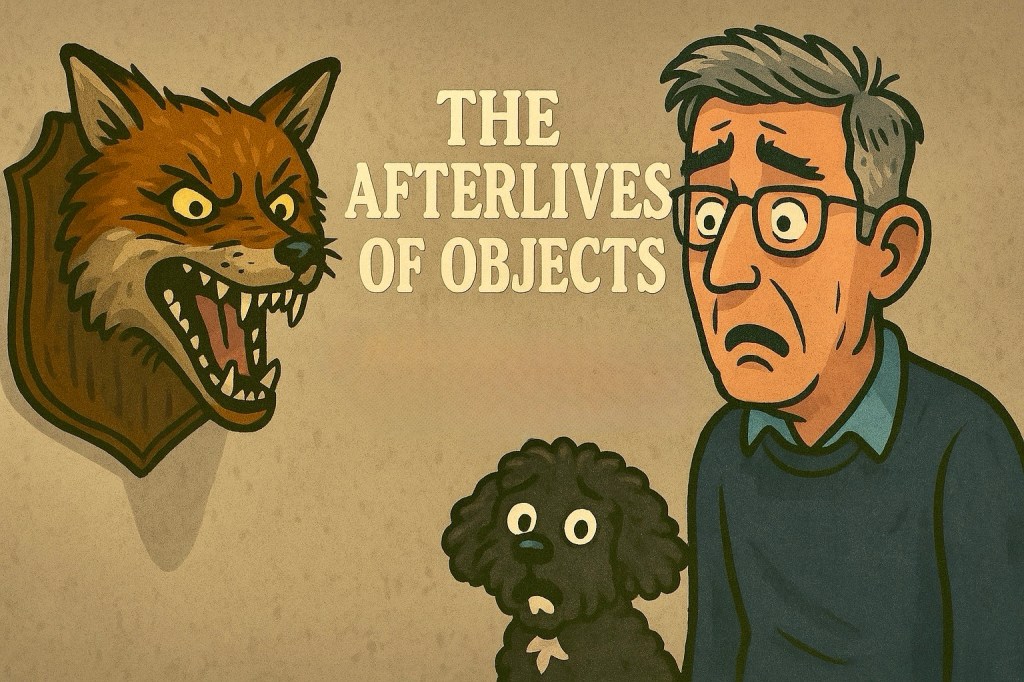
A snarling fox’s head.
Mounted on a wooden shield like some absurd medieval trophy,
its glass eyes locked in eternal indignation.
The taxidermist had caught it mid-snarl – frozen in the sort of expression one might wear
if their last living thought had been
“Oh bloody hell.”
Now I don’t go in for blood sports.
I think the word “sport” should involve at least the possibility
of a comeback.
You kick a ball, it kicks back.
You chase a fox with thirty hounds and a man in a red blazer,
it’s not a sport. It’s a procession with teeth.
But I looked at this thing -this poor, proud face –
and I thought, You don’t deserve to rot in a skip.
No fox, however unfortunate, should end up
wedged between an old toaster and a cracked toilet seat
at the municipal tip.
So I bid.
Modestly. Just enough to rescue it from obscurity.
And now it lives above my piano – my feature wall,
snarling eternally at Beethoven.
A silent duet of wildness and civility.
I like to imagine it wasn’t hunted.
Maybe it was roadkill.
A sudden, unfortunate dash across the M1
and then immortality,
via some bloke in Devon with a fondness for stuffing things.
That feels kinder.
I can live with that fiction.
And perhaps the fox can too.
Because now it has an afterlife.
It is witnessed. It is spoken of. It is named –
well, not literally, but you know what I mean.
I nod to it each morning as I pass,
as if to say: Yes. You were seen. You are remembered. You are not in landfill.
Though, God knows, when I go –
and some cousin or solicitor or opportunistic nephew comes to “sort the place” –
they’ll look up, see it glaring down from the wall,
and say, “Well, that’s going to the dump.”
And maybe it will.
Or maybe, just maybe, someone will feel what I felt –
that peculiar tug of the absurd and the sacred.
That desire to honour the overlooked,
to give memory to the voiceless,
to say: This thing mattered once, and I shall make it matter again.
And if that’s not the very definition of care,
then I don’t know what is.

 Wording