
“The heart is deceitful above all things, and desperately wicked: who can know it?”— Jeremiah 17:9
First of all…
On the Reluctance to Read the Modern
…or, Why I Approach Contemporary Novels Like They Might Bite Me
There’s a particular stiffness in my posture whenever someone recommends a “brilliant new novel.” A twitch behind the eyes. A tightening of the soul, like a butler clenching his jaw as the lord of the manor brings home a typewriter. I don’t say no, of course – just something polite and evasive like, “Ah yes, I’ll add it to the list,” knowing full well it will languish unread, somewhere between The Brothers Karamazov and a 1970s repair manual for oil-burning stoves.
The truth is, I approach contemporary fiction with a kind of ecclesiastical dread, as if each book might be a sermon disguised as a story. I fear the sledgehammer. Not the elegant, well-swung mallet of social commentary found in Dickens or Baldwin, but the blunt, Twitter-branded bludgeon of modern ‘issues fiction,’ where characters speak like hashtags and the prose reads like a UN resolution. I’m wary of books that confuse moral certainty with depth, and diversity checklists with actual character development.
It’s not that I dislike progress, or that I yearn for the days when heroines died tastefully of consumption while men shouted about honour in drawing rooms. No – I welcome thoughtful explorations of identity, power, suffering, redemption. But I want to discover these things as one finds mushrooms in a forest: hidden, unannounced, occasionally poisonous. Not shrink-wrapped and labelled with bullet points.
Perhaps it’s the funeral director in me – trained to hear what’s not said, to feel the weight of what hangs in the silence. Good fiction should do the same. It should haunt, not hector. Seduce, not shout. A reader should be allowed to lean in, to wonder, to draw their own breathless conclusion. But too often now, I feel I’m being lectured by someone who’s mistaking storytelling for a TED Talk.
So I hesitate. I return to old volumes, the brittle-spined reliquaries of subtler voices. I flick through Hardy, or Waugh, or the cool, mad geometry of Woolf. And yet – I remain open. Warily. Like a man testing a floorboard in an abandoned house.
Fingersmith, by Sarah Waters, for example, surprised me. It took my cynicism in one hand and my affection in the other, and performed a deft, Dickensian shuffle I couldn’t help admiring. It was modern, yes – but not preachy. Bold without being brash. Queer, even – but not politicised. It whispered rather than screamed, and in so doing, said far more.
So perhaps I’m learning. Slowly. That not all modern fiction is written by committee or aimed at the validation of the chronically online. Some of it still aspires to art, to ambiguity, to the strange alchemy that happens when character and language collide. Some of it, even, is rather good.
But I’ll still approach with caution. As one might approach a dog that looks cute, but has that slight twitch in the tail. Just in case.
There’s something unwholesome about a book that makes you gasp aloud in the bath. Not a genteel gasp, mind you, but a full-bodied, soap-displacing, “Oh-you-devious-witch!” sort of reaction. That, in short, was my experience reading Fingersmith by Sarah Waters – a novel so twisted it could double as a Victorian bedspring.
Set in a shadowy version of 1860s England where everyone seems to be lying, scheming, or drawing dirty pictures in the parlour, Fingersmith is a Gothic romp through gaslight, grime, and grotesquery. Think Dickens, if Dickens had been less preoccupied with orphans and more interested in female masturbation.
We begin with Susan Trinder, a cockney orphan raised among thieves and baby farmers in a den that smells faintly of stewed eel and betrayal. She’s roped into a plot by a foppish fraudster known only as Gentleman – a man who wears his waistcoat with the same precision he sheds his morals. The plan is deliciously dastardly: Susan must gain the trust of Maud Lilly, an heiress squirreled away in a country estate, help Gentleman seduce and marry her, then assist in flinging her into a lunatic asylum while they make off with the money. As one does.
I know what you’re thinking: “A bit overdone, surely?” Ah, but you’ve not seen Waters’ hand. What follows is not so much a novel as a conjuring trick. The story splits, refracts, and loops back on itself like a hall of mirrors in a cheap seaside attraction – except the mirrors are polished to perfection, and someone’s watching you from behind them.
Without spoiling the twist (and by twist, I mean the literary equivalent of pulling a rabbit out of a hat – you know what’s coming), suffice it to say that no character in this book is quite who they claim to be. By the midpoint, Waters yanks the rug so violently that I swear my spine clicked – too much effort. You can see this ‘twist’ coming like a slow train.
At the centre of all this smoke and subterfuge lies the relationship between Susan and Maud – one forged in falsehood, fractured by betrayal, but somehow rendered more honest than anything the men around them can muster. There’s love, yes – but not the rosy, tea-room sort. It’s messy. Erotic. Frightening. Like discovering that the person who sees you most clearly is also the one who helped lock you in a madhouse.
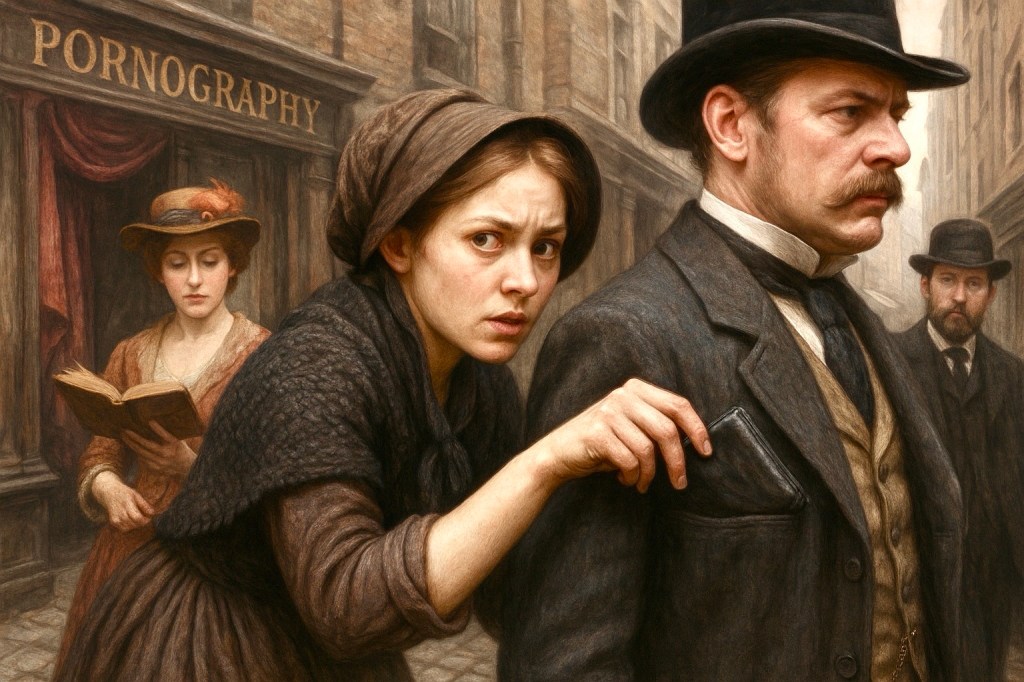
It’s also a deeply clever book about books. Maud’s uncle, a tyrant with a pince-nez and a penchant for filth, keeps her copying pornography for ‘scholarly purposes.’ Waters here is dancing a razor’s edge – exploring the line between liberation and exploitation, between titillation and degradation. Foucault would’ve had a field day. So would Freud, though he’d likely have missed the point and blamed it all on the mother.
But what I admire most is Waters’ unflinching portrayal of class. The novel teems with people who are either grasping up the social ladder or kicking those beneath them in the teeth. It’s a world where trust is a currency too expensive for the poor to spend. The real madness, as always, lies not in the asylum but in the drawing room.
Fingersmith is more than a genre piece. It’s a literary heist – Waters pinches tropes from Victorian fiction, polishes them with postmodern glee, and then sells them back to us under the counter. It left me winded, wary, and quietly moved. It reminded me that love, like crime, requires trust – and that trust, once broken, is harder to rebuild than a gaslit labyrinth in Kent.
Recommended – only just.

 Wording
I found your site via the jetpack app, hence I can’t search for an About page. Do you have one?
Cheers!
Thanks for stopping by. I don’t have an about page as such, just a short bio which you’ll find at the end of each post. All the best!
Thank you.