A couple of weeks ago, I found myself in Blanchland, Northumberland – a village so theatrically atmospheric it looks like it was designed by a heritage-obsessed monk with a fondness for mist. I was holed up in The Lord Crewe Arms, one of the North’s most famously haunted pubs – though frankly, the prices gave me more of a fright than the ghosts. Somewhere near the fire, with a cuppa in hand and the vague smell of damp ecclesiastical stone in the air, I struck up conversation with a fellow guest. At some point, I casually let slip that the place was said to be haunted – by a mournful monk, or a cavalier with unfinished business, or possibly both, depending on who you ask and how many wines they’ve had.
She smiled at first. Then she looked nervously toward the stairs. And while I didn’t mean to spook her – I’m no believer in phantoms myself – it did make me reflect on how these tales always seem to linger, like the smell of old soup in a rectory corridor.
And since I’ve been making my way through a rather weighty old book of British myths and ghost stories (equal parts folklore and theatrical nonsense), I thought it only fitting to write something of my own. Not an earnest tale of hauntings, no – but a reflection on a particularly persistent spectre: the Grey Lady, the White Lady, and every tattered wisp of melancholy chiffon said to be haunting the nation’s pubs, castles, wells, cellars, and guest toilets.
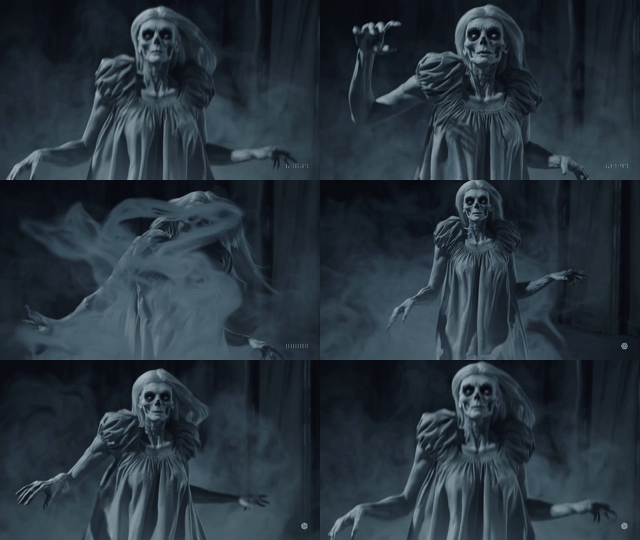
There are few certainties in life: taxes, the slow decline of British Rail, and the inescapable presence of a White Lady in every halfway decent village with a pub and a post office. From County Durham to Cornwall, from the Lowlands to the Lakes, it seems you can’t hurl a stone without it whistling past some ethereal woman in a nightgown, flouncing around an old mill or hovering mournfully beside a well. And always in white or grey, as though death were a dinner party with a strict dress code.
I must admit, I’ve never been one for ghosts. I believe in many things – entropy, the enduring mystery of why Gregg’s sausage rolls are never quite the same in different towns, and the ability of man to delude himself when left alone in a pub car park after dark. But ghosts? Not so much. And certainly not spectral seamstresses with a flair for Victorian melodrama.
The White Lady is the national cliché, right up there with roast beef and moaning about the weather. Her backstory, like most village gossip, varies slightly depending on who’s telling it: she was betrayed by a lover, pushed down a staircase, drowned in a well, or took a fatal tumble off the battlements because her fiancé went off to fight in a war and came back with a French wife and a terrible moustache. Sometimes she’s a nun. Sometimes she’s a jilted bride. Occasionally she’s a servant girl who saw too much. But always, always, she returns in luminous bed linen to do nothing more than drift about and sigh dramatically.
People love this. The mere whiff of a ghost story sends the spiritually suggestible into a state of caffeinated hysteria. They’ll insist they heard her – clear as day – sobbing in the west corridor of Crook Hall, or gliding along the battlements of Lumley Castle like a broken Roomba. They’ll claim her footsteps were definitely female. As if the afterlife includes orthopaedic stilettos.
It’s always women too, isn’t it? Have you ever heard of the Beige Man of Bishop Auckland? Or the Chartreuse Fellow of Chilton Moor? No. Ghosts, like everything else in British heritage, are predominantly female, silent, and slightly translucent. The patriarchy really didn’t stop at death.
The rational explanation, of course, is far less exciting. Cold drafts, old plumbing, overactive imaginations, and a tot too many of whisky. But where’s the fun in that? No one wants to hear that the shriek in the hallway was just a fox or the groaning in the walls is damp and regret. So instead, we conjure up Lady Lily, the long-suffering ghost of a castle, doomed to walk the corridors every night for eternity, which seems a bit much considering she’s only had one bad century.
Then there’s the piper under Elvet Bridge – Jimmy Allen – whose ghost allegedly plays his Northumbrian pipes beneath the cobbles of Durham city. I stood on that bridge once in silence for twenty minutes. All I heard was a Deliveroo scooter and the sound of my own back giving out.
Of course, belief in ghosts says more about us than it does about the afterlife. We’re meaning-making creatures, desperate to see patterns in the plaster and hear voices in the plumbing. We long for continuity, for proof that the veil is thin and that maybe, just maybe, Auntie Maureen is hovering by the bread bin, watching us nick the last Bourbon. Ghosts, I suspect, are really just expressions of the things we haven’t resolved: grief, guilt, an unreturned library book.
In County Durham, we’ve got our share. The White Lady of Aycliffe. The Grey Lady of Ebchester. The watery claws of Nelly Longarms lurking in the pond, ready to drag away misbehaving children – a spectral health and safety officer if ever there was one. But in all my years I’ve never once met one. Not even a faint shiver on the spine. Though I will admit, the bill from my energy supplier occasionally has a similar effect.
No, I think our obsession with ghosts is less about the supernatural and more about boredom. It’s the village equivalent of Netflix. The legends give character to otherwise silent walls, lend a bit of colour to grey stone and grey skies. They make people feel connected to the past, to a sense of mystery that’s otherwise been extinguished by LED lighting and regional broadband. Besides, it gives the locals something to talk about while waiting for the 7:38 to Darlington.
So do I believe in the Grey Lady? Not at all. But do I enjoy the theatre of it? Absolutely. Let her haunt, let her hover, let her wail on the moors if she must – but I’ll be in the café with a cuppa, listening to ghost-hunters describe ectoplasm on their GoPros while I inwardly suspect it’s just steam from a sausage bap.
And that, I think, is the real haunting: the things we choose to believe, long after we know better.

 Wording