There’s a moment, just after midday on the 21st of June, when the sun seems almost drunk with its own radiance. It leans heavily on the earth, like a tired old bishop full of wine and prophecy, and stares down the day as if daring it to get any longer.
The shadows are weak. The air is thick. And the light – the glorious, golden, oppressive light – begins to turn.
We don’t always notice it. Not at first. But somewhere inside, in the spleen or the spirit or wherever it is we store our forgotten rituals, we feel it:
“The solstice has come. The tilt has begun.”
This, then, is the longest day – a day so ancient it hums with meaning whether you like it or not. Whether you’re roasting in a supermarket car park or leaping naked through a flaming wheel in Latvia, you are part of the rhythm. And it does not ask for your consent.
Litha, and Other Pagan Mischief
Long before we gave it a name you could programme into a calendar app, this time of year was holy. Or unholy. Or both, depending on who you were sleeping with.
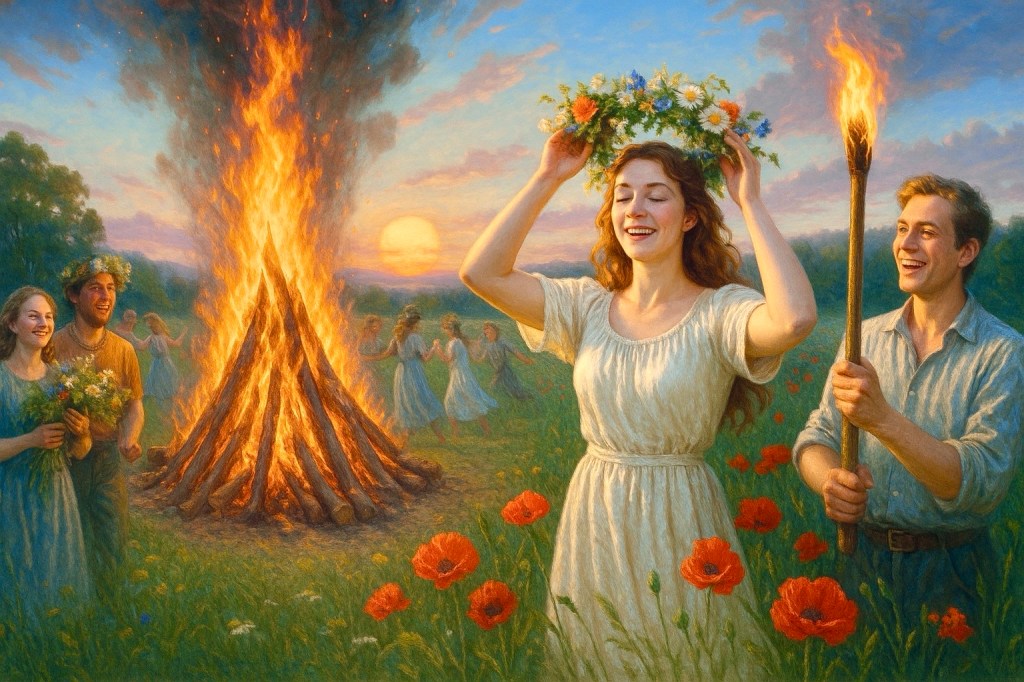
In old Anglo-Saxon tradition, it was known as Litha – one of the great fire festivals in the wheel of the year. A time of bonfires, herbs, dancing, sex, sacrifice, and soft cheese (probably).
The idea was simple: the sun, at its height, must be honoured – or perhaps, warned. After all, what burns brightest burns fastest.
So they lit fires on hilltops and leapt across them, believing it would grant fertility, protection, and better luck with cows.
In some places, they’d roll great flaming wheels downhill – an act of sympathetic magic to mimic the sun’s arc from glory to descent. It was essentially a flaming metaphor for ageing: dazzling, dangerous, and headed firmly downhill.
Midsummer Night’s Fever Dreams
Naturally, the Church – bless it – couldn’t leave the peasants to their own devices. So it overlaid the solstice with Saint John the Baptist’s feast, on the 24th of June. A little theological origami and lo! The pagan blaze becomes a holy fire, the fertility rite becomes a vigil, and no one is technically worshipping oak trees anymore.
But folk memory is a weed, not a flower – it persists.
Even now, in pockets of Europe and the mossy folds of the British Isles, the old customs survive. Fires are still lit. Herbs still gathered. Some people still bathe their faces in the dew of midsummer morning, believing it brings beauty and luck – which is only slightly more whimsical than whatever Gwyneth Paltrow is selling.
“There is a silence in midsummer light — an ominous stillness, like a cathedral before the choir begins.”
And beneath all this simmers an ancient sense that something is watching. Something playful, maybe. But not tame.
Shakespeare’s Fairies and the Forest of the Mind
If you want a literary companion for the solstice, look no further than Shakespeare, who turned midsummer madness into a genre all its own.
A Midsummer Night’s Dream is a play of misrule, enchantment, and erotic chaos. Lovers are bewitched. Reason is inverted. Bottom becomes an ass (as do most men in the woods). Fairies meddle. Identities blur. And the entire plot plays out like a metaphor for heatstroke-induced romantic decisions.
It’s not about the solstice, but it inhabits it.
“The lunatic, the lover, and the poet / Are of imagination all compact…”
The forest becomes a place where the civilised self unbuttons its shirt, falls over, and wakes up smelling of moss and regret.
Just as it should.
Scripture, Shadows, and the Turning Wheel
But of course, this day is not all light.
It is also a reckoning. The solstice is not the beginning of summer, but its peak – and its turning. From here on, the days shorten. The sun begins its long, slow descent.
“Even as we toast the light, we drink to its death.”
Ecclesiastes knew this better than most:
“To everything there is a season… a time to plant, and a time to pluck up that which is planted.”
And so we must ask: what, exactly, are we plucking up?
Nietzsche might say it’s eternal recurrence – the wheel turning again and again. Camus might tell us this is the summit, and we must smile at the descent. Jung would likely sketch a flaming mandala and warn us to mind our shadow.
Whatever the philosophy, the point remains: we are not at the beginning of light, but the beginning of its undoing.
A Personal Confession (Light and Longing)
I’ve always found something eerie about the solstice.
Not eerie in a ghostly way – not spectral – but eerie in that sublime, almost sacred stillness, like walking into a great cathedral and finding it empty, yet not alone.
The sky is too large. The earth too quiet. There’s a hush in the air that says:
This is the high point. You will not reach it again for some time.
There’s melancholy in that. And beauty. And maybe a little relief, too – for no one can burn at full brightness forever.
Postscript for the Year’s Zenith
So here’s to the longest day:
To the fire that blazes.
To the shadows that wait.
To the dew on your brow and the dreams in your pillow.
To the solstice – half-party, half-prophecy.
“May you leap the flame.
May you not trip over your own feet.
And may you, just for a moment, feel more alive than you are afraid.”
Because now, dear reader,
the light begins to die.
And that is part of the plan.
If you’ve enjoyed this, why not support me and Buy Me a Coffee

 Wording